
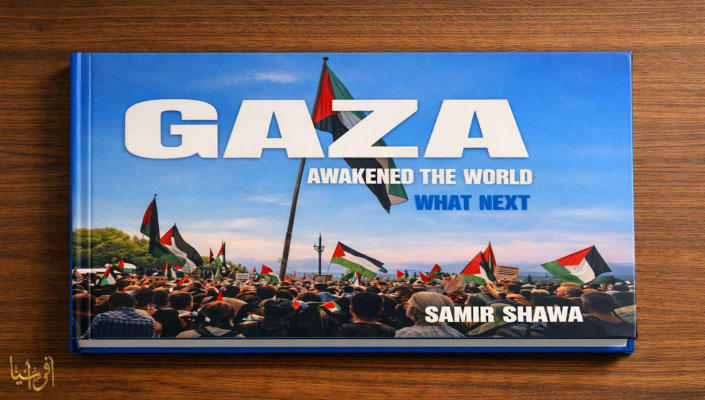
Afrasianet - Mouloud Ben Zadi - Palestinian author Samir Shawa begins his book "Gaza Awakened the World: What's Next?" , issued by Dar Al-Hani Cultural 2026, tracing the amazing diversity that Gaza has witnessed over thousands of years, saying, "Throughout history, Gaza has witnessed many divergent empires, which included diverse origins, races and religions, which had a great impact on the demographics of this historic city, including Egyptians, Palestinians, Greeks, Romans, Byzantines, Muslim Arabs, Crusaders, Mamluks, Ottomans and British."
It is the cradle of civilizations, a land of religions, a crossing point for empires, and a human space that brought together various nations and peoples, which coexisted for a long time before it was swept away by the flood of bombardment, destruction, famine and death, and stared at it by the specter of exclusion and demise.
More than just a sector: Gaza is a long-standing soul
The author then goes on to the origin of the name "Gaza" itself, explaining that "since its inception, the city has acquired many names according to the civilizations that have passed through it: the early Canaanites called it "Hazati", the ancient Egyptians called it "Gazatu", and the Assyrians "Izzati", a name derived from the word "Azza", which means strength and greatness, which is a description of the city's steadfastness in the face of the mighty throughout its ancient history.
It is also mentioned that it was named "Gaza Hashem" after Sayyid Hashem ibn Abd Manaf, the grandfather of the Prophet Muhammad, who died and was buried in Gaza.
In fact, Gaza was not only a land of succession of empires and coexistence, but also a body of beliefs. It was an extension of the ancient Canaanite history. In this land, a group of gods were worshipped: the god of the Supreme Father, Baal, the god of thunder, and Ana, the goddess of war. It was a land where languages spoke before they were written, and where words breathed before they were written.
In it, the Akkadian and Ugaritic languages laid the foundations of Syriac and Arabic. Shawa emphasizes Gaza's position as the cradle of civilization, as it was a Canaanite port, a Palestinian stronghold, and the resting place of the grandfather of the Prophet Muhammad, peace be upon him.
This diverse spiritual, linguistic, and civilizational heritage confirms that Gaza has been a melting pot of cultures and civilizations and a model of diversity and coexistence since the dawn of history.
Thus, in its first chapters, the book refutes the illusion that Gaza is not just a "refugee problem" or a political "sector", but rather an ancient, eternal city with a sacred spirit that modern weapons can silence or erase.
Gaza from Imperial Rule to National Catastrophe
Shawa goes on to trace the history of Gaza, taking the reader into the modern era, depicting the major events and transformations it witnessed, starting with its submission to Ottoman rule, as "in 1517 the Ottoman armies attacked the Levant and Palestine and occupied it easily."
This led to centuries of stalemate and deflation that ended with Napoleon's brief campaign. Shawa describes how the ambition of the French emperor turned into an "invasion of Palestine" after he established himself in Cairo, where he entered "without much resistance," raising the slogan "Freedom, Equality, Fraternity," which, in the author's eyes, seemed to contradict reality.
From this historical background, Shawa moves on to the beginnings of the Arab-Israeli conflict, transforming his narrative voice from a historian documenting the facts to an eyewitness.
The Nakba of 1948 paints a bleak picture of the Israeli domination, oppression, and confiscation of land that followed, emphasizing the structural imbalance of power, and arguing that the "Zionist movement" that was formed in Europe under the leadership of figures such as Theodor Herzl, possessed financial, organizational, and political capabilities that the "Palestinian national movement, with its limited resources," could not match.
In the midst of these events, he depicts how Gaza's population has rapidly doubled with the influx of refugees, transforming a once-cohesive and proud society into a society dependent on UNRWA aid, a dependence that the author criticizes for its erosion of human dignity.
But he balances this grim depiction by invoking nostalgic scenes from pre-war life: the brass bands of Vados, the intellectual salons of Gaza College, and the smell of tabun bread that brought together Muslim and Christian neighbors, highlighting the sharp contrast between a vibrant city and a later reality akin to an "open prison."
The return of exile and the illusion of two states
What is striking about this book is its focus on the experience of the Palestinian diaspora in Kuwait, as one of the most important stations of Palestinian exile after the Nakba. Shawa documents how, since the late 1940s, Kuwait has become a haven for thousands of Palestinians and a space to rebuild their community in exile.
This role was not limited to living stability, but also extended to political and organizational work, as it embraced the first nucleus of the Fatah movement, which was formed by Yasser Arafat, Khalil al-Wazir, and Salah Khalaf, and became one of the most prominent sources of support for the Palestinian cause for decades.
From this exile, Shawa moves on to what he calls the "false dawn of the Oslo Accords," which took place at the White House on September 13, 1993, and culminated in the famous handshake between Arafat and Rabin in Clinton's presence.
Shawa returned home in October 1994 to contribute to what appeared to be the Palestinian statehood project, writing from the site of the experience, revealing the gap between political promises and reality on the ground.
He recalls symbolic milestones that embodied that hope, such as the laying of the foundation stone for the Gaza port and the lighting of the gas field on September 27, 2000. However, this trajectory is quickly undermined by the outbreak of the second intifada following Sharon's provocative visit to the Al-Aqsa Mosque, a moment he sees as a breaking point for the so-called "peace process."
This idea, as he shows, dates back to the Peel Commission report after the 1936 strike, but it has eroded through decades of futile negotiations and changing realities on the ground, to the point where its implementation has become almost impossible in light of the outright rejection of successive Israeli governments.
He concludes with a direct question about whether this initiative was destined to fail from the start, providing a critical reading of a missed opportunity, and showing how the two-state solution turned into a hollow slogan used to buy time while settlements were expanding and the world continued to turn a blind eye.
Genocide and the Spirit of Resilience
The fourth section deals with the current genocide in Gaza, where Shawa abandons the role of the traditional historian to become a historian of ongoing atrocities. It is noteworthy that Hamas called its operation on October 7, 2023, the "Al-Aqsa Flood", but the Israeli response, as he describes it, was another, more deadly and more destructive one.
In a poignant humanitarian scene, Shawa conjures up the image of an elderly Gazan poet crouching among the ruins of his home in Jabalya, recalling Salah Jahin's quatrains with a mixture of sadness and irony: "War doesn't give you time to cry.
It steals your tears and leaves you standing among the rubble of your house, trying to remember how the door was opened, and how the mornings were like life before they became like loss. We live in a time of frequent floods, but this time it is the flood of Gaza, which carries a ship without Noah."
The book confirms a genocide, backed up by a horrific human toll: more than 200,000 dead and wounded, most of them women and children; more than 1,650 health workers; more than 240 journalists; and 2,700 families completely erased from the civil registry.
Shawa recounts specific atrocities, including the firing of 335 bullets at six-year-old Hind Rajab, the bombing of the Baqa'a café while journalists were present, and the starvation of infants documented by Ahmed al-Farra at Nasser Hospital. Still, hope remains.
In "Steadfastness," Shawa depicts the manifestations of clinging to life: children learning to play the violin in the rubble, elderly women planting roses in shell dumps, and families celebrating life inside displacement tents.
He believes that this daily steadfastness is the essence of Gaza's steadfastness, and its humanitarian response to a world that has been unable to stop the carnage.
Rebuilding from the rubble
Shawa refuses to end his book with a political plan or a road map, but rather with his firm belief in the principle of being able to rise from the ashes.
He rejects the illusions of the "Riviera" promoted by outside powers, whether in Kushner's real estate visions or Trump's peace plans, and insists that only the people of Gaza will rebuild their city.
He does not ignore the scale of the disaster, but confronts it clearly: sixty million tons of rubble filled with unexploded ordnance, the destruction of about 90 percent of infrastructure, and the psychological trauma of an entire generation that has known nothing but siege and war.
Yet history conjures up a counter-proof of despair: Gaza has been destroyed repeatedly by Alexander, the Crusaders, Napoleon, and the Ottomans, and each time it has risen.
This was confirmed by the Palestinian historian Rashid Khalidi in his book "The Hundred Years' War on Palestine", published in 2020, which concludes by affirming the survival of the Palestinian people despite the plans to erase them, pointing out that the Zionist movement came late and that its project is doomed to failure.
London's weekly demonstrations, the voices of Corbyn and Sanders, the artists of Couters, Banksy and Lenox, and the Palestinian flag flying from Celtic stadiums to Palestino. Even inside Israel, Levy and Ayalon have condemned their government's policies.
Shawa sees this awareness as one of the few positive outcomes of the war, despite its enormous cost, but he remains aware of the harshness of American "justice" over vetoes, the flow of weapons, and the Gaza Humanitarian Foundation, which has become a deadly trap for the hungry.
The final message is clear: the world may have failed Gaza, but Gaza will not let itself down. "Gaza has awakened the world" is a difficult and necessary reading, and a testimony to a people that refuses to disappear.
