
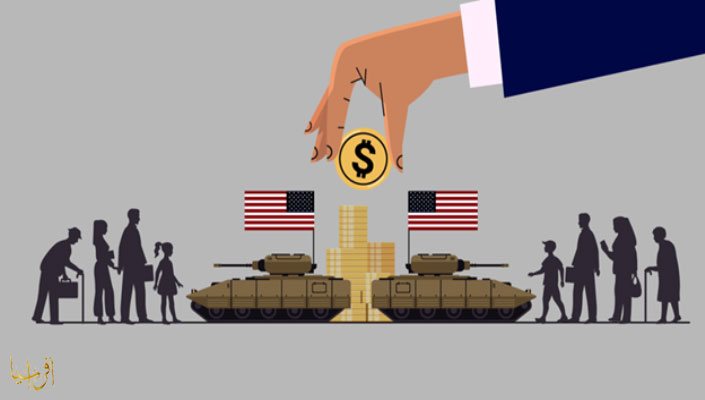
Afrasianet - The U.S. military operations against Iran, which began on February 28, 2026, under the name of Operation Epic Storm, represent a significant and costly strategic shift in the course of regional conflicts in the Middle East.
Despite the fact that the parties entered into a temporary and fragile truce last April, the direct repercussions of this conflict did not stop at the borders of the naval and air fronts, but extended to impose a costly coercive reality at the military and logistical levels, putting the operational efficiency of the US Air Force to an unprecedented test of the depletion of advanced equipment and systems.
The cost of this war was not only reflected in the purely defensive aspects, but also cast a heavy shadow on the political and economic environment inside and outside the United States, as the human toll of casualties and wounded soldiers intermingled with sharp inflationary jumps that affected the prices of energy, fuel, and basic commodities due to the disruption of vital shipping lanes such as the Strait of Hormuz.
In this report, we monitor the dimensions and repercussions of the US war on Iran:
Military Losses
The US Air Force has faced a significant depletion of its equipment and aircraft due to missile battles, naval and air confrontations in the region. Although the relative pace of fighting has slowed since the April armistice, the operational situation remains volatile.
According to Acting Pentagon Comptroller Jules W. Hearst III's testimony before Congress on May 12, 2026, estimates of the cost of military operations in Iran have risen to $29 billion, and he confirmed that this huge increase is mainly due to the update of estimates for the repair and replacement of damaged and destroyed equipment and aircraft.
The confrontations resulted in the recording of confirmed losses and damage to 42 US planes and drones, according to the Congressional Research Service, and were distributed as follows:
Details of US aircraft losses and damages:
F-15E Strike Eagle Attack Fighters: US forces recorded the loss of 4 F-15E Strike Eagle aircraft, with CENTCOM reporting on March 2, 2026, that the crews of 3 aircraft had successfully skydived after their planes were accidentally shot down by friendly fire over Kuwaiti airspace.
On April 5, 2026, a fourth plane was shot down by hostile defensive fire over Iranian airspace, and its pilots were rescued in two separate search and rescue operations.
One F-35A Lightning II fighter jet: It was reported on March 19, 2026, that Iranian ground fire damaged one F-35A during combat operations over Iran.
One A-10 Thunderbolt II Ground Attack Aircraft: At a press conference on April 6, 2026, Chairman of the Joint Chiefs of Staff, Air Force Gen. Dan Kane, stated that on April 3, enemy fire hit one A-10, which was later crashed and destroyed during search and rescue operations; the pilot dropped his seat and was safely retrieved.7 KC-135 Stratotanker Aerial Refueling Aircraft: On March 12, 2026, CENTCOM reported that two KC-135s had crashed over friendly airspace, with one crashing in Iraq, killing all six crew members.
The second KC-135 made an emergency landing at an undisclosed location in the area hosting US forces.
It was reported on March 14, 2026, that five KC-135 aircraft were damaged while on the ground at Prince Sultan Air Base in Saudi Arabia, during an Iranian missile and drone attack.
One E-3 Sentry Airborne Early Warning and Control System (AWACS) aircraft: On March 28, 2026, one E-3 aircraft was hit and damaged while on the ground at Prince Sultan Air Base in Saudi Arabia, during an Iranian missile and drone attack, and on May 7, 2026, an E-3 was parked in an unprotected take-off and landing runway.
Two MC-130J Commando II Special Operations Aircraft: On April 5, 2026, two MC-130J aircraft that were in support of the search and rescue operations of a downed F-15E were destroyed, deliberately destroyed on the ground inside Iran after they were unable to take off; and all aircrew members were safely evacuated.
One HH-60W Jolly Green II combat search and rescue helicopter: On April 6, 2026, General Kane said at a news conference that one HH-60W helicopter was damaged by light weapons fire on April 5, while supporting search and rescue operations for a downed F-15E in Iran.
24 MQ-9 Reaper medium-altitude, long-range endurance drones: On April 9, 2026, the U.S. military lost 24 MQ-9 Reaper since the start of U.S. military operations against Iran.
One high-altitude, long-range MQ-4C Triton drone: On April 14, 2026, a U.S. Navy document reported that one MQ-4C crashed in an accidental crash (Mishap).
These data show that the United States has lost an integrated system of air force, not only fighter jets and attack drones, but also heavy logistical support aircraft, early warning aircraft, and special operations, strategic losses that are difficult to quickly recoup and that directly affect the Central Command's ability to manage long-range air battles.
The ongoing military conflict has resulted in casualties among U.S. forces, in parallel with internal political and economic shocks that have put President Donald Trump's administration and the Republican Party in the face of mounting popular and parliamentary pressure as the midterm elections approach.
According to Reuters, 13 U.S. soldiers have been killed in the war and hundreds wounded, as the Pentagon has pumped tens of thousands of additional troops into the Middle East, including keeping three aircraft carriers in the region to maintain the fragile ceasefire that began after the Feb. 28 strikes.
Politically, administration officials have faced sharp criticism from Democrats, with Rep. Adam Smith, the ranking Democrat on the House Armed Services Committee, expressing dismay at the Pentagon's delay in submitting the $25 billion cost of the war.
On the other hand, Secretary of War Pete Hegseth defended the war with fiery statements, describing the Democrats' criticism as "defeatist and helpless," and calling the war a "quagmire" as providing propaganda material to the enemies, and stressing that the cost is justified to prevent Iran from acquiring a nuclear weapon.
President Trump's popularity has taken a hit since the war began, with a recent Reuters poll showing that only 34 percent of Americans approve of the conflict with Iran, down from 36 percent in mid-April and 38 percent in mid-March.
Democrats are using the decline to link the unpopular war to the fiscal capacity of citizens six months before the midterm elections, in which Republicans face an uphill battle to maintain their majority in the House of Representatives.
Disruptions in oil and natural gas shipments since the war began have also caused gasoline prices in the U.S. to rise to their highest level in nearly four years, according to data from the American Automobile Association, along with higher prices for agricultural products such as fertilizers and a long list of consumer prices.
This latest surge in inflation is worrying Republican insiders about their party's chances in the November elections that will determine control of the House of Representatives and possibly the Senate.
The ongoing war with Iran has pushed up energy prices and everyday costs for Americans, leading to a jump in inflation rates and increasing pressure on fiscal policies inside and outside the United States.
According to official data and statistics released through May 2026, published by the British newspaper The Guardian, inflation in the United States jumped to 3.8% in April, the highest jump recorded since 2023 according to data from the Bureau of Labor Statistics.
This is the second official measure of the CPI since the start of the war, with prices rising by 3.3% in March, up from 2.4% in February, while the core CPI (excluding food and energy) rose by a more moderate 2.8%.
The rise in energy prices stems directly from the ongoing closure of the Strait of Hormuz, through which one-fifth of the world's oil and gas normally passes.
Energy prices rose 3.8% in April to account for more than 40% of the total monthly increase, and gas (gasoline) prices increased by 28.4%, with the national average price per gallon at a level of more than $1 higher than a year ago, according to data from the American Automobile Association.
Oil prices continued to rise after Donald Trump described Iran's response to U.S. peace proposals as "completely unacceptable" over Iran's proposal for a shorter freeze and its refusal to dismantle its nuclear facilities.
On the other hand, the basic costs of daily living increased overall, with airline ticket prices increasing by 20.7%, food prices by 3.8%, and energy, utilities and electricity services increasing by 5.4%.
The deterioration of these conditions led to a marked decline in US consumer confidence in May compared to the same period a year earlier, according to the University of Michigan survey, and confidence in financial institutions such as the Federal Reserve, in similar readings to 2022 when inflation peaked.
America's debt exceeds the size of its economy amid mounting worries about deficits and inflation
U.S. debt at historic levels unprecedented in decades
On the other hand, the US debt exceeding the 100% of GDP barrier is no longer just a symbolic number in Washington, but has become a growing sign of a widening financial crisis in which high interest costs, military spending, inflation and war intertwine, amid the absence of any serious signs that the inflated deficit is contained.
Although the public debt has sparked warnings from financial and economic institutions, the political backlash has been limited, as Congress has continued to debate new spending packages and the Donald Trump administration has defended the largest defense budget in American history.
The newspaper quoted the "responsible Federal Budget Committee" as saying that the debt reaching more than 100 percent of GDP was a "particularly high alarm bell," while the Peterson Foundation called the move a "worrying financial stop."
Endless helplessness
But the problem, according to the report, is not so much the figure itself as the lack of a clear path to halting the continued rise of debt.
Michael Peterson, chief executive of the Peterson Foundation, said: "99 is a bad number, and 101 is worse than 100, but we care a lot because it's a circular number."
The newspaper explained that the US debt has risen as a result of the cumulative effects of the global financial crisis in 2008, the Corona pandemic, the rising cost of care for the aging population, along with repeated unfunded tax cuts, and inflation of interest payments.
The last time U.S. debt exceeded the size of the economy was after World War II, but it later fell to about 23 percent of GDP by 1974, supported by strong growth, inflation, and fiscal surpluses.
Today, the Congressional Budget Office predicts that public debt will rise to about 175% of GDP by 2056.
Interest Pressure
The pressure has been mounting as long-term US bond yields rise, with the 30-year Treasury yield this week reaching 5.12%, the highest level since 2007, compared to just about 1% in 2020.
Net interest payments on debt have also exceeded the volume of US defense spending, at a time when the government is forced to issue new bonds to pay interest on existing debts.
Ellen Zentner, chief economic strategist at Morgan Stanley Wealth Management, said clients are constantly asking whether the U.S. debt path is "sustainable," adding, "For me, that's one of the easiest questions... We are not on a sustainable path."
Japan Comparison
Some economists point out that Japan manages much higher public debt, with the International Monetary Fund estimating Japan's government debt ratio at around 201% of GDP in 2024.
But the New York Times made it clear that most of Japan's debt is owned by domestic investors, while the United States relies more on external financing.
Lawrence Kotlikoff, a professor of economics at Boston University, said the U.S. financial situation was "worse than Italy's" if social security and health care liabilities that are not fully included in official debt figures are accounted for.
"There are no adults in the room inside Washington... No one picks up on the problem and says, 'You have a crisis.'"
Inflation and war
The escalation of U.S. financial anxiety comes in conjunction with a new inflationary wave fueled by the U.S.-Israel war on Iran and rising energy prices.
The newspaper noted that the latest inflation data showed prices accelerating to their highest levels in three years, while the producer price index recorded the largest monthly increase since March 2022.
Fears have also increased that high oil prices and accelerating government spending will keep interest rates high for longer.
Meanwhile, the White House has requested about $1.5 trillion for the 2027 defense budget, a 44% increase, while there has been limited talk about the social spending programs that drive the bulk of the long-term deficit.
Anxiety motionless
Despite growing public concern, political action remains limited.
A Gallup poll in March showed that nearly half of Americans are very concerned about government spending and deficits, roughly equivalent to anxiety related to inflation and the economy.
But the report noted that the debt ratio exceeding 100 percent of GDP did not create the political shock that advocates of deficit reduction predicted, especially with the absence of a direct financial crisis so far.
Jason Foreman, an economist at Harvard University, said many were expecting "very high interest rates and possibly a severe economic crisis" if debt and deficits reached current levels.
He added that "it hasn't happened yet," making it politically easier to "do nothing" than making painful decisions that include raising taxes or cutting spending.
