
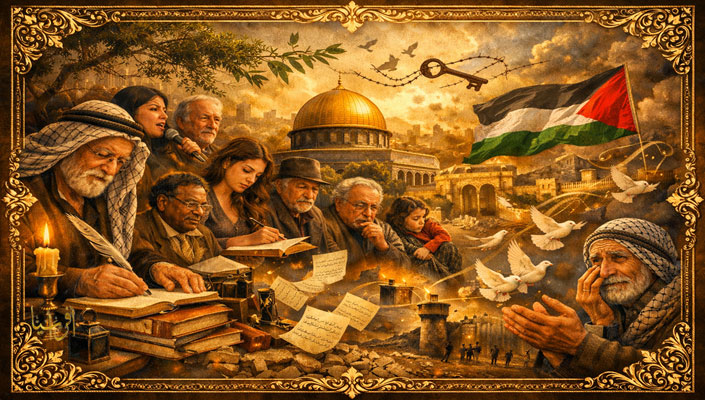
When poetry becomes a moral document in the time of extermination.. Poetry is an attempt to restore what is not repaired
Afrasianet - Tayeb Ould Aroussi - Poetry written about Palestine besieged by the machine of annihilation, war and occupation may not save any Palestinian physically, but it is undoubtedly capable of documenting their narratives and conveying their stories and feelings beyond the present time.
Many artists and intellectuals from around the world have interacted with the Palestinian issue as a humanitarian issue before it is political, and a matter of conscience before it is a border conflict. In this context, a new book entitled "Voice Pluralism for Palestine: 102 Poets" has been published, under the supervision of Michel Kassir, Metin Cengiz, and Emmanuel Malhab.
The book, published in Paris by Harmatan Publications, in 212 pages, at the beginning of January 2026, constitutes a qualitative addition to global solidarity literature, "and embodies a cultural moment in which geography and conscience intersect and language intersect."
A common human pain
This poetic work includes texts by two hundred poets from thirty-one countries, in thirteen languages spanning the continents of the world. This number does not merely reflect numerical diversity, "but rather reveals cultural and spiritual pluralism, as different languages, backgrounds, and experiences juxtapose in its pages, all united in a common human sense." In this joint collection, Palestine "is not an external subject that is written about from a distance, but an open human wound that finds its echo in the consciences of poets from the East and the West, from the North and the South."
The power of poetry here is that it gives meaning to small and forgotten actions and turns them into major references in the record of human dignity
The title of the book carries a profound connotation: "Phonetic pluralism" does not mean merely the collection of poems in a single volume, "but refers to the harmony of disparate voices that together form a human choir. Every poet writes from his cultural and linguistic position, but he engages in a collective discourse that rejects violence, denounces massacres and celebrates life." In this way, the poems become bridges that transcend borders, affirming that human pain is a universal language that does not need to be fully translated to be understood.
In one selected passage from the book, the tragedy of the bombing is embodied in an intense and moving image: "When my house is bombed, / I do not ask for the impossible, / I do not beg for a perfect miracle./ I only ask for a little mercy the size of a finger./ Leave my mother with one finger..."
This simple appeal sums up "The enormity of the tragedy. The poet does not ask for complete salvation, nor does he seek the world with a miraculous miracle, but rather asks for a 'finger', a symbol of the ability to touch, to search, to arrange the rest of life in the rubble. The image here goes beyond its realistic dimension to become a great metaphor for a man who is stripped of everything, leaving him with little hope to cling to.
The texts go on to portray the moment of bombing as a moment of refraction of time itself: "Time cracks like walls, and years fly in the air like windowed glass." Destruction is not limited to stone, but extends to memory, history and childhood. In addition to the house that was a shelter, it becomes a question, "and the room that was a bed of dreams becomes a hole of memory." Here the role of poetry is manifested as an attempt to restore what is not restored, and to preserve what has been erased.
Poems become bridges across borders
The Palestinian mother's search for the poem is not "just an individual act, but a symbolic image of resistance." She searches in the rubble for a trace of life, for a last breath, for a warmth that has not yet cooled down. Search, as the text points out, is her only form of resistance; "when a person is deprived of weapons and the ability to defend, the insistence on love, search and appeal becomes an act of moral resistance." Hence the power of poetry: It gives meaning to small actions, transforming them into major references in the record of human dignity.
A cultural and ethical document
The poets participating in this collection have come together not to add noise to the noise of the world, but to create a space for listening. The space to awaken the human conscience, especially since we are in a time when violent images and news are proliferating, listening becomes a rare act. The poem here does not compete with the media in the speed of the news, "but rather restores the human depth of the event, and gives the victim a name, a face, and a voice. It frees man from being reduced to a number or a transient address," and it turns out that the Palestinian issue is a common human issue.
In addition, the Diwan emphasizes that poetry is neither a linguistic luxury nor a rhetorical embellishment, but rather a "pain sensor" and a civilized mirror that captures the concussions of the human heart. "The poem does not stop a bomb, but it exposes it; it does not restore a fallen house, but it preserves its image in the collective memory so that it will not be erased." This is the power of literature, or as Yassin said, "art is either like a bomb or it is not," so poetry has the ability to resist forgetfulness, "and to stabilize the human narrative in the face of attempts to obliterate."
The poems in the book range from lament to protest, between meditation and anger, between sadness and hope. They juxtapose images of bereaved mothers, trembling children, and fathers who stand helpless in the face of devastation. But the thread that binds them all together is "the insistence on life. Even in the darkest moments, there is still a voice that declares that dignity can sprout in the harshest lands, and that man is greater than his rubble."
Palestine in this joint diwan is not an external subject to be written about from a distance, but an open human wound
The solidarity expressed by this act is not a passing slogan, but an act of presence. "To write a poem for a people under bombardment is to reject moral absence, and to affirm that suffering is not a local affair, but a shared human responsibility." When a poet raises his voice in defense of human life in Palestine, he proclaims the unity of human destiny.
This contribution may seem fragile to the war machine, but its apparent fragility "hides a deep moral strength. The word, though weak, has the ability to last longer than bullets. It preserves memory," gives victims symbolic recognition, and keeps the question open in the face of injustice and darkness, especially in a Western world that gives "lessons" in democracy and "human rights," so the book is at its core a message that tells Palestinians that they are not alone in this long night, and that distant voices carry their names in her poems.
Literature written by these poets, or in the names of the victims, is not just a passing text, but a testimony to a time, and a promise that humanity, no matter how broken, "can redefine itself. Thus, this book becomes a cultural and moral document", recording a moment of global solidarity, and affirming that poetry is still capable of being a space of light in the darkness of the world, and that the word, when it is siding with man, becomes an act of noble resistance. Thus, poetry still signifies, condemns, and pursues tyrants and tyrants anywhere in the world with its words.
________________
