
Afrasianet - Matthew Doss, executive vice president at the Center for International Policy, and Zori Lentzky, head of research and analysis at Dandelion Works, published an analysis titled "How the Abraham Accords Ignited a New Era of Conflict" by Matthew Doss, executive vice president at the Center for International Policy, and Zori Lentzky, head of research and analysis at Dandelion Works, argued that the Abraham Accords, which he promoted as a gateway to a new regional peace in the Middle East, contributed to the expansion of military cooperation between the Israeli occupation and Gulf states, and led to the escalation of regional tensions and wars in the region. The Palestinian issue and the increasing confrontations with Iran.
The Abraham Accords, signed by Israel, the United Arab Emirates and Bahrain under the auspices of the United States in 2020, did not lead to peace and stability in the Middle East as promoted, but rather contributed to entering the region into a new phase of regional conflicts and tensions, by expanding military and security cooperation between Israel and Gulf states, escalating the confrontation with Iran, and marginalizing the Palestinian cause.
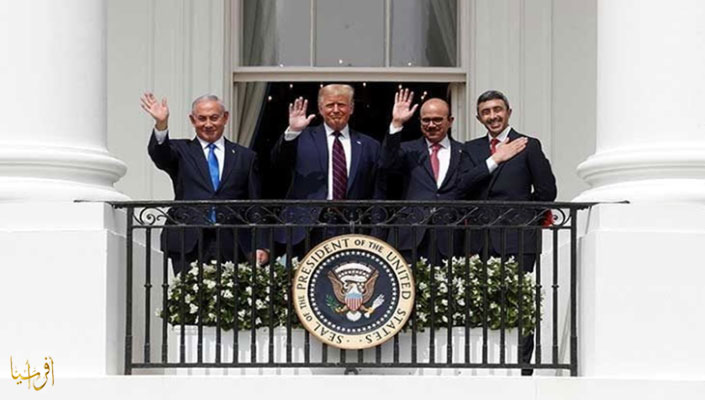
On September 15, 2020, US President Donald Trump oversaw the signing ceremony of the Abraham Accords at the White House, presenting them as the beginning of a "new Middle East", saying that these agreements will form the basis for a comprehensive peace in the region, which he described as an unprecedented historic achievement.
The report added that Trump was not alone in promoting this perception, as the agreements were widely praised by influential figures in US foreign policy circles, especially after they were later expanded to include Morocco and Sudan, where many commentators considered them to be the most prominent achievements of US foreign policy during Trump's first term.
Dennis Ross, one of the most prominent American experts on Middle East affairs, described normalization at the time as an "unexpected positive step," considering it an important contribution to Arab-Israeli peacebuilding, while the administration of former US President Joe Biden later adopted the agreements as a framework for regional peacemaking, although it approached them cautiously at first.
He recalled that US Secretary of State Antony Blinken stressed during the Negev summit in Israel in 2022 that the Abraham Accords had made the lives of the peoples of the region "more peaceful, prosperous, and vital," but that these promises were not fulfilled on the ground, but turned into "pure fantasy," as they described it.
The report stressed that the declared goal of the Abraham Accords was to strengthen economic and military cooperation between Israel and the Gulf states, and to put forward a new approach to resolving the Palestinian-Israeli conflict based on the idea of "peace from the outside inside", i.e., pushing Arab countries towards normalization first, in the hope that this would later lead to progress in the Palestinian file.
This approach has been seriously counterproductive, encouraging more hardline Israeli policies, providing political cover for the war in Gaza, and helping to escalate the military confrontation with Iran, rather than reducing tensions in the region.
Iran has been the main implicit target of the Abraham Accords from the outset, the report said, explaining that this became even more evident in April 2021 when the United States passed a law obliging Washington to encourage countries to normalize their relations with Israel, based on Iran viewing Iran as a "common threat" to Washington's allies in the Middle East.
He pointed out that in 2022, the Abraham Accords bloc in the US Congress succeeded in passing the "Deterring Enemy Forces and Enabling National Defenses" law, which focused on building an integrated missile defense network in cooperation with regional allies to counter Iranian threats, especially with Tehran and its proxies possessing a large arsenal of missiles and drones.
According to the analytical report, the Trump administration has taken an important strategic step to advance this path, by moving Israel from the scope of responsibility of the European and American leadership to the responsibility of the US Central Command, which allowed it to be militarily integrated with the Gulf states, led by the UAE and Bahrain, into a single security and military system.
This shift has allowed the United States to deploy joint defense systems and weapons in the Middle East, he said, and opened the way for unprecedented military and intelligence coordination between Israel and the Gulf states, within a unified defense framework against Iran.
This new structure was not limited to defense, but also helped Israel gain access to Gulf airspace, facilitating long-range military operations and allowing for the establishment of intelligence and security cooperation networks outside of traditional diplomatic frameworks, he said.
He said that arms sales were an essential and increasing part of the relations resulting from the Abraham Accords, explaining that Israeli arms exports increased by 30 percent in 2021 compared to the previous year, while 7 percent of those exports went to the signatories to the agreements.
Arms sales were a key part of the Abraham Accords, with Israeli arms exports increasing by 30 percent in 2021 compared to the previous year, with 7 percent of those exports going to signatories.
He pointed out that the UAE and Bahrain purchased Israeli weapons worth nearly $900 million during 2021, while the value of Israeli military sales to the signatories to the countries that signed the agreements by 2024 increased to nearly $2 billion.
The UAE has particularly strengthened its military cooperation with Israel, with Israel's Elbit Systems awarded a $53 million contract to provide the UAE Air Force with advanced electronic systems, and expanded cooperation between the two parties in the areas of drones, unmanned ships, satellites, cybersecurity, and surveillance technologies.
The report pointed out that military cooperation was not limited to arms deals, but developed into joint military exercises between Israel, the UAE and Bahrain, which included naval and air forces, in addition to the operation of joint military and intelligence centers on the Yemeni island of Socotra.
He stated that in 2022, Israel deployed the "Barak" air defense system inside the UAE, in a step that reflected an advanced level of security cooperation between the two sides.
The United States has rewarded Arab regimes involved in the agreements with massive arms deals, including a $23 billion deal announced by the Trump administration with the UAE, which included F-35 fighter jets, armed drones, and advanced military systems.
In 2023, the Biden administration signed a "comprehensive security integration and prosperity" agreement with Bahrain, with the aim of expanding security and intelligence cooperation and integrating Manama into the US Central Command's regional air and missile defense system, they said.
On the other hand, he pointed out that the situation in the Palestinian arena has witnessed a further deterioration after the signing of the agreements, and that the hypothesis that Arab-Israeli peace can be achieved without resolving the Palestinian issue has proven to be a failure.
According to the report, the drafters of the Abraham Accords considered that Arab-Israeli normalization could later lead to political progress for the Palestinians, and that the UAE had already used its accession to the accords to pressure the government of Benjamin Netanyahu to formally halt the plan to annex the West Bank.
But Israel has in fact used the agreements to marginalize the Palestinian cause and strengthen its policies on the ground, explaining that settlements and attacks against Palestinians have escalated significantly after the signing of the agreements.
He pointed out that settler attacks against Palestinians and their property increased by nearly 15 percent during the first year after the signing of the agreements, and then increased by 123 percent in 2022 compared to 2020.
He stated that there was evidence of Israeli military and police support for settler violence, while Arab signatories to the agreements did not exert any real pressure to stop those policies.
The UAE and Bahrain halted or significantly reduced their financial support to the United Nations Relief and Works Agency for Palestine Refugees (UNRWA) following the Trump administration's decision to stop funding the agency in 2018.
The UAE was among the largest donors to UNRWA between 2013 and 2019, reducing its contribution to just $1 million in the year the agreements were signed.
Settlement expansion and violence against Palestinians continued to escalate after the signing of the agreements, to the point that the UAE's ambassador to Washington admitted in 2023 that the agreements had failed to stop the annexation of the West Bank.
The report pointed out that documents obtained by Israel from Hamas revealed that Yahya Sinwar considered the Abraham Accords a danger to the Palestinian cause, and that Arab-Israeli normalization threatens to marginalize Palestinians within the Arab world.
The report stressed that the October 7, 2023 attack and the subsequent war in Gaza marked a turning point that allowed the Israeli-Gulf coalition to direct its efforts more towards countering Iran.
The report stressed that the six years following the signing of the Abraham Accords have shown that the Middle East has become less stable than it was before, in light of the ongoing war in Gaza, escalating tensions with Iran, continued confrontations in Lebanon, and worsening conditions of Palestinians in the West Bank.
The agreements undermined traditional Arab pressure on Israel on the Palestinian issue, and promoted the idea of achieving regional security through military alliances and security regimes rather than addressing the roots of the political conflict.
These agreements have helped Israel establish itself as a regional hegemon, at a time when its wars are becoming a threat to its neighbors, U.S. interests, and global stability.
The report concluded by emphasizing that the Abraham Accords were marketed as a framework for achieving peace and stability in the Middle East, but they led to the exact opposite results, as they contributed to widening the circle of wars and tensions, while the Palestinian issue remained unresolved, making any lasting peace in the region unattainable.
