
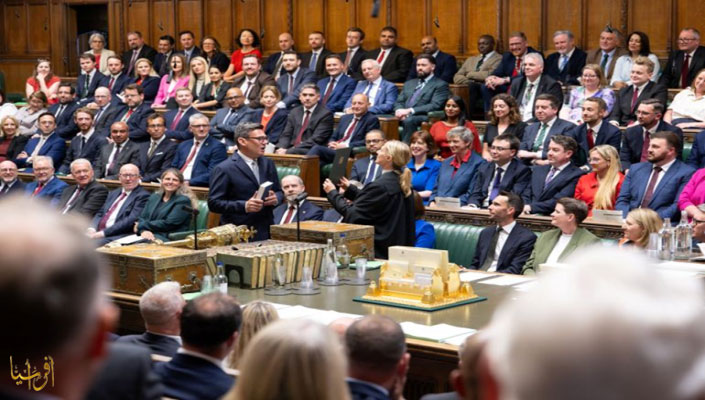
Afrasianet - Badia Al Sawan - Britain is poised to welcome its seventh prime minister in just 10 years, in a political landscape that has stunned observers at home and abroad.
Even more bizarre in this political shift is that three of the last leaders – David Cameron ,Boris Johnson andKeir Starmer – announced their resignation and stepping down within just three years of achieving overwhelming parliamentary majorities.
This accelerated rate of power rotation and the erosion of its legitimacy is unprecedented in modern British history for nearly two centuries, precisely since the violent upheavals that accompanied the Great Reform Act of 1832, which heralded the shift toward mass democracy.
This ongoing turmoil is due to successive crises monitored by the international press and considered a stark exception compared to other European countries, including Italy, which has long been known for the instability of its governments, which raises a fundamental question: Why is British policy devouring its leaders so quickly?
Years of stagnation and doomed promises
British Prime Minister Keir Starmer announced on Monday his resignation as prime minister amid a split in the ruling Labour Party , while his rival for the party's leader, Andy Burnham, was quick to confirm his intention to succeed him.
Starmer's resignation was not only the result of political scandals, but mainly due to his structural failure to pull Britain out of the heart of economic recession and his reneging on his major election promises, according to an analysis published by the Washington Post.
After a landslide victory described as the biggest in Britain's modern history, Starmer's popularity plummeted to the lowest among Western leaders, due to his rapid reversal less than three months after his election from his pledge not to raise national insurance tax, and to impose new taxes such as value-added tax on private schools, raising government spending to record levels without curbing the deficit or cutting borrowing costs that came higher than expected.
Instead of dismantling the bureaucracy that cripples construction and investment, Starmer's government has resorted to interventionist policies that the Washington Post has described as "shady state tricks" to gain temporary popularity, such as banning social media platforms for those under 16 and banning smoking for future generations, measures that have neither saved the economy nor prevented a crushing defeat in the recent local elections.
Coinciding with the economic downturn, Starmer's legitimacy was dealt a fatal blow after it was revealed that he ignored prior warnings about Peter Mandelson' s relationship with convicted sex offender Jeffrey Epstein and nevertheless appointed him as the UK's ambassador to Washington.
Today, after he stepped down, Britain is preparing to welcome a new prime minister, with former Manchester Mayor Andy Burnham, who was elected last week to Parliament, the front-runner to lead the Labour Party next month.
But the Washington Post warns that Burnham is taking a more aggressive approach by calling for forced pricing of goods and the nationalization of the energy and water sectors, which could face a backlash from financial markets.
Why does British politics devour its leaders?
For nearly two centuries, Britain has been experiencing unprecedented instability, with the fall of successive leaders – even those with overwhelming majorities like Cameron, Johnson and Starmer – not just a coincidence, but the result of a combination of five structural factors that the Financial Times structurally dissected:
• Brexit
Starmer's stepping down came a day before the 10th anniversary of Britain's vote to leave the European Union (Brexit), an event that caused a logistical dilemma and created a ceiling of unmet public expectations, leaving governments to waste half a decade debating the shape of relations with Europe rather than resolving the country's structural crises.
According to former Chancellor of the Exchequer Jeremy Hunt, the impact of Brexit is deeper than thought, as the Labour Party has been stripped of its traditional working class base in the north, while the Conservative movement has lost support in the affluent south, paving the way for the rise of populist currents led by Nigel Farage.
Analyst Luke Terrell confirms that the division in Britain today is no longer traditional between right and left, but has turned into an overlap of opinions that makes it difficult to build any stable coalition, with the street divided into 60% who call for "preserving and developing institutions", while 40% of voters believe that the way out is to "burn everything".
• Members of Parliament revolt
During the Brexit crisis, MPs used to build independent coalitions to achieve specific goals, and felt less obligated to support their party's agenda as a result of a separate democratic referendum.
In practice, the European Research Group, Europe's skeptical MPs, has succeeded in pressuring successive leaders and set a model for others, deepening the idea that the prime minister is "replaceable" at any time even if he has a large parliamentary majority.
WhatsApp groups have facilitated political planning and intrigue among backbenchers, while party leaders have failed to adapt to this new situation and have continued to practice politics in a traditional way compared to the modern style of MPs.
• Individual errors
No British prime minister since 2016 has managed challenges as Cameron caused the referendum, Theresa May torpedoed her power with early elections and a bad campaign, personal scandals and COVID-19 rallies toppled Johnson, Liz Truss caused the market to crash due to her economic recklessness, and Rishi Sunak failed to deliver a convincing target.
As for Starmer, his mistakes were summarized in making unrealistic promises and his inability to make decisive and difficult policy decisions such as the defense spending file.
Commentators compare this failure to the resilience and resilience of other leaders such as Canadian Prime Minister Mark Carney and Spanish Prime Minister Pedro Sanchez.
Accordingly, Trail rejects the argument that Britain has become an inarable state, arguing that the crisis lies in leaders who have made grave fundamental mistakes that could have been overthrown in any previous era.
• Economic recession
Britain has not recovered from the financial crisis and its growth has become slower than rich countries due to the size of its large financial sector, and the former director of the Institute for Financial Studies Paul Johnson believes that the economy is the main driver of politics, and that voters are fed up with the fact that their living conditions have not improved in nearly 20 years.
Successive prime ministers have focused on increasing spending to address the symptoms of the problems rather than addressing their causes and enacting real reforms that stimulate growth, causing incomes to stabilize and exacerbate a living crisis caused by stubborn inflation since 2022 and pressures from an aging population.
Since 2010, Britain's public debt has risen at a record pace to triple as a share of GDP, and the cost of servicing it has doubled, and despite record taxes, one pound out of every 12 pounds the country collects goes only to pay interest on debt, ensuring that the street remains disgruntled with anyone in power.
• "The Netflix Phenomenon"
The rise of platforms such as X andFacebook has fundamentally changed politics into a bespoke product on the demand of the voter, likening the phenomenon to Netflix.
This situation has helped the rise of the politics of "personalization" and digital charisma, but it carries a big trap, because the leader loses his peak popularity after his first day in power and it is difficult to rally people behind him based on popularity alone.
Burnham, who is almost certain to succeed Starmer, has a humble personality, thanks in part to his social media posts about football.
________________
