
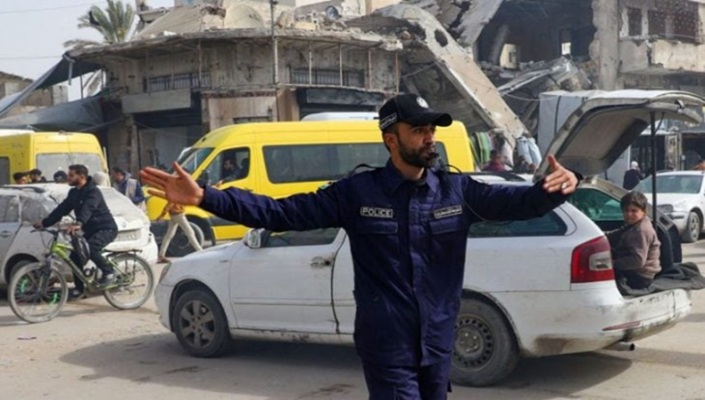
Afrasianet - The Daily Telegraph published a report by Henry Bodkin in which he said that the United States plans to rely on crime, looting and drug gangs to form police forces in Gaza, amid concerns from US leaders and Western allies.
According to Western officials, the Trump administration has presented plans to create a new security force that will include a large number of members of armed anti-Hamas militias.
They noted that Israel, which is believed to support US proposals, has armed and supported some of these factions since the Gaza war began with the October 7, 2023 attacks.
The Donald Trump administration, according to Western officials, has presented plans to create a new security force that includes a large number of members of anti-Hamas armed militias.
The idea of using some of these militias as part of a U.S.-backed peacekeeping force has drawn opposition from senior U.S. leaders.
Armed militias organized along family lines have decades of documented ties to organized crime, she said. Civilians in the Gaza Strip feel a deep distrust of it. In recent months, these militias have been accused of looting aid trucks, as well as murders and kidnappings.
In at least two of the most prominent militias, operatives have actively fought alongside or pledged allegiance to ISIS.
A source told The Telegraph: "A number of senior US military commanders have expressed concern that the peace process put forward by Donald Trump will not succeed without reliable security partners."
Britain, France and some other countries involved in trying to turn the president's 20-point peace plan into reality have also expressed concern.
Four months after the ceasefire, plans to create a police force to handle security tasks after Hamas appear to have stalled considerably, amid disagreements over its composition and funding. It is also unclear whether Hamas will voluntarily disarm.
The US administration had announced that President Trump would meet with members of the Peace Council, in the presence of delegations from more than 20 countries.
Organizers hope for funding commitments for Gaza's reconstruction, as well as promises to send troops to the U.N. International Stabilization Force (ISF), which is believed to be the highest rank of Gaza's new police and will coordinate with the Israeli military outside the enclave. Trump spoke on Sunday that $5 billion had already been pledged for reconstruction, and promised to send "thousands" of personnel to the International Stabilization Force and local police.
The plan to rely on Israeli-backed local militias came to the fore ahead of the Christmas celebrations, sparking controversy at the new multinational civilian-military coordination center in southern Israel. "There was a strong dismissal that this is ridiculous, they are not just criminal gangs, they are backed by Israel," a Western source said.
Jared Kushner, President Trump's son-in-law, is a central figure in the administration's efforts to move forward with the 20-point peace plan. Kushner is leading plans to establish new temporary "safe" settlements in the IDF-controlled part of the Gaza Strip, with the aim of removing Palestinians from the Hamas-controlled area if the group does not voluntarily surrender its weapons.
The first settlement, which is currently being built on the site of the former city of Rafah, is located in an area controlled by a militia." Popular Forces," an Israeli-backed group accused of drug smuggling and looting aid. Its former leader, Yasser Abu Shabab, who has denied involvement in organized crime, was killed in an internal dispute in December.
According to sources, Kushner is working closely with Aryeh Lightstone, CEO of the Abraham Accords Institute, who is said to endorse Israel's position on security and oppose the creation of a Palestinian state.
Lightstone coordinates most of the informal planning for Gaza's future from a hotel overlooking Tel Aviv's beach, including discussions with billionaire investors, prompting one source to describe the discussion group as a "Hilton Club."
Western officials question the feasibility of what they describe as Kushner's "ideological" approach. An official told The Telegraph: "There is a sense that Kushner and Lyston and their cronies believe that if they give the Palestinians the opportunity to flee Hamas, they will seize it." But the reality on the ground is that while many Gazans don't like Hamas, they don't like and don't trust family militias.
They are seen as criminals. There are also fears that the most ideological members of the administration will at some point turn around and say, "We gave you the chance to leave Hamas, if you're still in it, you must be sympathetic to it," at which point Israel would get the green light to reignite the war. It is currently unknown which of the family militias proposed by American and Israeli figures to be recruited and recruited into the new Gaza police force.
However, the White House has not denied that it has proposed this approach.
Nearly 20 years ago, reports from organizations such as the Brussels-based International Crisis Group raised concerns about drug and arms trafficking. Figures within the Popular Forces, such as Essam al-Nabahin, a senior commander, are believed to have fought alongside the Islamic State in Sinai, Egypt.
The Daghmash family in Gaza City is also accused of being linked to the terrorist organization. Although this has not been proven, the clan is suspected of helping to detain Israeli soldier Gilad Shalit, who was kidnapped by Hamas in 2006.
His release in 2011 was seen as a strategic security failure, as Israel forced the release of more than 1,000 Palestinian prisoners, including Yahya Sinwar, the mastermind of the October 7 attacks. A group called Jaish al-Islam, led by figures from the Daghmash, also kidnapped BBC correspondent Alan Johnston, who was detained for 114 days in 2007.
Israel's involvement with the Popular Forces came to light in May, after a senior official believed to have been opposed to arming Palestinian factions leaked details of this support.
Some Israeli media reported that at the beginning of the Gaza war, various factions received support from the Palestinian Authority's General Security Service in Ramallah, allegedly with the help of the CIA. However, Israel later took control of these relations.
Israel's involvement with the Popular Forces came to light last May, after a senior official, believed to have been opposed to arming Palestinian factions, leaked details of this support.
Hussam al-Astal, the commander of an armed faction east of Khan Younis, told The Telegraph in October that he had "coordinated" with Israel and was ready to help secure a post-Hamas Gaza. Al-Astal, a former PA security official, is one of a number of leading figures in the "tribes" who were imprisoned in Gaza at the start of the war, but fled when Hamas guards fled their positions.
Speculation has rife that the Peace Council, through its National Committee for the Gaza Administration, has chosen Jamal Abu Hassan, the former head of security in the Palestinian Authority in Khan Younis, to lead the new police force.
A Western official said a more recent version of the U.S. police plan proposed "unbiased recruitment," in which members could come from tribes, former Palestinian Authority security forces in Gaza, or elsewhere. "The process has lost momentum at the moment. The fact that without a credible force on the ground, the operation is doomed to fail." A US administration official told The Telegraph: "Planning efforts are still underway to develop the security vetting process for the police force, and we will not preempt this process."
