
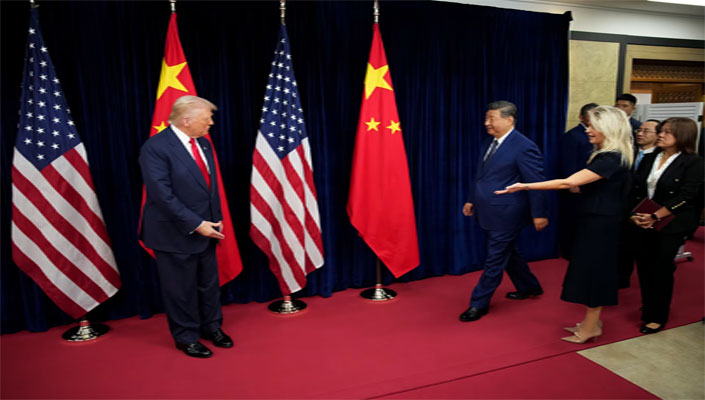
Afrasianet - Mazen Al Najjar - Now, wars are knocking on the doors of our region, as the Gulf countries and the region have been thrown into the eye of the storm, the lines of fire have raged, and their fragments have expanded, and this confrontation is only part of the wars and confrontations witnessed in the first decade of this century, which was accompanied by pivotal events and transformations, especially the declaration of a global war on "terrorism" by the United States in the wake of the attacks of September 11, 2001.
Events included the invasion and occupation of Afghanistan (2001), the invasion and occupation of Iraq (2003), the projects of a "new" or "large" Middle East, the forced and coercive spread of democracy, and Condoleezza Rice's creative chaos.
These adventures resulted in a cost that is now estimated at $6 trillion. That decade inaugurated a wave of historic wars and destruction of the Muslim world, stretching from Afghanistan to Gaza, Lebanon, through Iraq, Yemen, Syria, Libya, and Sudan. It resulted in millions of victims and displaced people and a political, economic, and social collapse.
Chinese Rise and Russian Escape
The United States' preoccupation with the war on terror made that decade and the subsequent one of the most glorious decades of China's rise economically, politically and strategically, as well as Russia, led by Vladimir Putin, was able to escape the clutches of Western penetration, fragmentation and oligarchy complicit with the West and Zionism.
I recall that the late thinker, Abdul Wahab al-Messiri, told of an Arab diplomat who met with his Chinese and perhaps Russian counterparts, and how they expressed to him their gratitude for the role of the Arabs in occupying the United States in invaluable years in the march of Chinese rise and Russian escape.
Many waters passed under the bridge in the river of international relations: China-American, Chinese-Russian, and American-European, until we reached the last few years, where the wheel of leadership of America and the West passed to Donald Trump, who was described by some international relations experts in his first presidency as the "greatest saboteur" of the international order that has existed since the end of World War II, and Trump is still exercising this role with determination and determination.
In the last decade, U.S.-China relations have taken varying forms, from clashes, scrambling, rivalries, and finally the struggle for the top. Xi Jinping's rise to the leadership and dominance of the Communist Party and the presidency of the state signaled an unprecedented new phase in Chinese politics.
It has gone from a long-standing tradition – established by Deng Hsiao Ping – that shows humility, secrecy, and non-defiance or a show of force, to a new tradition that shows the accumulation and expansion of Chinese power, the ability to challenge, scramble, and respond proportionately to the hostile positions of the United States and the West, and to spread around the continents of the world through the Belt and Road Initiative, and to assert hegemony over the South China Sea, advanced armaments, and accelerating technological superiority.
Strategic Opportunity
Although Xi ascended years before Trump's emergence, the historical irony is that Xi's personality style is best suited to successive presidents to lead China, in terms of his ability to counter the attempts to contain and encircle the Joe Biden and Trump administrations.
In light of Trump's "wars": trade against China, India, Russia, Europe, Canada, the Global South, now military against Iran, and geopolitical threats against Venezuela, Mexico, Cuba, Greenland (Denmark), and Canada, Xi and the Chinese leadership see it as a rare strategic opportunity rather than a threat because it accelerates the dismantling of U.S. hegemony over the international order, which is impeding China's rise globally.
In his speeches in 2025 and 2026, President Xi has repeatedly described "American chaos" as "an opportunity for China to lead a multipolar world," stressing "understanding with Russia" as a partner in countering "U.S. offensive wars."
Beijing seems to believe that the continuation of these "wars" until 2028 will redraw the map of the international order in its favor, as long as it remains the "responsible country" economically.
These wars and threats drain Washington and plunge it into heavy economic and military costs, weaken its ability to compete with China, and strengthen China's alternative in the Pacific, Central Asia, and Africa.
It also weakens European allies in NATO, pushing them toward energy deals with Russia, especially after the threats surrounding the Strait of Hormuz and its rising prices, shipping costs, and maritime insurance.
Its wars and threats also distract the attention of the American and global public opinion from China's quest to reclaim Taiwan and dominate the seas of the Far East, giving it time to strengthen and develop its military and economic capabilities.
Command.. bombs.. special forces!
Recently, the Munich Security Conference (2026) revealed not only the decline of the old international order, but also the openly rivalry between Washington and Beijing to reshape it, as Europe struggles to keep up with this rivalry.
The two speeches that had the greatest impact at the conference were delivered by U.S. Secretary of State Marco Rubio and Chinese Foreign Minister Wang Yi, which revealed competing blueprints for the next world order.
Rubio's speech was not just a critique of the post-Cold War order, but a declaration of the need to restore American primacy and hegemony as a organizing principle for the West. Power politics has never disappeared, and the United States has simply chosen to hide it behind the language of institutions.
The structural shift lies in one succinct formulation: The United States is willing to act alone, though it prefers to work collectively in accordance with its interests. Remanufacturing, supply chain autonomy, and border law enforcement will continue regardless of any consideration.
He notes that while sovereignty is based on supranational constraints, current U.S. behavior: extraterritorial sanctions, threats over Greenland and Venezuela, and open war on Iran; sovereignty is selectively defended. It is applied to protect U.S. freedom of action, not to impede its strategic goals.
In line with Trump's vision, Rubio explicitly rejected institutional constraints, arguing that the United Nations had failed in Gaza, Ukraine, Iran, and Venezuela, and that "it takes leadership from America. Bombs. Special forces."
The implications are stark: the institutions of the international order have no value at crucial moments, and law without force is just a fantasy. This signals a shift from a "rules-based order" to a U.S.-led system of power. The message was clear: The time for the West's managed decline is over. Trump's wars show the West's return to open competition.
Why do international institutions fail?
Diplomat Wang Yi, who is close to the Chinese president, sought in his intervention at the conference to redefine the international order from outside the Western system. He warned of the return of the "law of the jungle," in a direct criticism of Washington's rhetoric of power.
He believes that power politics have returned because Trump and his strikes are not without impulsiveness. While Rubio justified unilateral action by failing institutions, Wang pointed out that institutions fail because of being overtaken by major powers.
Wang cited Xi Jinping's "global governance" initiative, and emphasized sovereign equality, the rule of law, and pluralism. Behind this rhetoric is an ambition to reposition China as a partner in shaping global rules.
According to Wang, Beijing is not seeking to dismantle the international order, but rather to reset it towards a multipolar power and representation of the Global South. Therefore, its insistence on reviving the United Nations system is not just a slogan, but a Chinese strategic direction.
Institutions constrain unilateral military power, and Beijing sees it as a stabilizing factor against U.S. hegemony. Defending multilateral legitimacy is also a shield against hegemony.
Wang's declaration that "the Global South is rising collectively" signals coalition-building. China is seeking to strengthen its representation in the developing world and gradually change the balance of institutional power. It does not need immediate hegemony if it can reshape decision-making structures.
On Gaza, Iran, Ukraine and Venezuela, Wang stresses dialogue, wisdom, mediation and sovereignty, a consistent principle that does not support sanctions, nor the legitimization of unilateral strikes, nor an outright condemnation of China's allies.
Consolidation vs. redistribution
The contradiction between the American and Chinese visions is clear. Washington assumes alignment through its tacit influence in the form of NATO integration, dollar dominance, intelligence cooperation, and defense dependence. Beijing promotes independence because it cannot impose alignment.
The Munich conference revealed two divergent strategies: consolidation through influence on the part of the United States, and persuasion through China's multipolar narrative.
The emerging conflict centers on two organizational logics: a logic of steady Western consolidation of power based on U.S. supremacy and hegemony; and a multipolar redistribution logic centered on institutional balance.
For more than three decades, world politics has veered within an agreed framework toward unipolarity. The Munich conference made it clear that this delinquency was over. The regime is being renegotiated publicly.
According to scholars of international relations, the question is not whether the post-Cold War order will remain the same, but whether it will not remain. The question is: What will replace it?!
The outcome of the war now may answer that.
