
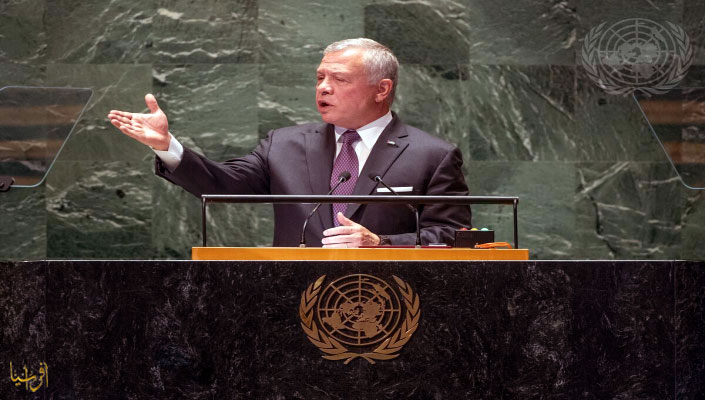
Afrasianet - Emad Daoud - In the General Assembly Hall, as King Abdullah II spoke, a delegate in the back row was running his finger over his phone screen.
Three flyers, one alert from a weather app, and a message from his aide reminding him of dinner time. The delegate saw nothing of what the king described at that exact moment: a child in a Jordanian field hospital in Gaza, only a few days old, sharing one artificial incubator with two other children because the number is not enough, in the same Jordanian field hospital that was targeted by Israeli attacks while he was treating the wounded in the Strip. This is not a scene from the speech.
This is a well-documented reality weeks before the speech. But the distance between the two, between the small screen in the delegate's hand and the crowded incubator in Gaza, is the same distance on which the king built his entire speech: the distance of attention.
The king chose a rare entry for his speech: cognitive psychology rather than the usual grievances. He pointed to a study that said the average screen time spent concentrating fell from two and a half minutes in 2004 to just 47 seconds today, and then moved from this small fact to a grand conclusion that he himself said clearly: "Attention is not just a knowledge resource, it is also a geopolitical resource." What the world chooses to look at decides which war deserves real diplomatic effort, which slips to the margins of the bulletin, and whether the ceasefire holds up after the camera is gone or collapses in silence.
Then he came up with the figure that makes this theoretical idea flesh out of flesh: in the first 300 days of the so-called ceasefire in Gaza, at least 300 Palestinian children were martyred, at the rate of exactly one child every day! A figure that was not invented by the speech; it was documented by UNICEF a few weeks ago, and the king mentioned it today in front of the same hall that signed that ceasefire, applauded it, and then returned to its screens!
More dangerous than the figure itself is the language in which the king carried it. Today's speech went beyond the usual diplomatic vocabulary to the vocabulary of law. The king described what is happening in Gaza as an attempt to erase the Palestinian presence and impose a new reality on the ground. What is happening in the West Bank is not just an escalation, but a radical shift: the demolition of homes to expand settlements is "forced transfer," the seizure of land is "de facto annexation," and the barrier system is an "oppressive structure" rather than a security one. Three short sentences, three specific legal terms instead of three loose diplomatic phrases that would have gone unnoticed. He then described the entire result in one unambiguous term: forced displacement and a war crime.
This same language is the ink that the king spoke of in the most dangerous part of the speech: the world has real tools, sanctions, asset freezes, diplomatic embargoes and isolation, and it has a track record of using them in cases other than this one. But when it comes to Israel specifically, the decisions remain, as the king said without embellishment, ink on paper.
Ink on paper, while a baby in a crowded incubator needs blood, not ink!
There is a trap that the discourse itself implicitly warns of, without calling it by that name: that the escalation of words becomes an alternative to escalating the situation. The language today is immeasurably clearer than in previous years, but this year the settlements have expanded faster than in any previous year, the checkpoints have increased, and the homes that were demolished have not been rebuilt simply because the word "forcible transfer" was used instead of "land registration."
If the escalation of language is not followed by a parallel actual escalation, the new, clearer ink becomes just a more accurate version of the old ink, telling the truth louder, without changing a single thing in the crowded incubator.
The king, when he talks about Gaza and the West Bank, did not separate them from the entire region, nor from Jordan in particular. When he moved to southern Syria and the Israeli incursions there, he no longer spoke of a safe distance that Jordan was watching from afar; he clearly said that any threat to the northern border or to water security is a threat to Jordan's own national security, and that the kingdom will not turn a blind eye, but will protect its security, water, and the interests of its people.
This is the language of a country that sees the red line approaching its own threshold, not only from its neighbor's threshold, not the language of the usual rhetoric of "extreme concern"!
One might ask: Aren't these the same accusations that are made every year in the same room? The difference this year is that the king has not left the "illusion" on which the past decade was built nameless: the illusion that Arab countries have never sought peace. He reminded the room that the 2002 Arab Peace Initiative offered Israel full normalization with fifty-seven Arab and Muslim countries, including Iran and Iraq at the time, in exchange for the establishment of a Palestinian state.
The offer remained open for more than twenty years, and the obstacle remained, in the king's own words, "never the absence of a partner for peace, but the absence of an Israeli government willing to accept it."
Twenty years of an offer that was not withdrawn, compared to three hundred days during which three hundred children were killed!
When the king arrived in both Gaza and the West Bank, he rejected a second illusion: that they were separate stories. He said they were two sides of the same strategy, destruction in Gaza and de facto annexation of the West Bank, with one unchanging goal: to make the establishment of a viable Palestinian state virtually impossible, not just postponed.
The delegate in the back row, somewhere in that room, finally raised his head when he heard the word "war crime" in a clear, untranslated voice. He looked for a moment, and then went back to his screen. This is the dilemma that the speech posed to the whole world, not to this delegate alone: that attention, in a time when attention has become a second of interest, is the only resource that everyone can still give, and also the only one that most of them refuse to give for more than forty-seven seconds.
The king left the hall suspended in front of a single question that he himself did not yet have an answer to. The truth was told today with rare clarity; how long does it take for the world this time to turn ink into something other than paper, before the number of the day three hundred and one is written?!
______________
