
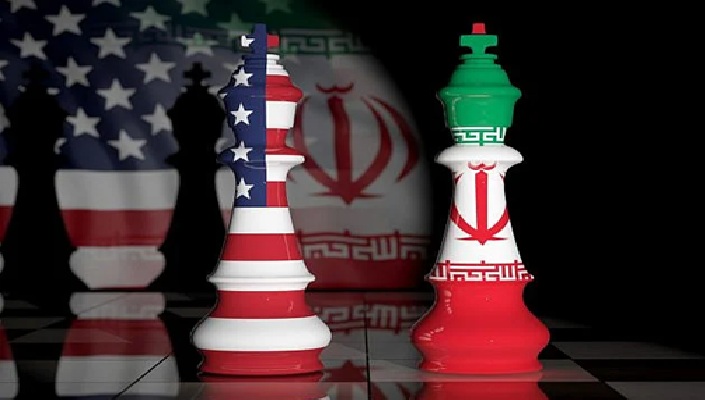
Afrasianet - Mohamed Farag - The Iranian negotiating experience, which isolates as much as possible the difficult shifts of the objective circumstance from its own margin in the negotiation process, places Washington not in a traditional confrontation with a state or political system, but with an ideology and identity.
There is no doubt that the first round of negotiations recently in Muscat took place at the height of Iranian-American tension, perhaps since the victory of the Islamic Revolution in Iran in 1979, and differs from previous negotiations in a number of conditions of the regional and international system, including:
1. Washington... Ongoing shifts in priorities
Before the nuclear deal in 2015, there was a critical moment in the US focus on Asia, as China's GDP at the rate of purchasing power was close to $10 trillion at the time, and in the United States it was $15 trillion, but the growth rates that reached 11% on the Chinese side, and those that were descending to negative values in 2009 in the United States, foreshadowed an ominous future for the United States, if Washington did not act quickly.
This priority did not prompt Obama to abandon Israel, but it implicitly contradicted the priorities of the occupation entity in the war against the axis of resistance, led by Iran, or at least increased pressure on it.
During Obama's presidency, Netanyahu was forced to adapt to American priorities, and this was reflected in the Bar-Ilan 1 speeches in 2009 and Bar-Ilan 2 in 2013, where he spoke of a demilitarized "Palestinian state" in the first, and in the second, his speech did not go beyond the ceilings of warning against the accumulation of Iran's nuclear capabilities and the need to tighten sanctions on them, and to try to block the agreement.
The most that Obama can offer within the condition of American priorities is to direct the paths of the "Arab Spring" and produce a state of chaos that fights the resistance forces on behalf of both Israel and the United States, and produces a reality that corresponds to the Israeli condition, both in terms of producing a state of internal political disintegration, the inability to produce alternative authorities smoothly, as well as the production of takfiri currents that have entered the scene.
The nuclear agreement took place at a time when the wave of takfiri organizations began to recede and the resistance forces in the region were victorious.
On the one hand, there is an implicit American desperation to follow Obama's previous title "Heading to Asia," and this is reflected in the language of the literature of American strategic documents, which talk about avoiding confrontation, in favor of denial deterrence. This pushes U.S. aggression to regions it considers less cohesive: Latin America and West Asia.
On the other hand, Washington believes that there are new data that were not available during the Obama administration, such as the major transformations in Syria and the pressures that the resistance forces in the region have been subjected to since October 7, specifically in Palestine and Lebanon. Data in which Washington finds pressure cards in the negotiation process with Iran, considering that the decline in the capabilities of the axis of resistance as a whole is necessarily reflected in its position in Tehran.
2. Russia... From a strong off-the-shelf start to a busy neighborhood
Russia's entry into the crisis line in Syria occurred in the same year that the nuclear deal with Iran was concluded. This was the fourth event of modern Russia's move beyond the borders, after the collapse of the Soviet Union (Chechnya, Georgia/South Ossetia and Abkhazia, Crimea). But this time it was the move towards distant geography, which had a lot of momentum that confused the American cards.
However, the Russia-Atlantic confrontation in Ukraine that began in 2022 has imposed a new reality, which weakens Russia's enthusiasm for strong action beyond borders, which has been demonstrated on many occasions, in Syria as well as in Venezuela.
On the other hand, and with a logic similar to the Chinese case, there is a vainly buried American feeling, more support against Russia in Ukraine, and in the recently issued US strategic documents (the National Security Document and the National Defense Document), Washington considers that Europe has become a continent in the process of withering, a civilization in the stage of decay, and that it is not dependent on it, and that the ideal ally is Israel.
While Russia, as well as China, were key parties in the P5+1 negotiations, the negotiations are now moving in the presence of Egyptian, Turkish, Omani and Qatari mediators.
Europe has moved from its position in the P5+1, and trade with Iran has increased after the signing of the agreement (from $1.3 billion in 2015 to $11.4 billion in 2017, according to Trading Economics), to activating the snapback mechanism and classifying the IRGC as a "terrorist organization."
3. The American Negotiation... The Regression of Logic and Competencies
Although the United States has been witnessing a significant decline in the level of political leadership for decades, the Trump team appears to be the worst in terms of political and technical expertise in negotiations.
Wendy Sherman was on the U.S. negotiating team in 2015, coming from an academic background, research centers, and a master's degree in social work, while Whitkoff appeared at the negotiating table in a hurry from the real estate empire.
On a technical level, if Ernest Moniz, a 2015 technical negotiator who holds a Ph.D. in theoretical physics from Stanford, is an active participant in climate agreements, and a director at the Massachusetts Institute of Technology, Michael Anton, who was selected in 2025 to be on the technical side of the negotiation, comes from a purely managerial background.
Because many analysts are enthusiastic about likening the Trump administration to the Reagan administration, as the negotiators on Trump's team have declined in the face of Henry Kissinger giving advice to Ronald Reagan before his famous meeting with the veteran Soviet diplomat, Gromyko: "Don't try to go into too many details with him, he knows a lot, stay on the scales."
Some prefer to call Washington's diplomacy "gunboat diplomacy," a diplomacy based on military pressure to achieve foreign policy goals. While military elements were in the background in 2015, the Trump administration decided to export them to its front in the recent round of negotiations in Muscat, with the participation of CENTCOM's leadership.
With all these transformations, and with the unprecedented wave of direct pressure on Iran, what surprises observers is that Iran continues with the same logic of negotiations, as if the external world and the objective circumstance do not represent a moving needle for the logic of negotiations, as it continues with what Mohammad Javad Zarif expressed about the leadership's directives in negotiations in his book "The Steadfastness of Diplomacy", that the triangle of pride, wisdom and interest must remain cohesive, but in the service of the most important side (pride).
In the introduction to his book "The Power of Negotiation", Abbas Araqchi proposes the basic meanings of this power, and presents national power as the first element of these meanings.
This is precisely what distinguishes the Iranian negotiation experience, which, as much as possible, isolates difficult objective shifts from its own margin in the negotiation process. This is what puts Washington not in a traditional confrontation with a state or political system, but with ideology and identity.
These are the most difficult negotiations, the most difficult moments for the region, and we are on the threshold of the exposure of the major turning points in the region, and on the threshold of a more accurate assessment of the prospects of the next stage, in the narrow corridor between negotiations and war.
