
Afrasianet - Author: David Lohno, Sonna Engel Rasmussen, Bertrand Benoit - The Wall Street Journal report argues that Donald Trump's "America First" policy in his second term has led to an unprecedented deterioration in the image of the United States globally, especially among its traditional allies in Europe, Asia and North America, threatening to become "America alone."
According to a report by the Wall Street Journal, US allies are increasingly dissatisfied with Washington's confrontational foreign policy approach, especially in the second term of US President Donald Trump, which has led to an unprecedented decline in America's global image.
In 1963, John F. Kennedy delivered his famous "I am Berlin" speech here, declaring American solidarity during the Soviet blockade. In 1987, Ronald Reagan stood in front of the Berlin Wall, challenging Soviet leader Mikhail Gorbachev to tear it down. Twenty-one years later, 200,000 Berliners gathered to listen to then-Senator Barack Obama, announcing a new era of American-European friendship.
The public mood toward the United States in Berlin today has changed: "After the turbulent first year of Donald Trump's second term, Germans rarely admire the current U.S. president, in part because he too does not like him."
This was evident during a speech Trump gave in Switzerland last week, when he mocked the Europeans, saying that if it wasn't for American help in World War II, "they would all speak German."
Positive outlook on the United States declines in much of the world
According to the Wall Street Journal, 59-year-old citizen Natasha Ahrens said, "My grandfather was from Hawaii, and he came out as a U.S. soldier, so I've always had a close connection to the United States." "I find the image that Trump is spreading of the United States around the world very destructive," she added.
This is a world where "America First" means "America Alone," as its allies look for alternatives to what appears to be an increasingly abusive relationship.
Last year, Trump cut off most U.S. foreign aid, withdrew from dozens of multilateral institutions, and ended direct military aid to Ukraine in an attempt to repel a Russian invasion that many Europeans see as a threat to their entire continent. He also threatened to use military force to annex Greenland before recently backing down, and imposed trade barriers on countries that sell goods to the United States.
The Wall Street Journal said a steady stream of insults accompanied Trump, directed almost exclusively at allies. Last week, at the World Economic Forum in Davos, he mocked French President Emmanuel Macron, criticized Canada for not showing more gratitude, called NATO a money-drainer, said, "Wrong, NATO countries didn't send their troops to the front lines in Afghanistan to help U.S. troops," and later apologized.
He said that despite everything the United States has done for its allies, they never return the favor: "All we ask for is a place called Greenland."
The number of Britons who view the United States negatively has doubled over the past two years to 64 percent, more than double the percentage of those who view it positively, according to a YouGov poll last week.
In Germany, 71 percent now view the United States as an "adversary," according to German polling firm Forsa, while only 16 percent view it as an ally in Europe, according to the European Council on Foreign Relations.
Forsa's director, Peter Matushik, said: "The image of the United States is at its worst right now."
Nearly two-thirds of Canadians and Mexicans hold negative views of the United States, according to various polls, and view their neighbor as a greater threat than China, a sentiment that resonates in Brazil, Latin America's largest country.
Even in Asia, the United States is taking a heavy blow to its reputation, with nearly half of South Koreans describing the United States as a threatening, authoritarian, and dishonest state, according to a poll conducted by the Hankook Research Institute.
Former Conservative Party leader William Hague wrote in a recent op-ed, "If the United States continues on this path, anti-American sentiment may take root in many democracies."
Trump has shattered the system of trust between the United States and its allies. "Nobody likes bullies"
America's image has always undergone several ups and downs: it has declined during the Vietnam War, Reagan's more aggressive stance in fighting communism in the 1980s, and George W. Bush's invasion and occupation of Iraq. Its image was also damaged during Trump's first term.
George W. Bush ordered the invasion of Iraq after his failed attempt to get U.N. support, but he still had a coalition of about 49 countries that offered help, and Trump has no regrets about pursuing U.S. interests.
Robert Kagan, a former Republican administration member and Brookings Institution scholar, said Trump had broken the system of trust between the United States and its allies, which had established a relatively stable world order over the past 70 years.
During that period, U.S. power helped protect allies, and in return, they hosted U.S. bases, shared intelligence, and maintained relatively open markets for U.S. companies.
Now, Kagan says, allies are unlikely to trust America as much again, regardless of a change of administration. "I think it's almost impossible to envision a recovery at this point," he says. Let's say another three years of this situation." "So step back a little bit on Greenland, this is not the end of the problem, it's the beginning of it."
According to the Wall Street Journal, another reason that hostility to America may be stronger this time around is pride, as previous presidents have generally tried not to ridicule other leaders and nations.
Former presidential spokesman and public relations expert in Mexico, Gabriel Guerra, said: "We have all been insulted, no one likes bullies."
How is a loss of confidence hurting America's economy?
According to the report, losing the United States as a reliable ally could hurt the appeal of leading U.S. brands abroad, which already face stiffer competition from Chinese products.
Major trading partners are scrambling to diversify their economies, European and Asian countries that rely on U.S. military power are ramping up their military production, and countries such as Canada, Britain and South Korea are showing rapprochement with China.
After Trump took office, many Asian countries that rely on trade expressed betrayal over last year's surprise tariffs.
Singapore's Prime Minister Lawrence Wong said in a speech to parliament in April: "These are not acts committed against a friend."
Local manufacturers, who have sought to attract U.S. buyers for decades, are diversifying their customer base, according to the Wall Street Journal: Paul Norris, who runs a clothing factory in Vietnam and relies heavily on a network of U.S. buyers, says he has added retailers from outside the U.S. to reduce his vulnerability to trade policy fluctuations.
The impact of this crisis extends to other aspects: the number of tourists arriving in the United States fell by 6% last year, driven by a decline in the number of Canadian and Mexican visitors.
After Trump imposed tariffs on Canada, grocery stores, such as Luluz and Soupee's, labeled local products.
The new and popular Maple Scan app allows users to try to avoid tariffs and support Canadian businesses by selecting local products.
Sasha Ivanov, a Canadian programmer from Calgary who developed the app, says: "We've been neighbours for years, and we've fought common wars, but in the end, things have become pretty unpredictable."
The shift is even more enduring and impactful in Europe, where the transatlantic partnership, which has kept the peace after two disastrous world wars, is in danger of collapsing.
European leaders have tried to appease Trump, agreeing to tariff increases without raising tariffs on U.S. imports, sending messages of flattery, and agreeing to sharply increase defense spending so that the U.S. can focus on threats elsewhere, such as China.
The United States now describes NATO as not of its own making, but a club for Europeans. Even if Trump temporarily backed down, his threats against NATO member Denmark to seize Greenland marked a crucial turning point: confidence in the U.S. ability to defend a European partner under attack has been eroded, and Putin has no doubt noticed.
"Donald, enough!"
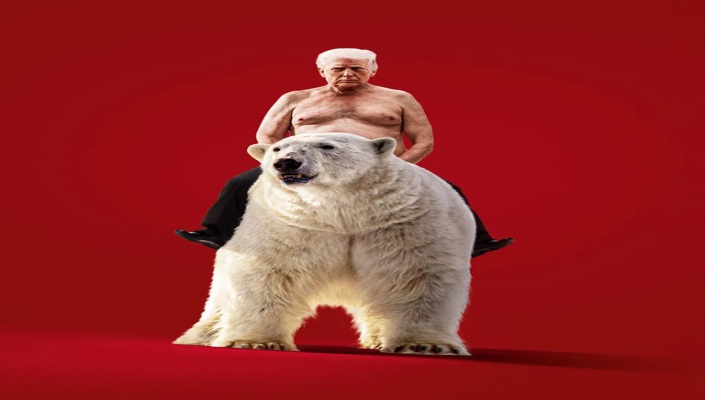
According to the Wall Street Journal, the cover of The Economist featured a photo of a bare-chested Trump riding a polar bear this week, an apparent reference to Putin riding a horse to show off his muscular muscles and disregard for the border.
Under the title "Donald, Enough!" , the German magazine Der Spiegel featured a photo of Europe's leaders dressed as Norse warriors and wielding swords. Below the photo: "How can Europe counter Trump's imperialism?"
Every year on July 4, the National Rebuild Society, a Danish-American friendship association, holds one of the largest celebrations outside the United States, bringing together up to 60,000 guests to eat pickled herring and enjoy music in the hills of northern Denmark.
Earlier this month, the neighboring city of Aalborg announced it would withdraw its core funding for this year's meeting unless organizers withdraw invitations to U.S. military and civilian officials, including the ambassador.
"It is painful to see a relationship that is more than 100 years old suddenly tested in this way," said Jürgen Bisch-Madsen, president of the Royal Danish Society for Foreign Policy.
Former Danish Prime Minister Anders Fogh Rasmussen said: "In fact, Trump's behavior is fueling forces in Europe who are arguing that we need an alternative to the United States."
