
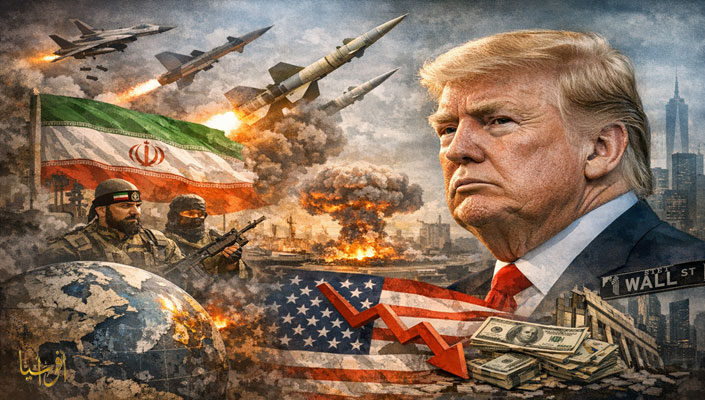
Afrasianet - The war on Iran, which began on Feb. 28, presents an extraordinary challenge to U.S. President Donald Trump, U.S. analysts said, stressing that this war has always been his personal war, revenge, and clearly strategically unplanned with clear accusations of a dubious role for Israel in implicating the United States in the war.
Analysts noted that reliance on military force alone has been the dominant feature of U.S. policy, with disastrous economic and political results.
Trump's previous success in individual operations, such as the airstrike on Iran's nuclear sites in June and the arrest of Venezuela's president and his wife in January, gave him a sense of sheer power, but at the same time made him vulnerable to the consequences of direct involvement in a full-scale war.
The deeper incursion into Iran over the past three weeks has exposed the weakness of the strategic planning of the president and his advisers, as the operations have made no tangible progress, but have only increased international complexity and tension.
They concluded that the war has divided U.S. and Iran's adversaries on the world stage. The closure of the vital Strait of Hormuz has disrupted global markets, with the price of oil rising by nearly 40 percent, while the price of gasoline in the United States has risen by nearly $1 a gallon, prompting Trump to try to promote the idea that short-term costs will benefit in the long run, but analysts have deemed that explanation to be far unconvincing. I hope it proves something."
His proposals, such as providing $200 million in insurance guarantees for ships passing through the strait or protecting tankers by military force without a specific timetable, showed the chaos of management and a lack of understanding of the realistic risks to soldiers and equipment, according to experts.
German Chancellor Friedrich Merz called the decision ill-considered and stressed that Europe had not been consulted or asked to help, while French President Emmanuel Macron stressed that France would never participate.
Analysts said Britain's refusal to send warships to the region, and Australia's and Japan's assertion not to participate, reflected the former administration's isolation and failure to build an international coalition.
They asserted that the attempt to provide "moral" or "noble" justifications for the invasion did not stand up to the analysis of the facts, and that relying on arguments such as protecting the Iranian people or preventing possible attacks on U.S. assets did not alleviate the growing criticism of the U.S. public.
The economic crisis resulting from the war was unprecedentedly severe, driving up oil and gas prices and turmoil in markets, adding to the pressure on the U.S. economy.
Trump's attempts to control media messaging by attacking the media and accusing it of spreading "fake news" and reviewing the licenses of some channels have failed to assuage public concern about the escalating crisis, analysts said.
Data from the Quincy Institute for Responsible Statecraft in collaboration with The American Conservative magazine showed that 79 percent of Trump supporters want to end the war quickly, despite initial support of 75 percent less than a month ago.
Analysts added that 58 percent of supporters oppose sending U.S. troops to fight on the ground in Iran, while more than half of supporters are concerned about rising fuel prices, reflecting divisions within Trump's electoral base.
Others argue that the administration faces a dual dilemma: internally and externally. Internally, rising prices and loss of life are putting pressure on the U.S. public, while externally, the distancing of traditional allies from participating in operations shows the U.S. weakening ability to lead an international coalition.
Analysts stressed that this divergence reflects the effects of repeating past experiences, such as the Iraq war, where European countries felt unconsulted and left to manage the consequences.
Forty-six percent of voters between the ages of 18 and 29 expressed opposition to the war, which could put future pressure on any potential Trump administration, should it decide to continue or escalate the conflict.
They said that the best option is in the Middle East. The time is now to declare a swift victory and end the war, to avoid further economic and military losses, and to protect Trump's base from losing confidence in him.
The U.S. assessments concluded that the war on Iran did not achieve any concrete strategic goals. Military operations did not eliminate Iran's nuclear capabilities as Trump claimed, nor did it prevent Iran from influencing the global economy, but rather led to higher oil prices and increased international tensions.
She explained that all indications reveal that the Trump administration was not prepared to deal with the consequences of the conflict at the domestic and international levels.
In their view, the purpose of the escalation was to search for a scapegoat to justify failures, while ending the conflict requires acknowledging failure and finding a safe way out to avoid further losses.
Experts also observed that the economic crisis caused by high fuel prices and increased pressure on global markets will continue to affect the US and global economy unless an urgent settlement is reached.
The analysis confirmed that the continuation of the war in the current situation will further isolate the United States internationally and complicate the management of future crises, especially in the absence of a clear strategy to end the conflict.
The sources believe that Trump's disregard for the potential consequences and his focus on personal and revenge goals has led to unprecedented internal and external difficulties in recent years.
She warned that any delay in making the decision would further complicate the crisis and damage the United States' standing internationally.
