
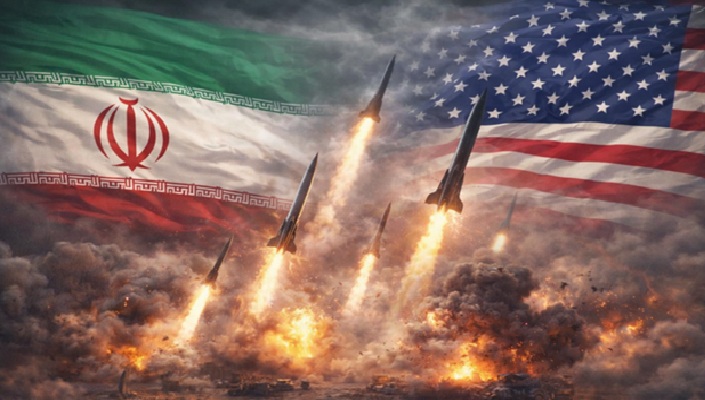
Afrasianet - Recent U.S. military moves in the Middle East show a fundamental shift in Washington's operational doctrine of moving from offensive readiness to a shelter-in-place strategy.
Rather than preparing for a military strike against Iran, the Pentagon is busy deploying additional air defense systems in an effort to contain a predictable response that it knows in advance will be broad and costly.
This behavior does not reflect restraint, but rather a structural inability to fight a war whose course can be controlled.
Based on official U.S. and security analyses and an internal Israeli vision of reluctance to make the decision to go to war, as well as Arab assessments of Washington's real motives and concern about a broad escalation, the U.S. boasting of its air superiority is no longer decisive in the equations of war with Iran.
Military analysts and experts confirmed to The Wall Street Journal that the United States is not preparing for imminent air strikes on Iran, and that the Pentagon is first focusing on bolstering air defenses to protect forces and allies in the face of a possible Iranian response, reflecting a clear reluctance to launch an all-out attack.
The Arab media, some of which are official, are full of analyses about serious questions about the real and serious goals of carrying out a US attack on Iran, especially in light of the great regional risks, and even analyses suggest that the US escalation against Iran is in fact aimed at pushing towards a negotiated deal rather than engaging in a direct military confrontation.
Israeli assessments showed a divergence of opinion on the possibility of an imminent U.S. attack, highlighting diplomatic efforts to de-escalate against offensive scenarios, an indication of indecisiveness within Israeli circles as well.
IDF Chief of Staff Eyal Zamir ruled out an imminent strike in the next few days against Iran, saying the current stage is characterized by uncertainty.Israel
Army Radio says that Washington does not inform Tel Aviv of the full details of its decisions, which raises Israeli concern that US President Donald Trump may reach an agreement with Tehran that is limited to the nuclear file and not ballistic missiles.
On the other hand, the Israel Broadcasting Corporation quoted an Israeli military official as saying that Tel Aviv cannot live with Iran's ballistic missile capabilities.
According to experts, Iran has built its military strategy on neutralizing US military superiority through a huge and diverse missile arsenal, including long- and medium-range ballistic missiles, low-altitude precision missiles, suicide drones, and defensive dumping capabilities via simultaneous launches.
This system is specifically designed to bypass and confuse Western interception systems, not to confront them technically directly.
Washington relies on systems such as THAAD and Patriot, but it faces three fatal problems: limited number compared to threat size, high cost per interception, and inability to respond to heavy multi-directional attacks.
This means that these systems are suitable for local and temporary defense, not to protect an entire theater of operations in the event of an all-out confrontation.
In any scenario of war with Iran, Israel would turn from an advanced ally to a central weak point, as Iran does not need to destroy Israel militarily, but it is enough to make painful missile penetrations, paralyze vital centers, and break the image of absolute American protection.
Washington understands that its failure to protect Israel, at least in part, will erode the prestige of U.S. deterrence globally and accelerate the international order's transition to a post-unilateral hegemony.
Tehran is capable of prolonging the conflict, opening multiple fronts, striking vital bases and corridors, and destabilizing energy and trade markets. The United States and Israel rely on the model of short and quick wars, which is no longer valid against an adversary willing to bear the long cost.
A broad escalation in the Gulf and the Strait of Hormuz means a sharp rise in energy prices, disruption in supply chains, and economic pressure on Western allies, making war with Iran an unmarketable adventure politically or economically, even within the Western camp itself.
The U.S. impasse deepens the erosion of the regional cover. Key Gulf states, led by Saudi Arabia and the United Arab Emirates, have distanced themselves from any direct military action against Iran, refusing to use their territory or airspace.
This refusal does not reflect neutrality, but rather a loss of confidence in the U.S. ability to wage an all-out regional war.
What the region is witnessing is not a preparation for a strike, but an unspoken acknowledgment that the balance of deterrence is no longer one-sided. Iran has succeeded in imposing the equation of "any U.S. attack will be met with a broad, long, and costly response," without guarantees of victory.
That is why Washington is taking a step back, and wrapping up the retreat in the language of "defensive readiness."
The current crisis reveals that the United States can no longer impose its military will by force alone. The world has entered a phase in which the effectiveness of traditional military superiority is diminishing in the face of asymmetric deterrence strategies.
In this context, the U.S. strike is not delayed... Rather, they are being disrupted, according to observers, who estimate that military moves reflect a willingness to contain a response rather than a decisive strike, and the cost of the risks far outweighs any potential U.S. and Israeli tactical military gains. Any decision to direct military escalation against Iran carries the potential for spiraling out of control, beyond the ability of the United States and its allies to contain.
