
Afrasianet - Israel's nuclear capabilities have long lived in a gray area, surrounded by a fence of international silence and diplomatic collusion under the so-called "ambiguity" policy, but these shadows, which obscured the truth for nearly half a century, are now fading under the weight of the Iranian war.
In an in-depth analysis published in Foreign Policy magazine, writer Yonatan Toval, a researcher at Israel's Mitvim Institute for Regional Foreign Policy, argues that the raging war with Iran is beginning to weaken Israel's decades-long policy of "nuclear ambiguity."
Toval points out that this shift is no longer just a journalistic analysis, but manifested itself in an official political movement in Washington, where 30 Democratic members of the House of Representatives, led by Joaquin Castro, demanded that the United States publicly recognize Israel's nuclear program, considering that the long policy of silence is no longer sustainable in light of the current confrontation.
Israel's policy of nuclear ambiguity has given the United States space to maintain Israel's military superiority without having to explicitly defend it within international nuclear non-proliferation institutions.
The Amimut Doctrine
The move represents a break with a political taboo that has held for more than half a century. Since 1966, Israel has been based on the doctrine of "amimot" (ambiguity in Hebrew), coined by former Prime Minister Levi Eshkol in his famous phrase that Israel "will not be the first to introduce nuclear weapons into the region."
According to the Israeli researcher, this policy was not aimed at deceiving adversaries, because the countries of the region, including Iran, had been dealing with Israel as an actual nuclear power for years, but rather aimed at easing the political and diplomatic pressures associated with Israel's strategic superiority in the region.
This policy has given the United States space to maintain Israel's military superiority without having to explicitly defend it within international non-proliferation institutions, while the international focus has remained on Iran's nuclear program.
However, the recent war has changed the nature of this balance, as the issue of nuclear weapons has become an open part of the regional war discourse. The strikes on Iran's Fordow, Natanz and Isfahan facilities were carried out as part of an explicit campaign aimed at preventing Iran from acquiring a nuclear weapon, which has made the talk of the nuclear balance in the Middle East more open and clear.
Dimona at the heart of the geography of the conflict
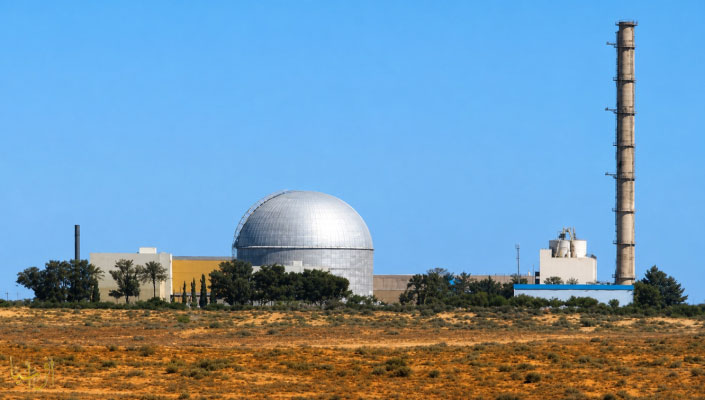
The analysis draws attention to the fact that the current war has brought the Dimona reactor out of the shadows and become part of the active geography of the conflict: when Iranian missiles rain down on the periphery of strategic installations, these sites become a daily item in war reports, depriving them of the quality of secrecy required by the policy of ambiguity.
The article also touched on statements made by David Sachs, a senior White House adviser, when he raised the possibility that Israel would resort to the nuclear option if the war escalated, before President Trump publicly commented that "Israel will never do that."
According to Tuval, the mere fact that the US president had to comment on this possibility reflects the transfer of the Israeli nuclear file to the public political debate in Washington, which in itself is a change in the "rules of diplomatic language" that have been preventing US officials from even addressing this file.
The world may begin to treat Israel as a declared nuclear state without the latter having the advantage of old silence, putting the region's stability to a new test that goes beyond the language of secrecy toward transparency that may be clearer, but not necessarily safer.
