
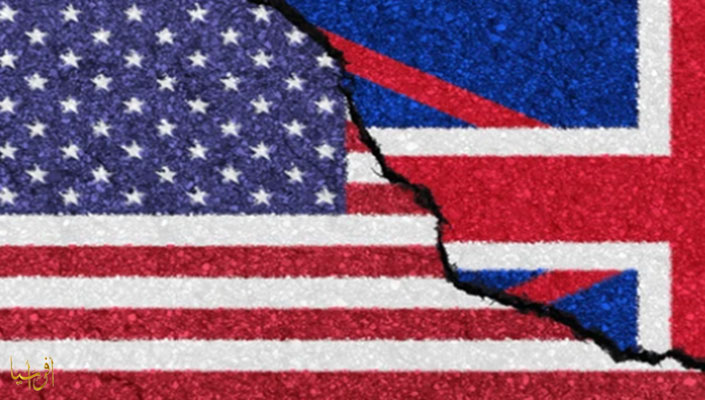
Britain angers Trump over threatening to punish Britain via Falkland Islands
Including the suspension of Spain's membership. Pentagon letter discussing sanctioning NATO members over Iran's war
Afrasianet - A U.S. Department of War (Pentagon) internal email talks about options for the United States to punish NATO members it believes have not supported U.S. operations in the war with Iran, including suspending Spain's membership in the alliance and reviewing the U.S. position on Britain's claim to the Falkland Islands, a U.S. official said.
The official said one of the options in the letter included the suspension of "difficult" countries from important or prestigious positions in NATO.
He said the policy options were detailed in a memo describing disappointment over what was seen as a hesitation or refusal by some NATO members to grant the United States (rights, military positioning and air transit) as part of the Iran war.
He noted that the letter described the rights of access, military stationing and air transit as "just the absolute minimum for NATO," adding that options were being discussed at high levels at the Pentagon.
U.S. President Donald Trump has sharply criticized NATO members for not sending naval fleets to help open the Strait of Hormuz, which was closed to global maritime navigation following the outbreak of the air war on Feb. 28.
Trump has also indicated that he is considering withdrawing from the alliance.
"Wouldn't you have done it if you were in my shoes?" Trump asked in an interview on April 1. , in response to a question about whether a U.S. withdrawal from NATO was on the table.
The official said that however, the email does not indicate that the United States will withdraw. It also does not contain a proposal to close U.S. bases in Europe.
But the official declined to say whether options include the United States withdrawing some of its troops from Europe, which many expect.
Asked for comment on the email, Pentagon spokeswoman Kingsley Wilson said, "As President Trump said, despite everything the United States has done to our NATO allies, they have not stood by us."
"The Department of Defense will ensure that the president has credible options to ensure that our allies are not just a paper tiger, but do their part. We have no further comment on any internal deliberations on this."
Analysts and diplomats say the U.S.-Israeli war with Iran has raised serious questions about the future of the 76-year-old NATO and raised an unprecedented concern that the United States may not help its European allies if they are attacked.
Britain, France and other countries have said joining the U.S. naval blockade would mean they would go to war, but would be willing to help keep the strait open once a permanent ceasefire is reached or the conflict ends.
But Trump administration officials stressed that NATO cannot be a one-way street.
They expressed disappointment with Spain, whose socialist government has said it will not allow its bases or airspace to be used to attack Iran. The United States has two important military bases in Spain, the Rota naval base and the Moron air base.
Summing up the content of the email, the official said the policy options outlined in the letter were intended to send a strong signal to NATO members with the aim of "reducing the sense of entitlement among Europeans."
The letter suggests that the option of suspending Spain's membership in the alliance will have a limited impact on U.S. military operations, but will have a significant symbolic impact.
The official did not disclose how the United States might suspend Spain's membership in the alliance.
The memorandum also includes an option to consider reevaluating U.S. diplomatic support for so-called ancient European "imperial possessions," such as the Falkland Islands near Argentina.
The U.S. State Department website states that the islands are under the administration of the United Kingdom, but Argentina still claims sovereignty over them. Argentine President Javier Mili is a Trump ally.
Trump has repeatedly insulted British Prime Minister Keir Starmer, calling him a coward for not wanting to join the U.S. war with Iran, and Trump has called British aircraft carriers "puppets."
Britain initially did not agree to the U.S. request to allow U.S. planes to attack Iran from two British bases, but later agreed to allow defensive missions aimed at protecting the region's population, including British citizens, amid the Iranian response.
In remarks to reporters at the Pentagon earlier this month, Defense Secretary Pete Hegseth said that "a lot has been exposed" through the war with Iran, noting that Iran's long-range missiles cannot hit the United States but can reach Europe.
"How dare he?!" Diplomatic storm and British reactions warn Trump after his remarks on the Falkland Islands
A wave of diplomatic and military controversy erupted after an internal Pentagon email was leaked indicating that the United States may reconsider its position in support of British sovereignty over the Falkland Islands.
London views the move as "retaliation" by Washington for not providing sufficient support for U.S. military operations against Iran.
The list included not only Britain, but also the possibility of Spain being suspended from the Atlantic alliance, in an apparent expression of "American frustration" with the position of some traditional allies.
Firm British response: "Our sovereignty is non-negotiable"
Downing Street was quick to respond to the reports, saying the UK's position on the Falkland Islands "will never change", declining to go into whether London was confident it could defend the territory amid rising tensions.
"The people of the Falkland Islands voted overwhelmingly to remain an overseas territory of the United Kingdom, and we always stand behind their right to self-determination, and the fact that sovereignty belongs to Britain," the Prime Minister's spokesman said.
British military outrage
Admiral West of Spitehead, the former commander of the frigate HMS Ardent, which was sunk in the Falklands War, launched a scathing attack on the reports, calling them "an insult to the independent, self-reliant and free people of Falkland".
West told The Independent: "How dare they!" , before commenting on the military threats: "The loss of American support for our sovereignty will have no effect militarily."
"The US recognition or lack thereof does not make the islands any less secure," the former Royal Navy commander added, in a reassuring message to the British public.
These developments come in light of a growing crisis of confidence between Washington and its European allies, after several NATO countries refused to engage in the US military confrontation with Iran, prompting the US administration to review its alliances and strategies in the region.
The Falkland Islands, which Argentina calls the Malvinas, are the source of a historic dispute between London and Buenos Aires, over which a brief but bloody war broke out in 1982 that ended in a British victory. Sovereignty over the archipelago remains a matter of diplomatic dispute, although its roughly 3,000 inhabitants insist they remain under British sovereignty.
Analysts are closely monitoring developments in this file, warning that any US withdrawal from supporting Britain's position could encourage Argentina to re-put forward its demands, which could re-ignite tensions in the South Atlantic at a delicate time when the region is witnessing unprecedented geopolitical volatility.
