
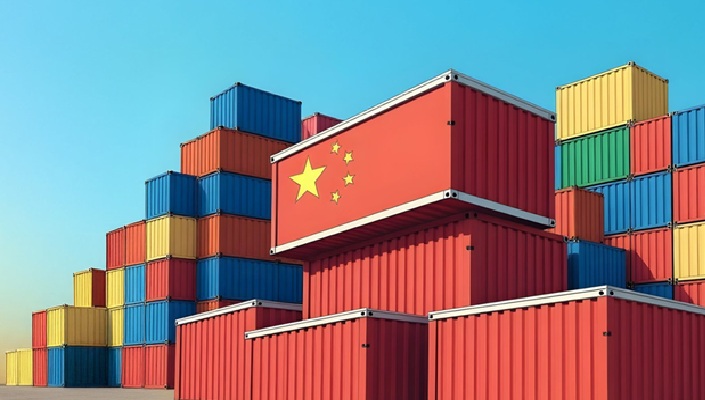
Afrasianet - Beijing portrays itself as a reliable partner and its export-dependent economy limits its ability to make ideal offers for those fleeing the trade war.
British Prime Minister Keir Starmer's visit to China is the latest victory Beijing can boast of in its rivalry with the United States, but the deals he brings to London also show the limits of the "balance" that middle powers may try to make.
This follows a similar visit by his Canadian counterpart, Mark Carney, a few weeks ago, where he concluded a trade agreement and then traveled to Davos to announce a new global trading order, in light of the strained relations between the United States, Canada and Mexico.
European leaders have also visited Davos, as have Indian Prime Minister Narendra Modi and others since Trump took office a year ago, but the tangible long-term economic and security benefits for Western powers remain unclear.
John Quilch, an expert on global strategy at Duke Conshan University, said, "Traditional U.S. allies feel wrong, and are now trying to diversify their options, but they are far from being able or willing to replace the U.S. with China."
From the perspective of London, Ottawa, and other Western capitals, these visits to U.S. President Donald Trump show alternatives if he continues to press on issues ranging from Greenland to the renegotiation of the U.S.-Canada-Mexico Free Trade Agreement.
But these are "superficial gestures in light of stagnant global growth," said Alicia García Herrero, chief economist for Asia and the Pacific at Bank Natics.
"These visits highlight the severe limitations of any 'shift' towards China. "It exposes the fragility of medium-sized countries, which compete for crumbs while the influx of Chinese exports floods their industries."
These visits benefit Beijing, by supporting the narrative of a broad shift toward China as the world's "trusted partner," in stark contrast to Trump's chaotic tariff policies and his growing list of threats and demands on partners and competitors alike.
Trump's efforts to separate the United States from China are also separating the United States from the world.
The deals struck by Western powers during the visits come in exchange for boosting integration with a country that had a trade surplus the size of the Dutch economy last year, but whose consumption is too weak to allow even its domestic producers to thrive.
During his visit to the world's second-largest economy, Starmer secured a 30-day visa waiver for Britons when they travel to China, and a reduction in fees on whiskey, while pharmaceutical company AstraZeneca unveiled a $15 billion investment.
Starmer got nothing but "frank dialogue" about the tension caused by China's increasingly assertive stance on Taiwan, the strengthening of ties with Russia after the invasion of Ukraine, and a crackdown on human rights in Hong Kong, a former British colony.
British and American politicians who have criticized Starmer's visit have also leveled accusations of espionage and human rights abuses, which Beijing denies.
Similarly, Carney left China with expectations that Beijing would cut or eliminate tariffs on canola, lobster, crab and peas, but that sparked threats of a 100 per cent tariff from Trump, who warned Ottawa against allowing Chinese electric cars into North America.
Even before Starmer wrapped up his visit to China, Trump warned Britain of the dangers of entering into trade relations with Beijing, after the prime minister hailed the economic benefits of resetting ties with China.
China's imports last year held steady at $2.6 trillion, but they were largely driven by energy and goods from emerging markets, not from the West.
However, its trade surplus jumped by a fifth to a record $1.2 trillion as Chinese manufacturers responded to Trump's tariffs by expanding into almost all global markets, at the expense of domestic producers.
This rate of growth suggests that China's trade surplus will be roughly the size of the French economy of $3 trillion by 2030 and the German economy of $5 trillion by 2033.
China's exports to the European Union rose 8.4 percent last year, while its imports fell 0.4 percent.
China's exports to Britain increased by 7.8 percent, while its purchases fell by 4.7 percent. With Canada, sales grew by 3.2 percent while purchases fell 10.4 percent.
"This makes significantly increasing trade integration with China risky, especially for countries seeking to protect or develop their manufacturing industries," said Eswar Prasad, former director of the IMF's China portfolio.
Prasad, who now studies trade policy at Cornell University, added: "China is not a safe haven for countries trying to adjust to the negative economic effects of U.S. tariffs."
However, some analysts argue that significant trade gains with China may not be as significant — or even realistic — for countries like Britain or Canada at the moment.
Resetting relations may be the best they can achieve, but it may be valuable, as the previous deterioration in relations has exposed the dependence of vital supply chains on China.
Analysts said the Asian giant's trade countermeasures had contributed to widening trade imbalances between the two countries, rather than narrowing them.
Noah Parkin, an expert on European-Chinese relations at Germany's Marshall Fund and Rhodium Group, described Starmer and Carney's visits as a "propaganda blow to Beijing", while warning that "this is not a shift towards China, but an attempt to reduce tensions with Beijing".
"No country wants to enter into open conflict with the two superpowers at the same time," he told Reuters.
________________
