
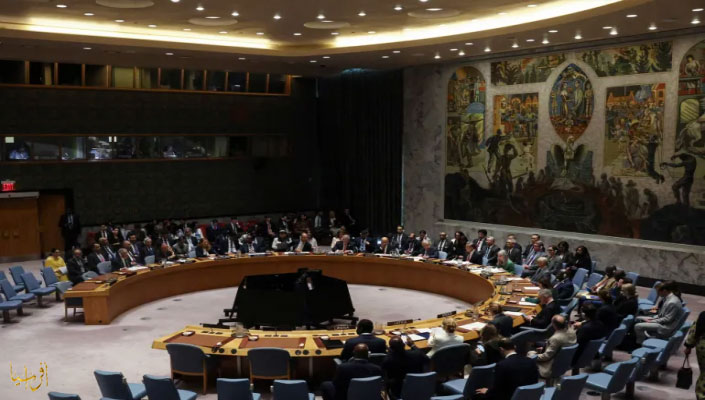
The reason for the weakness of the United Nations is due to the transgression of international law and the dominance of major powers
Afrasianet - Khalid Al Jaber - The United Nations enters its 81st session and is facing one of its most dangerous moments since its founding in 1945. The crisis that surrounds it today is not only about the inability of the Security Council to stop a war, nor about the failure of the Organization to impose a settlement in a particular international crisis, but also about a much deeper question: is international law still able to constrain force, or are we gradually returning to a world in which force determines the meaning and limits of law?
When world leaders, along with government officials, representatives of regional and civil society organizations, civil society organizations, the media, observers, think tanks, and researchers like me, gather in New York in September 2026, they will have not just a busy agenda, but an international map that is almost blazing on its sides, from Ukraine to Gaza, from Yemen to Sudan, to the ongoing war with Iran, as well as the crises of climate, debt, poverty, migration, and artificial intelligence.
But the most dangerous of all these files is the crisis that lurks behind them all: the shake of confidence in the international system itself, in its ability to apply its rules fairly, and in the restraint of force when it transcends the law, not just when it conflicts with the interests of the powerful.
Rules are in place and universal are absent
The problem is not the absence of rules, the UN Charter is still in place, international law has not been abolished, and the principles of respect for the sovereignty of states , non-use of force and the protection of civilians are still clearly written in its texts. The problem is that these rules are applied in a selective manner, condemning war when it is waged by the adversary, and looking for justifications when the ally fights it.
Sovereignty becomes a sacred principle in one case, then a detail that can be overridden in another, and the protection of civilians becomes a moral and legal duty in one war, and then subject to political calculations in another. Herein lies the real crisis: international law has not disappeared, but it is losing its universality, the quality that once gave it its moral power.
"The Security Council still reflects the balance of power that emerged after World War II more than it reflects the world today. The United States, Russia, China, Britain and France retain permanent membership and veto, while the world has changed politically, economically, and demographically drastically in eight decades"
________________
The United Nations was founded after a devastating world war on the simple yet ambitious idea that international security should not be left to the will of the stronger nations alone. The goal was to build a system that would prevent major wars, establish common rules for conflict management, and impose minimum restrictions on the use of force.
Much of the problem is due to the structure of the United Nations itself: the Security Council still reflects the balance of power that emerged after World War II more than it reflects the current world. The United States, Russia, China, Britain, and France retain permanent membership and veto, while the world has changed politically, economically, and demographically drastically in eight decades.
Africa, with its vast continent and growing population and political weight, does not have a single permanent seat, Latin America is completely absent from permanent membership, and the Arab world has no permanent representation. India, which represents a large part of the world's population and is becoming a global economic and political power, is still outside the permanent circle of the Council.
Therefore, the reform of the Security Council is no longer an administrative or technical requirement, but a condition for restoring the legitimacy of the entire international system.
Control of fateful decisions
Expanding the Council alone will not be enough, because the great dilemma is the veto. The veto was originally a political compromise to ensure the survival of the major powers within the international system, but in many cases it has become a tool to disrupt that system. When a permanent member state is a party to a conflict, or a key ally of one of its parties, a veto can cripple the Council's ability to act, and the organ responsible for maintaining international peace and security becomes less able to act at the moments when the world needs it most.
In Ukraine, Gaza, and other international crises, the Security Council has become more of an arena for political conflict between the major powers than an institution capable of imposing a compromise on it. This leads to a fundamental question: What is the value of a system of collective security if the most powerful states within it can disrupt it whenever it conflicts with their interests?
However, it would be a mistake to reduce the United Nations to the Security Council or declare it a total failure, as the Organization has played vital roles in many parts of the world over the past decades. Peacekeeping missions have contributed to the stabilization of ceasefires, UN agencies have saved millions of people from famine, epidemics and displacement, and international mediations have helped contain conflicts that could have escalated into wider wars. In Africa, Asia, and Latin America, the United Nations presence has often been the last barrier between a state and total collapse.
The United Nations appears weak when the major powers are struggling, but it becomes even more important when those powers take a step back and allow international institutions to function. The problem, then, is not the idea of the United Nations, but the lack of political will to implement what it was created for.
"If the United Nations is not reformed, the world will not necessarily replace it with a single new organization, but it may begin to gradually overtake it through parallel institutions, alliances, and blocs, and this is perhaps the greatest danger"
________________
Global South Seeks Alternative
What developing countries in particular should realize is that the world has changed, and the countries of the Global South are no longer just marginal parties waiting for decisions from major capitals. India, Brazil, the Gulf states, and many African and Asian countries have become increasingly economic, investment, and political weight, and the rise of blocs such as the BRICS, the expansion of the G20's role , and the growing importance of regional institutions are all indications that countries are looking for alternative spaces when they feel that existing institutions do not reflect their interests or status.
If the United Nations is not reformed, the world will not necessarily replace it with a single new organization, but it may begin to gradually bypass it through parallel institutions, alliances, and blocs, and that is perhaps the greatest danger.
The collapse of the United Nations will often not occur by the closure of its headquarters in New York or the cessation of the General Assembly, but by its gradual transformation into a symbolic institution, while real decisions move to military alliances, economic blocs, regional arrangements, and bilateral deals. Speeches, resolutions, and summits may remain, while their effective influence on the management of the international system may fade to the point of fading.
United Nations reform is no longer a luxury. First, it is required to expand the Security Council to reflect the new distribution of power in the world, and to give Africa, Asia and Latin America more equitable representation.
But institutional reform alone will not be enough if the political behavior of the major powers does not change, because the deeper problem is not that the international system lacks rules, but that the major powers want rules when they protect their interests and want to be exempt from them when they restrict their movement, and it is this duality that threatens the legitimacy of the system more than anything else.
Developing countries see this clearly: they hear talk of a rules-based international order, but they constantly ask: who sets these rules, who interprets them, and who determines when they are applied and when they are allowed to be bypassed?
"The test it faces today is not whether it can hold meetings and make decisions, but whether it can restore the relationship between force and the law. Eight decades after its founding, the United Nations is at a historic crossroads"
________________
Living under Common Rules
The future of the United Nations goes beyond the future of a particular institution because it is tied to the future of a deeper idea: can the world live under common rules, or is it heading back to a system in which the stronger decide what is legitimate and what is not?
It is more likely that we will not soon witness the birth of a new international organization to replace the United Nations, because the creation of an alternative order requires a consensus among the major powers, and this consensus does not exist today, but on the contrary, the world is living through one of its most divided phases since the end of the Cold War.
That is why the United Nations remains a necessity, even when it suffers from weakness and impotence, but its necessity does not mean that its survival in its current form is guaranteed.
The test it faces today is not whether it can hold meetings and make decisions, but whether it can restore the relationship between force and law. Eight decades after its founding, the United Nations is at a historic crossroads: either its institutions and rules of operation change to reflect the new world, or it remains a dilapidated organization trying to manage a reality that no longer resembles the moment it was born.
The real question is no longer whether the world needs the United Nations, but whether the United Nations can restore its ability to bring force to the law, which is used by the powerful today to justify power.
________________
Khalid Al Jaber - Executive Director of the Middle East Council for International Affairs in Doha, Leading researcher and academic, known for his expertise in international relations, political communication, and the dynamics of the MENA region.
