
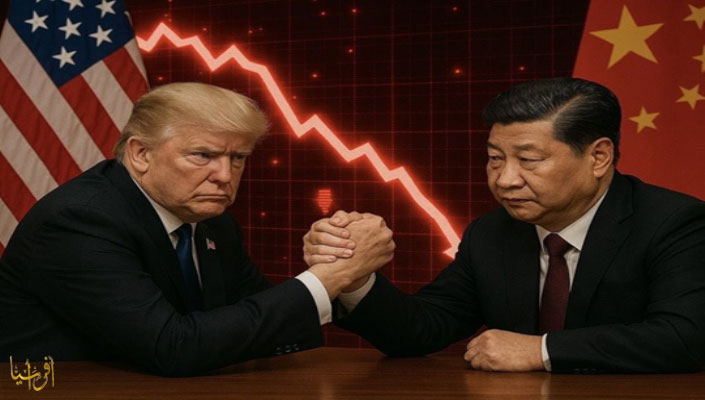
Afrasianet - Behind the scenes of official greetings and mutual smiles between US President Donald Trump and Chinese leader Xi Jinping in Beijing, the most dangerous files between Washington and Beijing remain pending without real solutions.
The summit, ostensibly an attempt to restore stability to the relationship between the world's two greatest powers, hid behind the diplomacy of courtesy a deeper conflict over Taiwan, technological supremacy, global influence, and the future of the international order, issues that neither smiles nor trade deals have been able to dispel.
Despite the positive atmosphere surrounding the visit and the conciliatory language used by both sides, the summit seemed closer to a temporary political truce than a real turning point in U.S.-China relations.
From the outset, it was clear that the summit focused more on managing tension than addressing its deep causes. Both sides declared success in "stabilizing" the bilateral relationship, but the most sensitive issues—from Taiwan to technological and trade rivalry and the reshaping of the international order—remained unresolved.
Orville Schell, one of the most prominent U.S. specialists on China, said in an analysis by Foreign Erez that the most prominent element of the summit was not the agreements as much as the nature of the personal relationship between Trump and Xi.
According to Schell, Trump has been remarkably keen to show respect and admiration for the Chinese president, and has reiterated that he has considered him a "friend" since his first term, and even believes that he is the American president who has known Xi longer than any other president.
This personal dimension was not only a protocol detail, but also part of Trump's philosophy of dealing with China. The US president, despite his sometimes hardline rhetoric toward Beijing, still views international politics with the mentality of "the great leader making a deal with another great leader." Hence the language of mutual courtesy and the keenness to show personal respect between the two men.
Symbolism and Diplomacy
China in turn treated the visit as an opportunity to rebuild some measure of stability with Washington, especially in light of Beijing's recognition of Trump's unconventional nature. Unlike in his first term, when China hardliners dominated his administration, this time Beijing felt that Trump's personality carried a measure of "political ambiguity" that could be exploited.
According to Schell, Trump and Xi are similar on a key point, which is their deep desire to gain personal recognition and respect from the other side, which is what made the summit full of symbolism and a carefully thought-out protocol review.
But behind these compliments, strategic differences have remained the same. At the summit, China put forward the concept of a "constructive relationship based on strategic stability," but this proposal, according to Schell, reflects more of a political ambition than a real shift in the nature of the relationship.
The core issues dividing the two countries have not been resolved, but have been postponed once again. At the forefront of these files is Taiwan, which Schell described as "the destructive issue of all U.S.-China negotiations."
Although Xi Jinping stressed before the summit began the sensitivity of the Taiwan issue for China, warning that its mismanagement could lead to conflict, the issue almost disappeared from public discussions afterwards, in a sign that both sides want to avoid blowing up the dispute during the visit.
Taiwan.. The postponed crisis
Despite its absence from the public scene, Taiwan remained present in the background of all discussions. Two $25 billion U.S. arms packages to Taiwan are currently making their way through Congress, amid questions about whether the Trump administration might make unspoken concessions to China by slowing the implementation of some military commitments.
Schell believes that during the summit, Trump appeared more committed to what is known as "strategic ambiguity" toward Taiwan, an approach based on not fully clarifying the limits of U.S. intervention. He also seemed wary of provoking an internal political battle over the dossier, both with Congress and within the U.S. establishment itself.
China, in contrast, has shown no willingness to make substantial concessions. Xi Jinping, according to Shell, views any flexibility on Taiwan as a sign of weakness, unlike former Chinese leaders such as Mao Zedong and Deng Xiaoping, who were more willing to postpone the file in favor of cooperation with Washington.
The summit revived the old language that has long governed U.S.-China relations, based on major trade deals. The two sides talked about China's purchase of huge quantities of U.S. soybeans, deals for Boeing planes, and the creation of a new trade council.
But these agreements, according to Schell, do not mean that deep economic differences are over. China remains committed to an industrial policy aimed at reducing its dependence on the West, while at the same time making the West more economically dependent on it, giving it strategic leverage.
Washington has also not achieved a real shift in rebalancing the economic relationship or limiting China's technological influence, although Trump has taken prominent figures from the technology and financial sector, such as Nvidia CEO Jensen Huang, in an attempt to demonstrate U.S. technological power to Beijing.
The World of Powerful Leaders
Shell places the summit in a broader global context, represented by the rise of a pattern of leaders with grand nationalist ambitions, such as Vladimir Putin and Kim Jong Un, who seek to reshape their countries' standing and reclaim what they consider "historical greatness."
In the case of China, this ambition, according to Schell, is linked to a deep desire to restore Beijing's historic imperial status, whether through Taiwan, the South China Sea, or global economic influence.
But the main problem, he sees it, is that neither side seems willing to make real concessions, which means that the summit has temporarily reduced tensions, but has not actually come close to resolving the structural causes of the conflict between Washington and Beijing.
Behind the scenes of protocol, smiles, and trade deals, the major issues — from Taiwan to technological dominance and global influence — remained open to a long conflict that the summit did not resolve, and may not have been able to resolve in the first place.
