
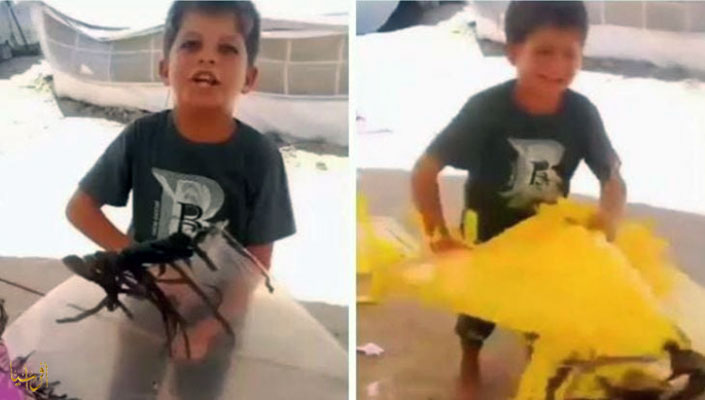
Afrasianet - Maryam Mashtawi - He wasn't carrying a weapon. He was carrying an airplane, a small paper plane, that didn't need a runway, or a control tower, and no one's permission to take off.
A child from Gaza made it, and kids make things they like, with a little paper, a lot of imagination. Maybe he folded it with his little fingers more than once until it straightened its wing.
Maybe he lifted it up in front of his eyes to make sure it looked like the planes he knew. And maybe for a few moments, he forgot that planes in Gaza had another meaning.
But somebody threatened to bomb his plane. And here happened something that a child should never learn: he got angry, he screamed, he cried, and then he grabbed his plane and tore it up with his hands.
He didn't wait for anyone to come and destroy it. He didn't let it go to the sky. He tore it up himself, as if a child of his age had suddenly discovered a harsh rule of survival: If what you love were going to be taken away from you, it might be less painful to kill it with your own hands.
The plane was kite, yes, it was paper, but the scene wasn't, it was painfully real, the child was tearing up the paper violently, and in his little movements he was angry more than his body.
Children in safe cities make kites and then fight over which ones fly farther, run after them in the parks. They throw them off balconies, laugh when they hit the wall, and if a wing breaks, they make another.
This child was not only playing with his plane, he was living with it the complex relationship that war children have with things, they love and fear for them at the same time, and this is perhaps one of the ugliest things that wars do to children, they not only make them fear for their lives, but also make them fear for their toys, their doll, their bed, their school bag, a picture hanging on the wall, on their favorite cup, on a paper plane, as if war, when you enter a house, you don't just ask about big things.
She also searches the small drawers, looking for the simplest thing to give the child a sense that the world is still normal, and then she puts the fear aside. Children don't say, "I'm helpless."
They don't say, "I've lost my sense of security."
Children scream, kick, cry, tear up their planes. We adults have the language to hide our breakdowns in words, and the child only owns his body.
When he can't change the world, he tries to change the only thing he still controls, the plane was in his hands, so he tore it up. And that's where the cruelty of the whole scene lies.
The child has regained control of his toy in the only way he has left. He destroyed it himself, as if he were saying to the one who threatened him: You will not take it from me, I will not leave you the pleasure of destroying it, here I am doing it before you, take your sky and leave me my torn paper, what a defeated little victory!
And what a great defeat in which a child needs to destroy his toy, in order to feel that he still has a decision.
When the sky becomes a place of fear
Moreover, the airplane is not a completely innocent game in the memory of a child from Gaza, a child who is born in a place where planes cross the sky laden with death, does not learn the sky as much as anyone else learns it.
We say to the child: Look at the plane. He raises his head in surprise, there, he may raise his head anxiously, we associate the sky with clouds, travel, airports, holidays. As for the children of war, the sky may become a place to be listened to, is there a sound?
Is it approaching? Will it pass? Will it stop? Even the sky, the only thing that no one is supposed to have, can be taken away from a child. That is why the kite in his hands seemed more painful than just a toy, perhaps he was making, without knowing it, his own version of the sky.
An airplane that doesn't bomb anyone, an airplane that doesn't carry death, a plane piloted by a child, an airplane that flies where it wants, an airplane that only needs a little push of his hand to fly, maybe he wanted to reconcile himself to the shape of the plane, to turn that fear-related object into something that could be grabbed, laughed at, and controlled its course.
Then came the threat, and the plane returned to its old meaning, danger, and tore it apart. In a few seconds, you can see a whole history of war passing through a child's face, we don't always need pictures of collapsed buildings to understand the meaning of destruction, sometimes a paper is enough, a toy is enough, it's enough for a crying child because he had to tear something he loves. Houses can be rebuilt, roads can be paved, broken windows can be replaced.
But what do we do with things that break inside a child and don't show up in the pictures? Who restores his trust in the sky? Who convinces him that the plane can be a flight, not a raid?
That a loud voice can be a celebration rather than an explosion? That when a knock on the door doesn't always carry bad news? That what he likes is not necessarily threatening?
And that he has the right to make something beautiful out of paper and then keep it? Maybe one day this child will grow up, maybe he will forget the shape of the plane he made... He will forget the color of the paper, the number of folds, and the place where he stood, but the body remembers what the memory sometimes forgets.
Deep in it may remain that old feeling, that beautiful things don't last, that what we love may be taken away from us suddenly, that we have to precede the loss before it precedes us, and this is one of the silent crimes of war, it doesn't just kill the present, it creeps into the future.
You travel with the child to the man he will become, you sit in his memory, in his fear, in his relationship with safety, in his way of attaching to things and people, the moment he hears the sound of an airplane twenty years later, and he doesn't know why his heart contracts, I watched the child tear up his plane, and I thought that the world would go on as usual, the airports would open their doors, thousands of planes would take off, other children would sit by the windows watching the clouds from above, asking for juice, fighting over the seat overlooking the sky, and in another place, a child had tore up his plane because he was afraid of being bombed.
What is this enormous distance between two children living on the same planet? A child asks: Where are we going to travel this summer? And a child who just wants to let his kite stay, maybe years later no one will remember the name of this plane, the paper is light, the news is plentiful, and the tragedies of Gaza are scrambling on the screens until the tragedy has to be more horrible than the previous one in order for us to stop in front of him, but I want to remember it, I want to remember a child who stood angry in front of the world, and instead of launching his plane into the air, tore its wings apart.
Because some scenes of war don't need blood to be bloody. It's enough to see a child learning, very early, to protect what he likes by destroying it. It's enough to see a paper plane that doesn't reach the sky, to understand how far the sky can be from a child.
He tore up his plane. But what was torn in front of us was not just paper. It was that small, intuitive part of childhood that is supposed to tell a person in the early days of life: Do what you want, play, dream, and be afraid. In Gaza, even this simple sentence sometimes seems like a dream that needs a miracle to fly.
________________
Maryam Mashtawi - Lebanese Writer
________________
