
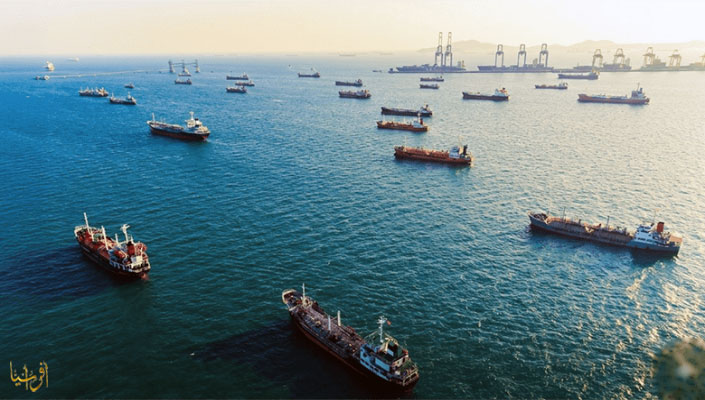
Afrasianet - The "New York Times" published an article by Rosemary Kilanick, director of the Middle East program at Defense Priorities, in which she said that the Strait of Hormuz must be reopened, even if it means Iran imposing tolls on traffic through it.
At a time when President Donald Trump is not threatening to turn the Strait of Hormuz into U.S. territory, his administration is demanding that the strait return to a free international corridor for global oil supplies. The president must face reality: Neither of these things will come true.
The scenario represents a defeat for the United States, but it remains the least bad option under the current circumstances.
"The war with Iran has exposed two realities: Iran cannot completely close the Strait of Hormuz, and the United States cannot open it completely"
________________
Despite months of U.S. bombardment and missiles, Tehran has proven capable of disrupting oil tankers in the strait, through which a fifth of the world's oil supply passed before Trump launched an attack on Iran in February.
The Strait of Hormuz is a narrow and perilous sea lane, stretching for 90 miles and taking the shape of a horseshoe, giving its borders, Iran to the north and Oman to the south, the potential to disrupt navigation, Kilanik said.
The strait's rugged coastline provides an ideal haven for Iranian precision-guided missiles, drones, and attack boats to threaten ships through "hit and flight" tactics, tactics that are impossible to decisively eradicate.
Iran can produce these weapons at a low cost and in unlimited quantities, making Iranian attacks a constant threat to the transit through Hormuz, a risk that even negotiating agreements with Tehran will not remove.
Shipping companies have been reluctant to risk their crews and cargo under suboptimal security conditions, allowing Iran to restrict traffic without having to attack every vessel trying to cross, it said.
Even with U.S. military aid that has depleted ammunition stockpiles and strained naval forces, only about five million barrels of oil per day have crossed the strait without Iran's explicit consent, compared with about 20 million barrels per day before the war began.
In the long term, U.S.-led operations to smuggle oil through Hormuz would carry the risk of U.S. casualties and would be a financial burden on U.S. taxpayers.
It is logical for the American public to be skeptical of the costs of ensuring freedom of passage for countries that are unwilling to help secure the strait, when those countries can cover the costs themselves through transit fees.
Financially, transit fees are a better option for the United States and the world than in the case of an extended partial closure of the strait.
Although the recent resilience of global oil markets has surprised many, the daily supply deficit, which reached 14 million barrels at the height of the war, has led to a significant depletion of global stocks of crude oil and its derivatives, gradually depleting the protective reserves that have prevented oil prices from rising only slightly compared to pre-war levels.
If the current tension over the Strait of Hormuz leads to a sharp jump in oil prices, the economic damage could be severe, especially for the United States, whose economy is far more heavily dependent on oil than other great-power economies such as Russia and China.
Although imposing transit tolls in the Strait of Hormuz may be embarrassing for the United States and for Trump personally, turning safe passage into a source of revenue would encourage Iran to allow as many ships as possible to pass through to maximize its toll collection.
Moreover, if Iran becomes dependent on revenues from managing the strait, it will become more difficult to close it in the future for political reasons.
Iran is already in talks with Oman on the future of the strait, as joint management of the waterway could boost regional cooperation and motivate Iran to show some responsibility by softening its rhetoric and behavior.
This could eventually pave the way for Iran's return to the international community, giving it recognition that would make it easier for it to abandon its nuclear program, which is currently an alternative source of prestige.
Tariffs would benefit Iran financially, but even high estimates of those revenues would not compensate for the $270 billion in war losses
"Imposing tariffs would benefit Iran financially, but even high estimates of those revenues would not compensate for the $270 billion in war losses"
________________
If Iran raises between $6 billion and $14 billion a year in transit fees, according to some estimates, it could take nearly 20 years to offset the costs of the war.
During this period, market changes will lead to a decline in the importance of the Strait of Hormuz, with exporters in the region constructing alternative pipelines and oil demand declining as a result of the shift to electric vehicles.
It is also true that allowing Iran to control the Strait of Hormuz may set a bad precedent that encourages other countries that overlook strategic and sensitive shipping lanes to seek control of it, but what happens in Hormuz will often remain confined to it, given its unique geographical characteristics and market importance for transporting the Persian Gulf's oil that is unmatched by any other waterway.
The Houthis in Yemen cannot realistically emulate Iran's maneuver in Hormuz because they control only a fraction of the Red Sea coast, and their capabilities in the areas of missiles, drones, and targeting systems are far less than their Iranian counterparts.
Although the Houthis' campaign against Red Sea navigation between 2023 and 2025 led to a decline in the number of cruises, large quantities of cargo continued to cross the corridor, and most Houthi attacks caused little or no damage.
It also provided shipping companies with a viable alternative of changing the route through Cape of Good Hope, adding marginal fuel costs of almost $1 million per vessel.
According to leading sociologists, all forms of taxation are intrinsically similar to "coercive protection" (or extortion for protection) practices; history shows that those who are able to provide security or threaten consequences in a geographic area often exercise their political power and collect taxes in that area. Iran has shown that it already has significant control over the Strait of Hormuz.
While this is not ideal for the United States, it is in the best interest of consumers, the global economy, and regional stability to accept this new reality as soon as possible.
The consequences of Iran's enduring dominance over the Strait of Hormuz may dissuade future U.S. presidents, or Trump, from waging risky and unnecessary wars.
________________
