
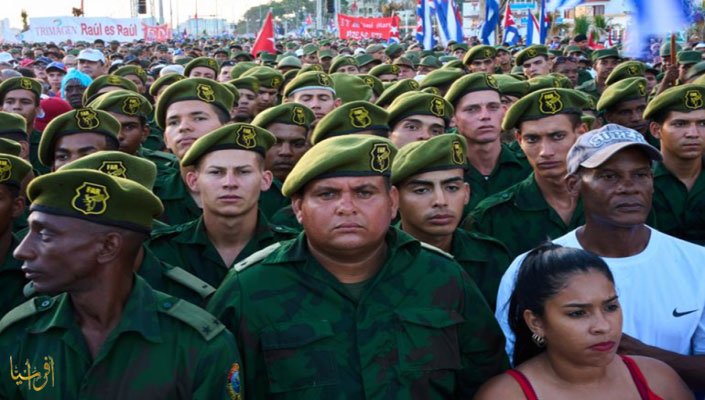
Afrasianet - Mahmoud Lafi - Amid the drumbeats of war that the United States has been expressing its desire to beat recently, and a suffocating oil embargo that has reached its limits, Cuba is living in a way that continues to declare defiance and resist any possible war under the slogan of "homeland or death".
In the latest official U.S. statement on Thursday, Secretary of State Marco Rubio stressed that the prospect of reaching a negotiated agreement with Cuba is "not great at the moment," stressing that his country will continue to put pressure on the communist government in Havana, and that other options are available to President Donald Trump.
Trump, who has repeatedly threatened the island with military options, on Wednesday threatened to "liberate Cuba" and called it a "rogue state," as his country filed a criminal indictment against former Cuban President Raul Castro, the younger brother of Fidel Castro , who led Cuba's communist revolution in 1996, in a move that angered Havana and sparked controversy over its timing and significance.
It also coincides with the move of the US aircraft carrier USS Nimitz to Caribbean waters, amid sharp criticism from China and Russia of the atmosphere of escalation.
Cuban President Miguel Díaz-Canel warned on Monday that any U.S. military action against his country would lead to a "massacre," which would have countless consequences for peace and stability in the region.
But if war becomes a fait accompli, what cards does Cuba threaten to use as part of the "asymmetric deterrence" gamble against the United States?
What does America want?
Since the Cuban Socialist Revolution in 1961, the United States has sought regime change in Havana through a series of restrictive measures and punishments, but the regime has recently found itself trapped alone, especially after the arrest of Venezuelan President Nicolás Maduro , who supplied Cuba with a third of its oil needs.
Oil supplies to Cuba were cut off at the end of January after the US military operation in Venezuela and Trump's threat to impose tariffs on countries that export crude oil to Cuba, and this threat succeeded in intimidating countries such as Mexico, which stopped sending oil shipments after supplying the island with 44% of its oil needs.
Washington blames the Cuban government's economic situation on the island, which has led to power cuts for up to 22 hours and worsened the country's worst crisis in decades, claiming it has a monopoly on the country's resources, while the U.S. president is demanding that it take the initiative to reach an agreement with his country.
Cuban Deterrence Cards
Despite suffering greatly from the repercussions of the suffocating US embargo, which sometimes has a disastrous impact on all aspects of life, analysts conclude that Cuba is not completely incapable of defending itself, pointing to its reliance on strategic cards that make it more resilient.
1- The doctrine of "people's war": turning every citizen into a soldier
Havana is based on a military strategy known as the "People's War," which is to turn every Cuban citizen into a soldier, which it adopted after the fall of the Soviet Union, and is based on resisting foreign invasion by mobilizing the entire civilian population to engage in guerrilla warfare, similar to the Vietnam War.
As part of its preparation for this strategy, Cuban state media published photos of civilians receiving military training as part of a "people's war" scenario, according to CNN, in which everyone in Cuba is being trained militarily and integrated into the national defense system.
Last Friday, Cuba's Civil Defense released a "family guide" that provides "practical" information on "protecting lives in the face of possible attacks from the enemy," according to government websites.
Despite its lack of modern weapons, military experts estimate that the Cuban military is still able to put up a "fierce resistance" against any U.S. ground attack.
CNN quoted military expert Hal Kleepak as saying, "They (Cubans) have proven, as we have seen time and time again in natural disasters, their ability to mobilize and get the population out."
Geography : Cuba's proximity to America
Analysts point to another pivotal variable in Cuba's deterrence equation: geography and the United States' neighbor, just 144 kilometers from its coast, that would enable Havana to reach American cities and harm its residents.
Carlos Malamud, an Argentine Latin American analyst at Spain's Royal Elcano Institute, says Cuba's proximity to the United States means it is able to respond much more than any threat America has faced in the past, whether in Venezuela or Iran.
Malamud notes that any attack on Cuba could lead to the Cuban response reaching U.S. cities, adding that "the ability to inflict casualties on the civilian population, and in cities like Miami, for example, will be higher."
Sebastian Arcos, director of Cuban-American studies at Florida International University's Institute of Cuban Studies, agrees with the earlier view, noting that Cuba may attack U.S. civic centers in an attempt to turn American public opinion against the Trump administration.
3 – The Social Nuclear Button: Blowing Up the Migration Bomb
Perhaps one of the important cards that constitutes an American security and political nightmare, and on which the besieged country relies at the time of the clash occurs, is the opening of beaches to the masses of those wishing to emigrate to the United States, which will lead to confusion inside the United States.
Helen Yaffe, professor of Latin American political economy at the University of Glasgow, describes the wave of immigration to the United States as a result of any attack on the island as "one of the most significant repercussions."
"Any attack on Cuba would lead to an immediate and uncontrollable mass exodus, mainly by sea," it adds.
Yaffe concludes that this outcome alone should make Washington stop, especially as the November midterm elections approach, especially "for a president who bases his political identity on anti-immigration."
4 – Strong allies "Russia and China"
One of Havana's strengths in strengthening its resilience to U.S. power is its reliance on U.S. adversaries, China and Russia.
Axios published a report last week based on classified intelligence that Cuba had acquired more than 300 military drones and discussed plans to use them to attack the U.S. naval base at Guantanamo Bay, along with U.S. military ships in Key West , Florida, without specifying the supplier.
However, a senior U.S. official told the website that Cuban officials have sought more drones and military equipment from Russia over the past month.
He noted that Russia and China have sophisticated espionage facilities in Cuba to monitor and analyze electronic signals and communications, with the aim of obtaining intelligence.
On the recent U.S. action of criminal charges against former Cuban President Castro, Beijing declared that it "strongly supports Cuba."
In Moscow, Kremlin spokesman Dmitry Peskov said: "We believe that under no circumstances should such methods of violence be used against former or current heads of state."
The rigidity of faith and the fragility of living
The paradox, on the other hand, lies in the deep gap between the tools of military resilience and Havana's experience of fighting long and costly wars of attrition for the United States, and the bitter reality on the ground, as a result of the unprecedented U.S. blockade, which raises doubts about the fate of any military confrontation.
Cuban Energy and Mines Minister Vicente de la Levy says his country no longer has any stockpiles of crude oil or fuel, as a result of the U.S. oil embargo.
He warns that stockpiles of crude oil, gasoline and diesel have been completely depleted, noting that the country currently relies only on locally produced natural gas, and that the energy crisis has led to power cuts in some areas of the capital Havana that reached 22 hours a day.
According to observers, Cuba is following a path previously followed by the United States in several countries, including Iraq, which faced a 13-year blockade that deprived Iraqis of food and medicine supplies, and ended with the invasion of the country in 2003, which caused the deaths of 1.5 million Iraqis, according to some estimates.
