
Afrasianet - Fahim Al Sourani - Russian President Vladimir Putin has told his US counterpart Donald Trump that Moscow will review its position in peace negotiations, after Russia announced a Ukrainian drone attack on the Russian president's residence in the Novgorod province in the northwestern part of Russia, according to a Kremlin statement.
Russian Foreign Minister Sergei Lavrov also confirmed that Ukraine tried to attack Putin's residence, saying that Moscow would change its position on negotiations aimed at ending the war in Kyiv, and that "these reckless actions will not go unanswered."
He explained that Moscow "does not intend to withdraw from the negotiations following the attack of Ukrainian forces on Putin's residence," but will take into account the final transformation of the Kyiv regime into a policy of state terrorism.
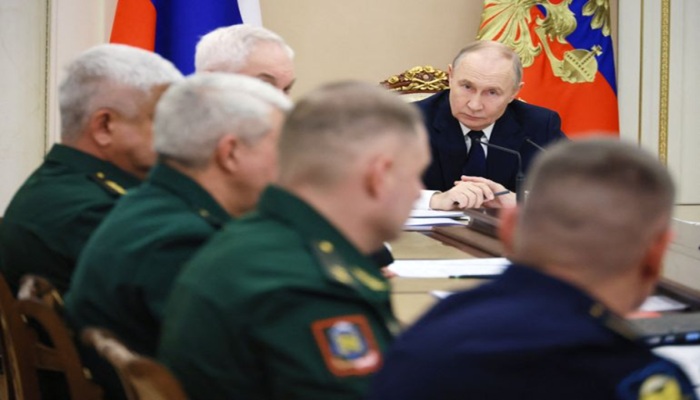
This comes at a time when Putin has threatened that if the Ukrainian authorities are not ready to "end things peacefully", Russia will take over the tasks of ending the war by force. Speaking at a meeting with senior Russian military commanders, he said Moscow's interest in the voluntary withdrawal of Ukrainian forces from some areas is waning due to the rapid advance of the Russian armed forces.
Russia's statements of readiness for further escalation and non-cessation of hostilities until the West begins to take into account Moscow's interests and stop supporting Kyiv indicate a shift from discussions of consensual "peace plans" (such as US President Donald Trump's) to a strategy of resolving the conflict by force and preparing for a long-term confrontation to achieve a complete military victory.
According to Russian observers, these statements reflect a sharp hardening of the Kremlin's position in light of the new military and political developments, which may push for a prolongation of the war with Ukraine.
According to security expert Vladimir Kuznetsov, the attempt to target Putin's headquarters in Novgorod was a Ukrainian response to the results of the meeting between Trump and his counterpart Volodymyr Zelensky in Florida, which ended without any tangible progress, and that Kyiv is continuing to fight and will not give up easily, as he described it.
Kuznetsov told Al Jazeera Net that Putin's statements confirm a remarkable hardening of the stance towards a peaceful settlement and readiness for a larger escalation, which was clearly reflected in his instructions regarding the continuation of full control over Donetsk , Lugansk, Kherson and Zaporizhzhia and the expansion of the "buffer zone" along Ukraine's northern border.
Accordingly, the spokesman asserts that Putin has sent clear messages that Moscow is more than ever ready to abandon diplomacy and shift towards a force scenario, as long as Zelensky does not agree to peace on Russian terms, including ceding the areas it has controlled and withdrawing from NATO.
According to Kuznetsov, the conflict between Ukraine's aspirations for Euro-Atlantic integration and Russia's interests in maintaining its influence in the region will continue as long as a "historic solution to the Donbas dilemma" is not found and its entire territory handed over to Russia, as one of the most prominent conditions of the ceasefire.
He adds that the rapid advance of Russian forces on this axis in recent weeks will push Ukrainian forces to withdraw voluntarily, if Volodymyr Zelensky does not order them to stay under all circumstances, which means pushing them to commit suicide, as he put it.
For his part, international conflict researcher Fyodor Kuzmin asserts that the "Kyiv regime's" attempt to target Putin's headquarters gave the Kremlin the opportunity to review the terms of negotiations and increase the pace of intensified attacks against Ukraine.
In fact, he says, Russian forces have received direct and explicit orders to continue the offensive and "expand the security zone" along the border with Ukraine to ensure full control of the four regions (Donetsk, Lugansk, Zaporizhzhia and Kherson).
According to Kuzmin, Putin's words are also an indirect response to the 20-point U.S. peace plan , which was presented during Trump's talks with Zelensky, and a warning that Russia will achieve its military goals by force if Kyiv does not accept Moscow's conditions.
He continues that the scenarios for resolving the Russia-Ukraine conflict have entered the tunnel of uncertainty, and that reaching a negotiated ceasefire agreement has become less likely, and the hypothesis of entering into a long-term war of attrition , in which the two countries waste their resources without achieving a decisive breakthrough, has revived.
Kuzmin considers that what he describes as the recent Ukrainian provocation comes in the context of the disruption of the settlement process, due to the state of concern in Kyiv andBrussels about the achievement of a Russian-American agreement in which the Europeans have no role, as well as concerns about the "parallel negotiations" that are taking place between Putin and Trump's envoys, in which the European Union and Ukraine see an attempt to bypass them.
The spokesman ruled out a diplomatic breach in the wall of contradictions between Russia and Ukraine in the foreseeable future, due to the great divergence in positions and the stalled in negotiations, especially on the files of Ukrainian territory, of which Russia controls 20%, and Kyiv's insistence on NATO membership, in exchange for Russia's demands for neutrality.
He concludes that Russia's diplomatic means in the next phase will focus on creating a division among Ukraine's Western allies to reduce the pace of Western military aid and maintain a field superiority on the battlefronts.
