
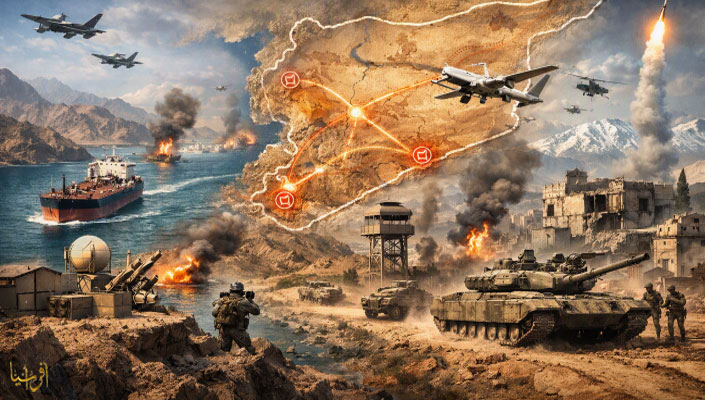
The geopolitics of West Asia is a decisive factor in the power struggle, and the attack on Abu al-Duhur reflects Israel's attempt to prevent the expansion of Turkish and Iranian influence in the region.
Afrasianet - Ahmed Al Darzi - At dawn on August 18, 2026, the eight Israeli airstrikes on the Abu al-Duhur military airport in rural Idlib were not just a passing link in a long series of attacks on Syrian sovereignty.
They were, in essence, a geographical message par excellence, carrying more destruction than missiles. Israel, whose Prime Minister Benjamin Netanyahu acknowledged that the strike was due to what he described as "an imminent deployment of Turkish forces at the facility near Aleppo," was drawing a line Red on the map of West Asia: The Anatolian Plateau does not go beyond the Levant Gate.
This event was not isolated from the ongoing war in the Gulf and the Strait of Hormuz. Rather, it was a direct aftermath of the "Al-Aqsa Flood" earthquake on October 7, 2023, which reshaped the map of the conflict in what many consider the "center of the world": West Asia.
The ongoing war in its various forms has multiple facets and motives, with its political, ideological, human rights and social dimensions. The conflict of strategic minds in the region has taken into its depth.
But this alone is not enough to explain the trajectories of war: a deeper depth that has contributed to the formulation of these minds: the patterns of geopolitics that play an essential role in charting the trajectories of conflict, as Charles de Gaulle said: "If you want to understand politics, you have to spread out the map, and you know that history is a shadow of geography."
From Mackinder to Kaplan: The Geopolitical Legacy of West Asia
To understand the geopolitical message behind the Abul Duhur strike, it is necessary to return to the theoretical foundations that shaped Western strategic thinking toward this region. In 1904, the British geographer Halford Mackinder stood before the Royal Geographical Society in London to lay out his famous theory of the "heart of the earth."
The essence of his vision was that the Eurasian mass represented a solid, resource-rich continental "heart" that was invincible from the sea. Hence his immortal saying: "He who controls the heart of the earth controls the island of the world, and he who controls the island of the world controls the whole world."
This theory was not just academic reflection. Over time, it has become a strategic doctrine for senior decision-makers. In the Cold War, Washington was inspired by Mackinder's idea to encircle the Soviet Union through alliances such as NATO.
What is happening today in West Asia is an extension of this vision: the struggle for the "heart of the world" is not over, but has moved to its southern extremes, where land powers (Iran, Turkey, China, and Russia) meet naval powers (the United States and Israel).
A century after Mackinder, Robert Kaplan came to assert that geography is not dead, but is returning to take revenge on those who ignored it. In his book The Revenge of Geography (2012), Kaplan rejects the idea of the "flat world" promoted by Thomas Friedman, and asserts that geography remains key to understanding the world's conflicts.
He does not see mountains, deserts, and rivers as mere silent features, but rather as "actors that contribute to the formation of foreign policy, trade routes and war routes throughout history."
In his analysis of the "Greater Middle East," Kaplan pays particular attention to Iran. In his view, the Iranian plateau is "the most pivotal in the greater Middle East, not just a terrain, but a deep structure that gives Iran its resilience and maneuverability."
The mountains that surround it and the deserts that stretch deep into it are not only natural obstacles, but "elements of the survival strategy. It is a geography that produces politics, and gives it its limits and potential."
This analysis explains why Iran has been able to withstand the most violent military campaign since World War II, and why the U.S. "checkmate" strategy that bet on a quick decision has failed.
While Kaplan presents a realistic Western vision, the Egyptian thinker Gamal Hamdan presents a different vision, both civilized and humanistic, that sees geography as a factor of renaissance and a national figure.
In his encyclopedic book The Character of Egypt: A Study in the Genius of Place (1967), Hamdan bases his vision on what he calls the "genius of place," i.e., the unique geographical characteristics that distinguish Egypt from other countries.
He argues that Egypt is not just a geographical homeland or a political entity, but a unique "personality" that has crystallized over thousands of years of continuous interaction between man, place, and history. If Kaplan says that "maps determine the fate of countries," Hamdan adds a deeper dimension: "The genius of a place makes history if you understand it deeply."
Al-Sham Theater: The Fractured Heart of Geography
What unites these visions is the realization that West Asia is not just a transient region, but the theater of the Levant – the space that gives any rising imperial power its true value. It is a predominantly plain theater, with its plateau terraces rushing into the plains from the Anatolian Plateau and the Iranian plateau. Behind it are the larger actors: China and Russia to the east, and the United States overseas with its Israeli base.
It is this theater that explains why Turkey, with its harsh Anatolian plateau, fears any vacuum in Syria, because its return to the theater of history can only take place through the Levant.
It explains why Iran seeks to secure a security belt that stretches from the Gulf to the Mediterranean. It explains why Egypt – with its Nile Valley and its spatial genius – stands ready to regain its regional role. Each of these three powers is aware, with its geopolitical awareness, that its fate is tied to this theater, and that any retreat In it, it means a decline in its existence as an imperial power.
Israel: The Disruptive Virus of the Naval Forces
In this context, Abu al-Duhur's strike reflects Israel's deeper role in the conflict equation. Israel, which has taken control of the United States — the maritime superpower - as a "disruptive virus" - is only a new face of the naval powers that have taken turns dominating since Magellan's voyages and the discovery of the Cape of Good Hope: from the Dutch to the Spanish to the French to the British, and finally the Americans.
This role has made Israel a "disruptive virus" — not in the sense of a parasitic parasite, but in the sense of an entity that harnesses the body of its host (the United States) to serve its expansionist goals, while in return providing it with an advanced base in the heart of the region.
The relationship between Washington and Tel Aviv is not a peer relationship, but a harnessing relationship, in which Israel controls U.S. policy toward the region through networks of influence that stretch from Congress to the White House.
This is why the war on Iran, while not serving direct U.S. interests, has become a reality, because it serves the "Greater Israel" project, which sees any rising regional power as an existential threat.
Israel sees itself as more deserving of leading and dominating the world than the eroded powers, and it is the rightful heir to the former powers. Any Turkish military posture in Syria, from its perspective, is a red line that should not be crossed.
Conclusion: Geography takes revenge
What we are witnessing today in Western Asia – from Hormuz to Abu Duhur – is a living embodiment of what might be called the "clash of geography." Geography is not just the backdrop of events, it is its first and deepest driver. As de Gaulle said, history is a shadow of geography.
The Iranian plateau is holding out, the Anatolian Plateau is trying to make a comeback, naval forces are eroding, and the disruptive virus is trying to survive.
In the midst of this clash, the Levant remains the theater on which the fates of empires are decided. Whoever controls this theater controls the heart of the world, and whoever controls The heart of the world is dominated by the fate of history, and the latest attack is nothing but a preemptive confirmation to prevent the filling of a vacuum that may occur with the American inability to resolve the impact of the geography of Hormuz.
The question that remains: Do the authentic powers of West Asia realize culturally and historically that geography is not only an arena of conflict, but also a framework for cooperation and testing it by getting rid of the disruptive virus?
Or will it continue to clash until it realizes, belated, as usual, that geography is not only taking revenge, but is turning into a theater, a cosmic Colosseum, where conflict is simultaneously presented, managed, and consumed?.
________________
