
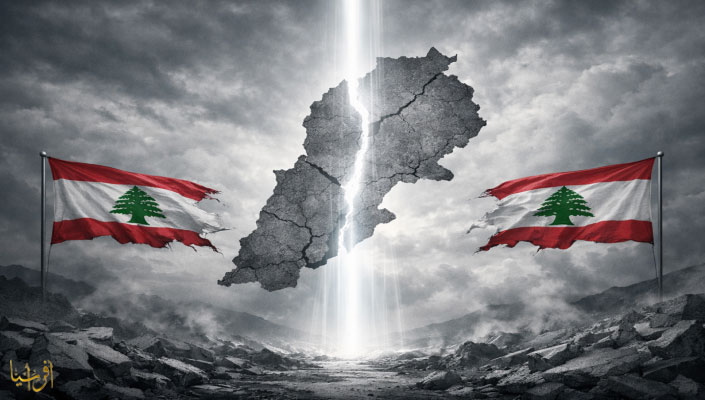
The homeland is not just a recognized border, nor a science or institutions. The homeland is the ability of a society to defend its conditions of survival, to determine the shape of its economy, to protect its memory, and to refuse to turn its pain into an opportunity for others.
Afrasianet - Zainab Barjawi - The most dangerous thing about the Framework Agreement is not that it imposes security obligations on Lebanon, nor does it open the door to new political arrangements with Israel, but rather that it carries with it a project to redefine Lebanon itself: who is the enemy, what is the function of the state, who has the right to power, what is the position of the south, what is the fate of the resistance, and what kind of economy is to be built after the war and collapse.
In this sense, the agreement should not be read as a separate text from society. Great documents do not work in a vacuum, they do not remain ink on paper. They rearrange institutions, redistribute power, produce a new language of legitimacy, and create winners and losers. What appears to be a "security settlement" may, over time, turn into a complete program of re-engineering the state, society, economy, and consciousness.
The question, then, is not only: What did the PA do? Bill: Which Lebanon do you want to produce through this signing?
The economic model that had ruled Lebanon for decades has collapsed. The banking and rentier model, which lived on the flow of capital, real estate, services, remittances, and public debt, is no longer able to reproduce itself in its old form. Banks have lost legitimacy, the state has gone bankrupt, the middle classes have eroded, immigration has expanded, and the elite that managed the collapse has been looking for a new formula to protect its privileges.
In such moments, external compromises are not separate from internal reconstruction. When the regime fails to produce wealth, it resorts to creating a new job for the country. When the old model is delegitimized, the search for another model that ensures the continuity of the same groups begins, albeit under different slogans. "Peace," "stability," "reconstruction," and "regional integration" become economic terms as much as they are political.
According to this logic, what is needed is not just an end to the war.
What is required is the reintegration of Lebanon into a new regional system, in which external capital, aid, investments, and reconstruction become tools for reshaping the country. This integration cannot take place without redefining the sources of danger internally. Capital enters not only a militarily stable territory, but also into a society devoid of the ability to intervene, and to a state that places its security function at the service of protecting the new economic order.
Here, the targeting of the resistance becomes bigger than the issue of weapons. The resistance is not a military group suspended outside society, but rather the product of a long social history: marginalized areas, villages that have lived through the occupation, groups that have been deprived of the state, networks of solidarity, a memory of blood and displacement, a political culture that has been formed outside the official narrative of the Lebanese regime.
Therefore, dismantling the resistance is not limited to collecting weapons. It needs to dismantle the environment it produced, redefine its history, distort its symbols, criminalize its language, rewrite its relationship with the state, and transform its existence from an expression of confronting the occupation into an "internal problem" that needs to be addressed by security and administration.
This is the fundamental shift: from resistance as a result of occupation and aggression, to resistance as the cause of the crisis, from a social environment that resisted because the state was absent, to an environment that is accused of preventing the state from existing, from a society that has paid the price of liberation and defense, to a society that is required to prove its loyalty to the state by abandoning the tools of power before the conditions of danger change.
This process is not just linguistic. When the language changes, the institutions change. If the resistance becomes an "insurgency," the army becomes a tool to control it. If the south becomes a "security burden," the displacement of its people becomes manageable. If stability becomes contingent on disarmament, aid becomes a means of extortion. If economic integration became a priority, any social or political resistance became an obstacle to investment.
At this point, the state becomes something else. It is no longer an apparatus to protect society from the outside, but gradually becomes an apparatus for rearranging society from within according to the externalities. Its task becomes to control the opposing groups, adapt the regions, protect the funding routes, and manage the transformations that allow the elite to reproduce itself.
Thus, the state is no longer a "master" simply because it has a monopoly on power. A monopoly of power, if used to protect an externally imposed order, is not a sovereignty but a function. A state may be strong against its citizens, weak against those who occupy its territory. It may be able to dismantle internal networks, but it is unable to force withdrawal. It may raise the banner of the law, while rewriting the law itself to suit the new subordination.
Therefore, the real question is not whether the state will restore the monopoly on arms, but in the service of whom will it use this monopoly? Is it to protect the earth? Or to ensure the stability of a regional project where there is no place for resistance? Is it to unite the community? Or to rearrange the balance in favor of an elite that wants to usher in a new era of dependency?
The history of the region teaches us that the grand agreements with Israel were never just the end of a war. They were always the beginning of broader transformations: a change in the economy, a change in the functioning of the state, the rise of new elites, the decline of popular sectors, and a coup in the political language. The "enemy" gradually becomes a "partner," dissent becomes "extremism," the market becomes a substitute for politics, consumption a substitute for emancipation, and stability a substitute for justice.
In this context, society is not only required to accept an agreement, but to learn a new way of looking at itself. To consider that sacrifice was a mistake, that resistance was a burden, that sovereignty is to receive aid, that patriotism is obedience, and that the future begins when the past is buried.
It is a process of complete political re-education. It starts with a change of vocabulary, and then moves on to curricula, media, institutions, and general culture. History is re-presented as a series of uncalculated adventures. The resistance is separated from the land that gave birth to it. The villages that have survived are transformed into areas that need to be "rehabilitated." The elite that brought the country to collapse is presented as the only realistic project.
But realism that doesn't ask who pays the price is not realistic. What is meant to be presented as a transition to stability may be a transition to a new kind of control. Aid will not be unconditional, reconstruction will not be charity, investments will not come to free the economy from dependence, but may be reproduced with more rigid tools.
Money will go into selected areas, projects will be linked to security, property will be redistributed, and it may open the way for external capital in land, energy, ports, telecommunications, and real estate. In a weak state and an exhausted society, devastation becomes an opportunity to change the social map itself.
This is what makes the battle for the resistance part of a broader battle against those who own Lebanon. It is not only a matter of those who want to disarm a military force, but also those who want to remove everything that hinders the transformation of the country into a compliant economic and security space. The resistance, in this sense, is not only targeted because it is fighting Israel, but also because it represents a frontier to full domination: Social, cultural, political, and symbolic boundaries.
This does not mean that everything that surrounds resistance is outside of criticism, nor that every social structure associated with it is perfect or complete. But there is a fundamental difference between criticism from within the project of liberation and the dismantling that serves the project of control.
What is required today is to pay attention to the fact that the conflict is not only over an item, a weapon, or an area. Dispute over the meaning of the state. Is the state a tool for the liberation of society, or a tool for reintroducing it into subordination? Do you rebuild the economy on production and justice, or on conditional aid and privatization? Do you protect the areas that have paid the price, or do you consider them a burden that needs to be controlled? Does it regain sovereignty from the outside, or impose its authority on the inside?
The most dangerous thing that can happen is that the new project succeeds in portraying itself as irreplaceable. To tell people that the time of resistance is over, that the market is the future, that only the outside has the keys to reconstruction, and that the very elite that made the collapse will lead the salvation. Then the agreement will not only change politics, but it will have confiscated the national imagination itself.
The homeland is not just a recognized border, nor a science or institutions. The homeland is the ability of society to defend the conditions of its survival, to determine the shape of its economy, to protect its memory, and to refuse to turn its pain into an opportunity for others. Hence, the defense of resistance is inseparable from defending the independence of society, and its right not to be reshaped according to the interests of external capital and the subordinate elite.
The battle, after all, is not over a missile, an item or a ministry. The battle for Lebanon that will emerge from this war: Will it be a country devoid of memory, governed by fear and need, run by an elite that associates its existence with the satisfaction of the outside? Or is it a country that rebuilds its state and economy on the basis of both social and national sovereignty?
The "Framework Agreement" is not just a piece of paper. It is a historic possibility for the production of a new Lebanon. The danger is not only that this Lebanon will be weak to Israel, but that it will become organized to serve it: in its economy, in its security, in its consciousness, in its definition of who is the enemy and who is a good citizen.
Therefore, resistance to the agreement is not only by rejecting its provisions, but also by rejecting the society it wants to create: a society without memory, a state without independence, an economy without justice, and a patriotism without resistance. When the resistance is defeated socially and culturally, Lebanon is left with nothing but the name of a state that performs a function that does not resemble its own people.
________________
Zainab Barjawi - Lebanese Journalist
________________
