
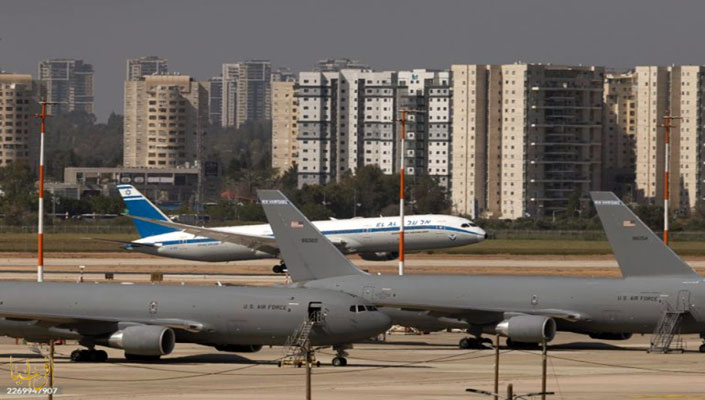
Afrasianet - Mohamed Al Zaaneen - In an unusual scene that embodies the repercussions of the war in the region, Israel's civilian airports, led by Tel Aviv's Ben Gurion Airport and Ramon Airport in the south, have been turned into de facto military bases teeming with U.S. Air Force refueling planes.
This profound shift, which came in the midst of the Israeli-American war against Iran, has resulted in a suffocating crisis at the level of maritime traffic, and has sparked a wave of criticism and warnings within Israeli circles, amid assurances from security experts that this step will turn civilian airports into legitimate targets directly.
Ben-Gurion loses his identity
In the face of this military accumulation, the director of the Israeli Civil Aviation Authority, Shmuel Zakai, sent a strongly worded warning message to Transportation Minister Miri Regev, the details of which were revealed by Israel's Channel 12, and Zakai confirmed in his speech that Ben Gurion Airport has become a "military airport with limited civilian activity," and he warns that this intensive American presence limits the ability of Israeli companies to operate, and prevents the return of foreign companies.
Zakai pointed out that the security establishment is preventing the Ministry of Transportation from exercising its role, stressing that this situation poses a danger to the survival of small airlines, and called for the American side to immediately evacuate its planes and transfer them to Israeli Air Force bases.
Unprecedented collapse
The language of the numbers came to confirm the official warnings: Ben Gurion Airport's report for April 2026 revealed a sharp decline not recorded in years, and according to the airport's director, Udi Bar-Oz, the airport witnessed the passage of only about half a million passengers, a decline of 73.53% compared to the same month last year.
International flights received a major blow with a drop of 66.67%, while cargo traffic declined by 26.8%. At the corporate level, the Israeli company "El Al" witnessed a 68% drop in the number of passengers, while Israeli reports confirmed that 200 airport employees were referred on leave without pay due to the reduction in activity and the refusal of major foreign companies to return.
U.S. planes swallow runways
On the ground, visual evidence and navigational data conclusively documented the engulfing of airport facilities by military aviation. Between February 25 and mid-April, the lenses of international news agencies documented multiple footage showing US refueling planes lining up inside Ben Gurion Airport.
In parallel, Israeli visitors, journalists, and media outlets circulated scenes on social media platforms confirming the unprecedented congestion of these military planes in every corner of the airport.
In a scene reflecting the size of the military presence, Israeli platforms on April 24 showed footage revealing large crowds of planes crammed into a small area of the airport.
The clip broadcast by Israel's Channel 12 on May 11 was perhaps the most striking, showing at least 30 U.S. refueling planes lying in close proximity to the airport, while another U.S. military plane was operating on the runway near another civilian aircraft activity.
These visual footage matched the island's open source unit's analysis of Flightradar24 data, which showed that U.S. refueling planes — such as the KC-135 Stratotanker and KC-46A Pegasus — topped the list of aircraft at the airport.
Of the 142 planes that were spotted, 46 were U.S. military aircraft, representing about 32.4% of the total planes, surpassing El Al's fleet of only 26 aircraft.
The overcrowding prompted authorities to move 12 U.S. planes to Ramon Airport in the south, creating a similar crisis there.
NOTAM's notification bulletin confirmed the closure of the Q30 air route near the Ramon base for the entire month, in a move that appears to be aimed at making way for military flights.
Inner anger and "surreal" scenes
A report by the Israel Hayom newspaper confirmed that the crisis has been on the Cabinet table for some time , and that travelers to Eilat have complained about the disruption of their planes' landing due to "active movement of the American partner."
Yanir Kozin, a correspondent for Israel Army Radio, expressed his shock after accompanying Israeli President Isaac Herzog on a flight, saying, "When we landed, I didn't see civilian planes at all, only American refueling planes. It's a surreal scene."
Israeli legal activist Snir Schwartz warned that the airport's destination was turned into a military base without an official decision or legislation, which makes it a "legitimate military objective according to the laws of war."
Israeli aviation officials say the Americans particularly prefer to place aircraft and defense systems at Ben Gurion Airport because of the operational advantages and infrastructure that exist there.
Deficits and the Legitimacy of Targeting
The views of security experts intersected to explain this remarkable shift, as both Major General Mohamed Abdel Wahid (a national security expert) and strategic researcher Osama Khaled agreed on two fundamental points: the first is that the resort to civilian airports clearly reveals the severe destruction and inadequacy of the infrastructure of Israeli military bases – such as the Nevatim base and Tel Nof – that were damaged after being bombarded by Iranian hypersonic and ballistic weapons.
The second point they agreed on is that this step would revoke the legal protection of Ben Gurion and Ramon airports, and place them in the circle of direct and legitimate Iranian targeting in accordance with international law.
This logistical build-up could reflect U.S. preparations for strong and long-range air operations against Iran, while denying the existence of any sorties from nearby Gulf states.
He explained that the dispersal of US forces at civilian airports comes after dozens of US targets were hit by impactful strikes, and referred to what the "Washington Post" newspaper revealed about the targeting of 228 US sites during the war on Iran, and also pointed out that there were significant losses that were not announced.
This deployment also reflects a U.S. commitment to Israel's strong support, strengthens deterrence, and sends a message to Iran that the U.S. is ready for a rapid escalation, Abdul Wahid said.
For his part, Osama Khaled, an expert, stressed that US strategic aircraft require infrastructure and warehouses that are no longer available in destroyed Israeli bases, and said that any renewed engagement will put Israeli air navigation under fire, raising the cost of the war in a violent and unprecedented manner.
During the outbreak of the US-Israeli confrontation with Iran, Ben Gurion and Ramon airports faced intensive attempts to target Iranian missiles and drones, and Israeli reports documented material damage to facilities and some private jets.
Observers believe that the continued military presence at the airports makes them vulnerable to additional waves of targeting, especially if the ongoing negotiations reach an impasse and hostilities resume.
