
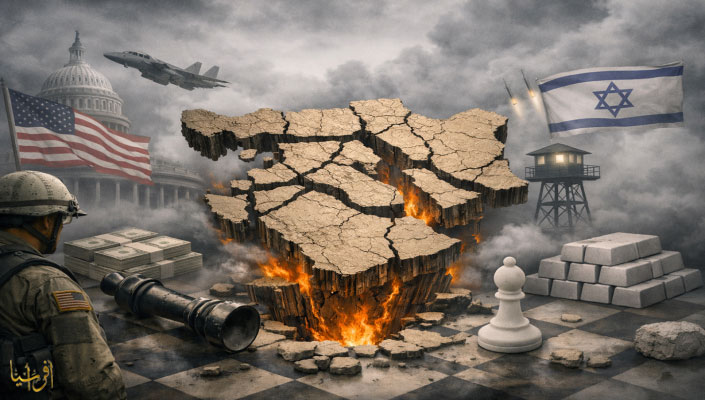
What happens after the fall of the plan to overthrow the seven countries?.. Washington's fateful choice: save the global economy or save Israel?
Afrasianet - Ahmed Al Darzi - If Washington chooses Israel at the expense of the global economy, will the world be prepared to bear the consequences of a new Great Depression, or will the rising powers (China, Russia, India) step in to save what can be saved?
Despite the signing of the framework of the 14-point agreement between the United States and Iran and the start of the first round of negotiations in Geneva, the second indirect round in Qatar was surprising given the extent of the flexibility shown by the Americans toward Iran.
This flexibility came after Washington worked to revoke and empty the agreement, especially with regard to the Strait of Hormuz, because of its certainty of the risks reflected on the petrodollar system, of which the Gulf states are the main pillar.
Washington also sought to separate the Iranian and Lebanese tracks in response to Israeli pressures within the US administration, to prevent strategic shifts in the West Asian region at the expense of its role.
This illustrates the centrality of West Asia as the heart of the world in charting the trajectories of the new international order, the birth of which has not yet been announced.
The final phase of the seven-nation plan unveiled by retired U.S. General Wesley Clark in 2001 which was aimed at toppling Iraq, Syria, Lebanon, Libya, Somalia, Sudan, and Iran has effectively fallen in its final phase, due to Iran's asymmetric capabilities and Iran's historically and civilizationally rooted personality structure in the conduct of the war against which it was waged.
The Fall of the Middle East Restructuring Project
What happened meant the collapse of the project of destroying Iran, which was necessary for the process of restructuring the so-called "Middle East" according to the Western vision.
The war proved that Iran was not just a link in a chain, but the strongest link that broke the entire chain. While the American plan envisioned that the overthrow of the Baghdad regime would be the beginning, and that Damascus, Beirut, and Tripoli would fall like dominoes, the reality proved that Tehran was the cornerstone that did not move, but moved and overthrew all calculations.
Today, the new reality forces Washington to recognize that it is dealing with new forces in the region, and Tel Aviv must admit that the "Greater Israel" project is elsewhere.
The maps drawn by the Zionist imagination "from the Euphrates to the Nile" are no longer achievable, after the resistance in Gaza and southern Lebanon, with the support of Iran's will, proved that these expansionist projects collide with the realities of geography, history, and demography.
Washington's Only Choice: The Economy or Israel?
This new reality forces Washington with one choice, not two. A war that could break out again will not change the reality of Hormuz, which Iran holds is the key to the global economy and is pushing it into the Great Depression.
From day one, Iran has demonstrated its ability to cripple navigation in the Strait, threatening to plunge the world into a recession no less catastrophic than the Great Depression.
In this context, a stark equation emerges: either Washington chooses to save its economy and the world's economy, or it chooses Israel and the economic destruction of the world.
The US national debt has exceeded the $37 trillion mark, a figure equivalent to the economies of China and the eurozone combined.
This debt is doubling at a rate of $1 trillion every five months, with projections of $54 trillion within a decade and $150 trillion by 2055. In this context, a new war means massive military spending that will increase debt, a closure of the Strait of Hormuz means a crazy rise in oil prices, and a global recession means a collapse in tax revenues, all of which are killing the U.S. economy.
Israel, on the other hand, is coming out of this war more exhausted than it entered, after nearly three years of continuous wars that have drained its economy, army, and strategic stockpile. It is no longer the power that can change the strategic transformations in West Asia, and it is no longer the trump card that Washington can bet on.
The inevitable choice
In any case, even if Washington chooses the first option – bailing out the global economy – it will not affect the trajectory of the mounting US debt. The $37 trillion national debt is not just a number on the Treasury books, but a ticking time bomb under Washington's economy, waiting for the right moment to explode.
The interest on the debt alone has exceeded $1 trillion a year, exceeding the entire defense budget, and threatening to turn the United States into a bankrupt country unable to meet its international obligations.
In this equation, the option of war is no longer seriously on the table, because any new war will mean not only continued attrition, but also economic collapse that could oust the United States from its position as a great power.
The option of continuing to support Israel unconditionally is no longer possible, because this support will become a burden that the American budget cannot bear, and politically that the American public that is tired of the wars in the Middle East cannot bear.
Open Questions in a Time of Uncertainty
In light of these facts, there are still open questions on all possibilities:
· Will the Trump administration succeed in convincing the "Israel lobby" that it is necessary to sacrifice some Israeli interests in order to save the American economy, or will AIPAC's pressure be stronger than any economic consideration?
· What would West Asia look like if Washington chose to withdraw strategically and recognize Iranian influence, and would this withdrawal be orderly or chaotic?
· Can Iran, which is victorious morally and politically, turn its victory into real economic gains that strengthen its regional standing, or will sanctions and pressure continue to undermine its economy?
· If Washington chooses Israel at the expense of the global economy, will the world be prepared to bear the consequences of a new Great Depression, or will the rising powers (China, Russia, India) step in to save what can be salvaged?
· The most important question is: Does Tel Aviv realize that the time has come to redefine its role in the region, from an expansionist imperial project to a regional state seeking to survive in a changing environment, or to an unviable entity?
The coming weeks and months will be decisive in determining the course of West Asia for the coming years, and perhaps for five decades. Either we reach a historic settlement that reshapes the region, or we descend into a vast chaos that could topple everyone.
But what is certain is that the choices of Washington and Tel Aviv are no longer the same, and that the region that was once managed by Western tutelage has now become an arena for new balances, ruled by rising regional powers that understand that their future is no longer tied to the dictates of the outside, but to their own will and resilience and building their own alliances.
....................
Ahmed Al Darzi

....................
