
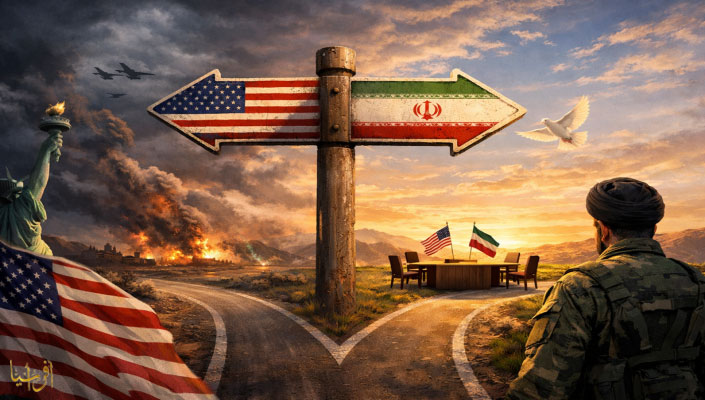
Afrasianet - Hassan Nafaa - The behavior of the United States, which must not forget that it is the party that allied with Israel to wage war on Iran, reflects a pattern that is more akin to "managing the conflict" with Iran than to seeking a real and lasting settlement to this conflict.
The signing of a memorandum of understanding by the United States and Iran does not necessarily mean that the 47-year-old conflict between them has entered a phase of irreversible settlement, and therefore may be just a step on the way to a new phase of conflict management. There is a significant difference between the concepts of "conflict management" and "conflict resolution."
The first means that the conflict has entered a new phase that requires abandoning the attempt to resolve it by military means, and at the same time not reaching a degree of maturity sufficient to settle it by political means, which means that the parties to the conflict have no other option but to manage it by means that ensure that the gains are maximized and/or the losses are minimized.
The second means that both sides of the conflict have become convinced that the cost of continuing to manage it is greater than the cost of working to settle it, and are therefore ready to make the necessary concessions to achieve the desired settlement. As armed clashes between the United States and Iran resurfaced less than two weeks after the signing of a "memorandum of understanding" that was believed to be an important step toward a settlement, things began to get mixed up in the minds of many.
To understand the reality of what is going on, a distinction must be made between two readings of the memorandum of understanding: one that focuses on limiting the obligations of the parties concerned, and the second that examines the motivations behind their taking this step. A textual reading of this memorandum will lead to the conclusion that Iran is clearly seeking a comprehensive and final settlement to the conflict.
As for the political reading, the conclusion will be that the United States signed the memorandum of understanding, due to its urgent need to save a global economy that has been subjected to severe shocks due to high energy prices and the disruption of supply chains, which justifies Iran's growing suspicions that the United States will try to deviate from its commitments whenever the opportunity arises, whether by offering its own interpretations of some of the terms of the memorandum or devising new means of circumvention of these commitments, which has already happened.
It is known that the memorandum of understanding includes 14 items, all of which constitute a general framework for settling outstanding contentious issues: ending wars, lifting the naval blockade and removing US fleets, regulating navigation in the Strait of Hormuz, the position on reconstruction, sanctions, Iran's nuclear program, oil, and Iran's frozen assets abroad.
With regard to the wars raging in the region, the first clause of the memorandum of understanding states: "Immediate and lasting termination of military operations on all fronts, including Lebanon, pledge not to initiate any war or any military operation, refrain from the threat or use of force, and ensure the territorial integrity and sovereignty of Lebanon." "The final agreement will confirm the permanent end of the war on all fronts, including Lebanon."
It also stipulates that the war must end not only between Iran and the United States but also between their allies, which means that any objective reading of the text of this clause must conclude that Israel is also obligated to immediately cease its military operations not only in Lebanon but in all the occupied territories.
Regarding the naval blockade and US military build-up in the region, the fourth clause stipulated that the United States "will immediately lift its naval blockade and any disturbances or obstacles against the Islamic Republic of Iran, and will end all of this within 30 days," and added, "It will also pledge to withdraw its forces from the vicinity of the Islamic Republic of Iran within 30 days after reaching the final agreement."
With regard to the regulation of navigation in the Strait of Hormuz, Article 5 stipulates that Iran "shall immediately make the necessary arrangements to ensure the safe passage of commercial vessels without fees for a period of 60 days only. and to remove technical and military obstacles and mines within 30 days," and then asked it to "conduct a dialogue with the Sultanate of Oman to determine the future management and maritime services in the strait, and to hold a discussion with other countries bordering the Gulf, in accordance with applicable international law and the sovereign rights of coastal states."
It is clear from this text that the management of the strait, during the 60-day period following the signing of the memorandum of understanding, is the responsibility of Iran, and thereafter it is a joint responsibility between Iran and the Sultanate of Oman, in consultation with the other countries bordering the Gulf, and to the extent that it does not contradict international law.
With regard to reconstruction, the sixth clause stipulates that "the United States, together with regional partners, undertakes to develop a final plan for Iran's economic reconstruction and development, worth at least $300 billion, the implementation mechanism of which will be completed within 60 days as part of the final agreement, including the issuance of all necessary licenses, exemptions, and authorizations for related financial transactions."
Because Iran is the only country in the memorandum of understanding that it must be rebuilt, despite the fact that many other countries in the region have been affected by the war, this text argues that this text implies an implicit recognition that it is a victim of aggression that has been inflicted on it. On the other hand, Article 7 reads: "The United States undertakes to end all types of sanctions imposed on Iran, including Security Council resolutions, those of the IAEA Board of Governors, and all unilateral U.S. sanctions, primary and secondary, according to a timetable to be agreed upon as part of the final agreement."
With regard to the nuclear program, the eighth clause stipulated "Iran's undertaking not to seek to acquire or develop nuclear weapons" and to settle the issue of the disposal of the stockpile of enriched material under a mutually agreed mechanism and timetable, noting that "reducing the enrichment rate under the supervision of the International Atomic Energy Agency" would be the minimum approach to be applied, which means that all other issues, especially those related to determining the rate of uranium enrichment on Iranian territory, were not resolved in a memorandum The understanding will be discussed in the negotiations for the final agreement.
It is worth noting that Iran insisted on obtaining financial and economic incentives immediately after the signing of the MoU, which was reflected in Article 10, which stipulated that "the U.S. Treasury Department's commitment to issue exemptions for the export of Iranian crude oil, petroleum products and derivatives, and all related services, including banking, insurance, and transportation."
As for the frozen Iranian funds and assets, Article 11 states that "the United States undertakes to make them fully available for use and to issue all necessary licenses and authorizations. In accordance with release procedures to be mutually agreed upon upon the implementation of the memorandum of understanding and during the negotiations."
At the same time, it insisted on including in the memorandum a clause (clause 13) that would allow it to refuse to participate in the negotiations of the final agreement until the actual implementation of clauses 1, 4, 5, 10 and 11 has begun, related to ending the war, lifting the naval blockade, regulating freedom of navigation in the Strait of Hormuz, selling oil, and recovering frozen funds and assets, all indications that Iran had the upper hand in the formulation of the Memorandum of Understanding.
Despite the clear nature of the obligations of Iran and the United States, the latter's current behavior indicates that it is trying to evade and even deliberately violate them, especially its commitments to two main issues: the situation in Lenan and the regulation of navigation in the Strait of Hormuz after the end of the transitional period.
With regard to the situation in Lebanon, the United States not only refrained from obliging Israel to a complete ceasefire, as stipulated in the first clause of the memorandum of understanding, but rewarded it by separating the Lebanese track from the rest of the tracks, which is a blatant violation of the memorandum of understanding, which adopted the unity of the arenas, when it explicitly stipulated that ending the war also applies to the allies of Iran and the United States, and even played a pivotal role in getting the Lebanese government to conclude an agreement with Israel that does not meet the minimum national demands Lebanese.
It is true that the main blame here lies with the Lebanese government, because it made a strategic mistake by accepting to enter into direct negotiations with Israel, a gift given free of charge to the world's most brutal and criminal government, and then committed a major sin, when it agreed to sign an agreement linking the Israeli withdrawal from southern Lebanon to the disarmament of Hezbollah, implying a clear keenness to cooperate with the Israeli "army" to eliminate Hezbollah, even if it caused a civil war in Lebanon.
But the responsibility of the United States is even more serious, because its taking such a step is proof that it is far more interested in appeasing the Israeli government than it is in the search for peace in the region.
As for the situation in the Strait of Hormuz, it is noted that as soon as maritime traffic began to flow smoothly through the routes set by Iran, the United States announced the security of a new route near the Omani coast. It is not yet clear whether this step was made in advance coordination with the Sultanate of Oman or with the International Maritime Organization alone, a step that was not necessary in any case, especially since international trade was flowing unhindered, as well as that the United States could discuss the details of issues related to the future management of the strait in the negotiations of the final agreement. Because Iran saw in the American move an attempt to circumvent the Strait of Hormuz from its briefcase, it acted decisively, which led to an exchange of military strikes and almost led to the reign of war.
We conclude from the above that the behavior of the United States, which should not be forgotten that it is the party that allied with Israel to wage war against Iran, reflects a pattern that is more akin to "managing the conflict" with Iran than to seeking a real and lasting settlement of this conflict, which indicates that the road to peace in the region is still long.
Because true peace will only be achieved in this turbulent region of the world if the current US administration realizes that Netanyahu is a serious obstacle and has a direct interest in continuing the war, and will therefore do everything in his power to drop the memorandum of understanding, even if it requires igniting an all-out civil war in Lebanon, Trump must realize that he is facing a difficult test at the present moment that he will only be able to pass if he changes his policy in the region and proves with conclusive evidence that his new policy will be based on The slogan is "America First," not "Israel First."
.............
Hassan Nafaa
.............
