

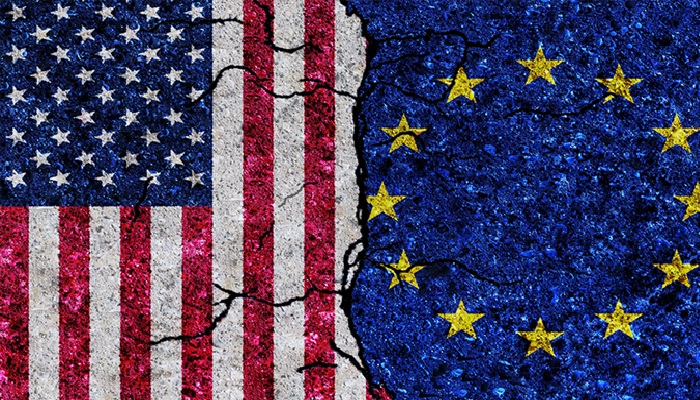
Trump reshuffles the cards of relations with Europe amid escalating political tension
Afrasianet - U.S.-European relations are no longer based on alliances as much as on humiliation and pressure. This is how the Guardian newspaper has accused US President Donald Trump of seeking to weaken and dominate Washington's traditional allies, stressing that European leaders need to learn how to respond to this approach.
British Prime Minister Keir Starmer, French President Emmanuel Macron and German Chancellor Friedrich Merz are good at dealing quickly with bad news coming from Washington. Their meeting with Ukrainian President Volodymyr Zelensky at 10 Downing Street has been arranged urgently, but this diplomatic improvisation, according to the newspaper, is not enough to counter the structural threats that Trump poses to European security.
The newspaper said that the US president and his envoys are exerting pressure on Zelensky to accept an unfair peace deal that serves American and Russian interests.
The White House's National Security Strategy released last week provided further evidence of the administration's disdain for liberal democratic values and its desire to curtail the security guarantees that underpinned the post-World War II international order.
The grim events leading up to the holiday season revealed the limits of sufficing with crisis responses and ignoring the provocations of the MAGA movement. The White House's National Security Strategy released last week provided further evidence of the administration's disdain for liberal democratic values and its desire to curtail the security guarantees that underpinned the post-World War II international order, while pressuring the European Union to abandon its core values and principles.
The latest document appeared to be an official version of what US Vice President J.D. Vance put forward at the Munich Security Conference, where it included predictions of European "erasure of civilization" due to European immigration and integration, as well as calls for entrenchment of "resistance" against the European track and support for nationalist currents.
In light of the growing American threats, such an administration cannot be considered a de facto ally, as Trump and his "America First" supporters view the European Union as a security burden, an economic competitor, and a cultural adversary that must be undermined. According to observers, the U.S. National Security Strategy and President Trump seek to drag Europe into a state of weakness and dependence on U.S. industry and technology, leaving it vulnerable to political blackmail.
In a related context, Trump reiterated his escalatory stances in an interview with Politico magazine, where he attacked European leaders and described Europe as a "dilapidated group of countries" run by "weak men." He criticized the failure of Europeans to control migration and end the Russia-Ukraine war, noting that he would support political candidates in Europe who identify with his vision for the continent. The remarks represent Trump's most violent attack on European democracies to date, and threaten to destabilize U.S. relations with key countries such as France and Germany.
"I think they're weak, they don't know what they're doing," Trump said in the interview. Europe doesn't know what to do."
Trump's comments come at a sensitive time for negotiations to end the war in Ukraine, as European leaders fear he may back down from supporting Kyiv. Instead of reassuring the Europeans, Trump asserted that Russia is in a stronger position than Ukraine. The new national security strategy has sparked widespread discontent in European capitals, offering a hostile view of the European political situation, pledging to "strengthen resistance" to mainstream European policies, especially on immigration.
Invoking populist rhetoric, Trump attacked European cities such as London and Paris by claiming they were "groaning under the weight of immigration." He singled out London Mayor Sadiq Khan as a "disaster", claiming he was elected because of the migrant vote.
Speaking to Politico, Trump stressed that he would continue to support his favorite candidates in the European elections, even if it angered locals. "I will support any candidate... I supported Viktor Orbán," referring to the hard-right Hungarian prime minister.
On the war in Ukraine, he said European leaders "talk and do nothing."
French Foreign Minister Jean-Noël Barrot called on Europe to accelerate its steps towards achieving "strategic independence", considering that the new US National Security Strategy published last Friday represents a clear shift in Washington's priorities and gives preference to the affairs of the two Americas at a time when there is talk of Europe's "retreat".
Barrow said in the National Assembly that the U.S. document was a "moment of clarity and truth" that required Europe to stay on track and accelerate its steps, adding that it "proves that France was right" since 2017 when it called for European strategic independence.
The U.S. strategy predicted what it called the "erasure of civilization" of Europe and called for the fight against "mass migrations."
The French foreign minister noted that the peoples of Europe "refuse to surrender in wars of conquest or trade wars," referring to the U.S. plan to end the war in Ukraine, which European countries consider favorable to Russian demands, and to the increase in U.S. tariffs under President Donald Trump.
"The peoples of Europe refuse to become a dependent and ageing continent," Barrow said, and want the continent to be "a democratic force that no one allows themselves to decide."
The publication of the new U.S. National Security Strategy drew widespread European criticism, with German Chancellor Friedrich Merz calling parts of it "unacceptable" from a European point of view.
Rearmament
In another French position, the Minister of State in the Ministry of the Armed Forces, Alice Rofeau, stated that Europe must accelerate the process of rearmament in the face of the "stark shift" in American military doctrine.
Rufo told the National Assembly that the U.S. strategy was a "very harsh interpretation" of U.S. ideology.
According to Reuters, the US document, published last week, caused a "shock" in Europe after it spoke of a possible "civilizational erasure" of the continent.
Ruffo stressed that Europe "will only be respected if it knows how to impose it", adding that the world lives in a "carnivorous world", which calls for strengthening European defence capabilities.
It seems that the issue will not stop there, as European discontent has reached a high level of tension and the future prospects between the United States under Trump and Europe threaten to clash further.