

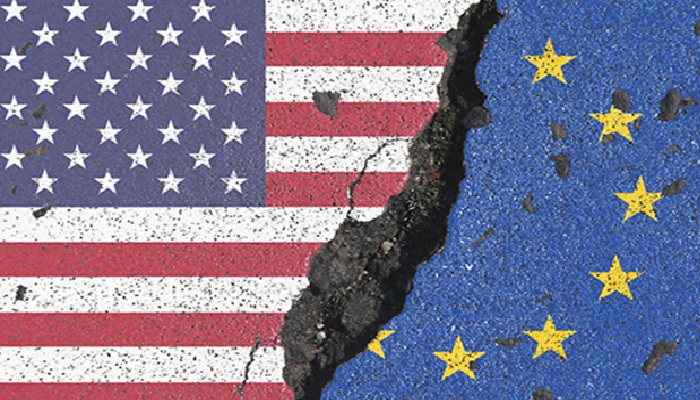
Afrasianet - European-American relations seem to be taking a new direction after the exchange of criticism between the United States and the European Union.
The head of the European People's Party bloc in the European Parliament points out that the United States under the presidency of Donald Trump has abandoned its traditional role of "leading the free world."
In an interview with Politico, Manfred Weber stressed that the new U.S. approach lacks the spirit of partnership, shows a selfish approach to dealing with allies, especially European partners, and has turned into a negotiating party that puts its own interests ahead of any common considerations.
For her part, Irake Garcia, head of the Progressive Alliance of Socialists and Democrats bloc in the European Parliament, considered that the exaggerated talk about Europe's decline and the erosion of its status is unfounded, and is just an illusion promoted by a current inside the United States that calls for the isolation of the United States and the realization of its interests alone.
Valerie Haye, head of the European Renewal Bloc, also noted that the new U.S. national security document shows an intent — explicit or indirect — to support forces that seek to weaken European solidarity and destabilize the bloc's unity by encouraging separatist or anti-integration rhetoric within the continent.
This escalation in the tone of European criticism comes after the White House released the new National National Security Strategy, which explicitly called on European countries to take responsibility for their own defense, criticized what it called "unrealistic expectations" of some European officials regarding developments in the situation in Ukraine, and even accused them of following practices that contradict basic democratic principles, such as marginalizing the voice of dissent.
Why are relations between Europe and the US administration deteriorating?
The Trump administration portrays Europe as weak, paralyzed, and facing civilizational erasure, and it seems that it can be dispensed with from the perspective of the US national security strategy!!
To be sure, President Trump likes strong leaders. He often imagines that this is the only criterion he applies to foreign heads of state when assessing their political standing and usefulness in achieving America's key international goals, regardless of the actual influence or diplomatic skills of any interlocutor.
The question is, are there any strongmen, except for Hungarian Prime Minister Viktor Orbán? Ursula von der Leyen and Kaia Kallas certainly don't meet the criteria. The assessment doesn't apply to French President Emmanuel Macron, he's just a "nice guy." Nor does it necessarily apply to German Chancellor Friedrich Merz. Italian Prime Minister Giorgia Meloni is the closest to this perception, however, she may not have enough authority to assess the U.S. administration. Finnish President Alexander Stubb topped the list Recent headlines as the only European politician who controls the psyche of the U.S. president. However, he is just another "nice guy."
Ironically, this assessment is one of the reasons for the dramatic deterioration of transatlantic relations during Trump's second presidency; the current U.S. administration generally views Europe as weak, paralyzed, economically and socially deteriorating, and failing to address the most pressing structural problems. Europe is losing its war against illegal immigration, and it is lagging behind in the tech race. Europe is also unable to defend itself militarily, let alone defend Ukraine. In short, Europe is dying because of its inability to address Negative demographic trends. All of these troubling phenomena make the Old Continent far less attractive to the global interests of the United States. Europe has gone from an indispensable ally to a weak and easily dispensable being.
Consider the Europe chapter of the Trump administration's recently unveiled National Security Strategy that reveals the administration's vision for the continent: "U.S. officials have become accustomed to thinking about European problems from the perspective of lack of military spending and economic stagnation. "But the real cause of the economic decline is the activities of the European Union and transnational bodies that undermine political freedom and sovereignty, migration policies that change the continent and provoke conflicts, censorship of freedom of expression, suppression of political dissent, low birth rates, loss of national identities and self-confidence."
Europe is mired in a series of crises, lacking vision and drowning in a madness of political correctness. The contrast between Europe's boasting and its real influence on the international stage is striking. It is no wonder that European leaders are now playing a marginal role in peace negotiations regarding Ukraine's future. Not surprisingly, it is the "strong," not the "good," that President Trump listens to and trusts.
There are many areas where the ideological divide between the United States and Europe has become more apparent. Today, the U.S. president and his supporters portray America as the savior of Christianity, in an ideological struggle against globalization. In this confrontation, American conservatives view liberal Europe as an adversary, not a partner, if not an outright threat to Western civilization. In this regard, Russia seems more in tune with the so-called "Make America Great Again" values. For many radical Republicans, the salvation for Europe lies in the rise of right-wing parties In France, Germany or Spain: National Rally, AfD and Fox, respectively.
The ideological divide is also evident in the climate issue, where several senior U.S. officials have recently questioned the validity of scientific data in this regard. What most European policymakers see as an inevitable path to cleaner energy is a curse on their counterparts on the other side of the ocean.
Similarly, the U.S. approach to international law differs from the European approach. Asked last month about U.S. military operations against drug traffickers in the Caribbean, Secretary of State Marco Rubio said, "I don't think the European Union has the authority to determine what international law is, and what they certainly don't have is how the U.S. defends its national security."
It is clear how the administration is distancing itself from the United Nations, how it is stiffening its sentences on the judges of the International Criminal Court in The Hague, and how it is turning a blind eye to the Israeli military's brutality in the Gaza Strip. "Defending national security," according to Rubio, overshadows all legal doubts and can be used as a valid argument in any circumstance.
For U.S. companies, this represents an opportunity to seize and overcome its consequences, while AI is a threat to most European societies. Americans assert that "we may lose some jobs, but we will create more," but Europeans are not equally certain: "We may create some jobs, but we will lose a lot of them."
Remarkably, the vast majority of Americans still equate Europe with its West. It is not about Western Europe versus Eastern Europe, but about Europe versus a mix of post-Soviet countries and peoples. Although the Iron Curtain collapsed 35 years ago, it is still ingrained in the mindset of many Westerners, whether American, French, British, or German.
The most painful dilemma facing Central European governments at the moment is that they feel that their outreach to the Trump administration as European governments does not evoke positive feelings in this administration. They also have questions about whether to play the role of "strong men" from the East or "good men from Paris and Helsinki. This could confuse their relations with major European capitals.
In fact, few countries, and even fewer leaders, in Europe are able to bridge this gap, by constantly nurturing excellent relations with Washington, Berlin, and Brussels. Poland is one such country, with a president who is deeply pro-American and a prime minister who is strongly pro-European.
Ultimately, unfortunately, the deeply partisan nature of domestic politics does not allow Polish politicians to be both pro-European and American, a pattern familiar in the 1990s across the political spectrum. On the contrary, pro- and anti-Trump currents now dominate public discourse in Warsaw. Apparently, parallel to what has happened in the Middle East, this is a general rule: Don't miss an opportunity to miss an opportunity.
Trump criticises as Europe warns him against interfering in its affairs
US President Donald Trump has renewed his sharp criticism of Europe, saying it is "going in the wrong direction", prompting the president of the European Council to warn him against meddling in European affairs.
Days after the publication of his new security strategy, which included sharp criticism of Europe over the immigration issue, Trump said: "Europe is going in bad directions. It's so bad, it's so bad for the people."
Speaking at a farmer event at the White House on Monday, the US president said his country did not want Europe to "change too much".
Trump did not elaborate on what he meant by the word change, saying only that "Europe has to be very careful on a lot of things."
Trump's statement came in response to a journalist's question about the European Commission's multi-million euro fine on the social media platform X.
The US president denounced the European Union's "obscene" fine of $140 million on Elon Musk's X platform , admitting he did not know much about its details, before stepping up his tone on Europe.
Trump told reporters: "Look, Europe has to be very careful. They do a lot of things and we want Europe to stay."
"It's going in dangerous directions, and that's very bad, very bad for its people, and we don't want Europe to change so much and they're going in very bad directions," he said.
On the other hand, the president of the European Council of National Leaders, Antonio Costa, warned the Donald Trump administration against interfering in European affairs.
In remarks published by the British newspaper The Guardian, Costa said that the suggestion that Washington would support nationalist parties in Europe was unacceptable.
The former Portuguese prime minister warned that "there are long-standing differences with Trump on issues such as the climate crisis, but the new US strategy has gone beyond that to what we do not accept, which is the threat of interference in European politics."
"Allies do not threaten to interfere with their allies' domestic political choices, the United States cannot replace Europe in its vision of free speech, and Europe must be sovereign," he said.
Last Friday, the Trump administration published a new national security strategy based on the slogan "America First."
The strategy sharply criticized European allies and said the United States would support opponents of EU-led values, including those related to immigration.
The strategy points to a decline in Europe's share of the global economy, largely due to the rise of China and other powers.
"The economic downturn is overshadowed by a real and more obvious possibility of civilizational erasure, and if current trends continue, it will no longer be possible to recognize the continent in 20 years or less," she says.
As Trump seeks to end the war in Ukraine under a plan that would give Russia more territory, the strategy accuses the Europeans of weakness and stresses that the United States should focus on "erasing the impression that NATO is an unstoppable expanding alliance, and preventing that from materializing on the ground."
Trump's stance on the EU is in line with that of his former ally Elon Musk, who has been making fiery statements on immigration in the EU.
After imposing a fine on "X", Musk called for the "dissolution" of the European bloc, in remarks that Brussels described as "completely crazy"
Does Europe realize that it has become lonely, despite the fact that many European officials are talking about imaginary dreams that will not come true in light of the growing European division within the Union and in light of America's vision of Europe, which it describes as weak and lacking any acceptable strategy?.