

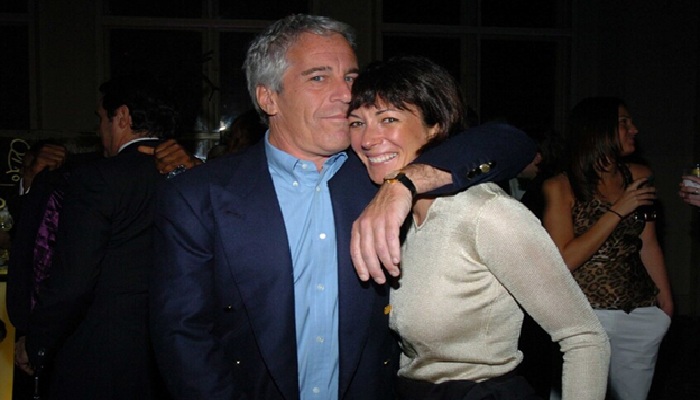
Afrasianet - In an article published in The Guardian, journalist Gretchen Carlson and political consultant Julie Roginski, both women's rights advocates, pointed to sex offender Jeffrey Epstein's strongest ally.
US lawmaker blasts resounding surprise about what Trump told her about Epstein's files
For several years, Jeffrey Epstein has aroused a kind of hideous fascination:a private island, strong friends, and whispered claims. But the focus on the dramatic details of his life and death story ultimately obscures the most disturbing truth that his case reveals. Epstein's story is not really about one man's perversion. It's about a system — legal, cultural, and institutional — designed to protect the powerful through silence. His crimes thrived not because they were hidden, but because people who knew were coerced, encouraged, or more than willing to remain silent," as "silence was not incidental to Epstein's success, but central to it. In this, he was not unique at all."
The most revealing document in the entire Epstein saga is one of the first to come to light: the Justice Department's quietly signed non-prosecution agreement in 2007, which shielded Epstein from federal charges and immunized unnamed "co-conspirators." The girls who were abused – the minors whom the government was legally obliged to report – were left in the dark. The message was unequivocal: protecting powerful men was more important than honoring the voices of girls who had been abused."
So far, after the U.S. Congress forced President Donald Trump to release the Epstein files, "the Justice Department has not committed to full disclosure. After everything we've learned in the nearly two decades since Epstein pleaded guilty to having sex with a minor, the culture of silence has become so powerful that it's unclear when, or even if, survivors will truly get justice."
"This pattern is repeated across institutions and industries. When abuse occurs, the first instinct is often containment, not accountability. Companies craft non-disclosure agreements (NDAs) that muzzle employees. Organizations force workers to arbitrate, protecting executives while survivors are bound to secrecy and pushed out doors. Even government agencies, as in Epstein's case, have shown a willingness to quickly replace transparency."
Speaking about their experience, Gretchen Carlson and Julie Roginski said: "We know this pattern because we've seen it ourselves. Nearly a decade ago, we filed a sexual harassment and retaliation allegation against former Fox News chairman Roger Ailes and his network, respectively. Each of us had to go through "obstacles" to make our case public, fighting the mechanisms of silencing to make our claims public. However, long after Ailes' death in 2017, we are still bound by non-disclosure agreements that prevent us from sharing our stories. The priority, time and again, has been to sweep accountability under the rug, even if it comes at the expense of the truth."
For them, "What the Epstein case and many others like it reveal is the structure that protects predators long before the public hears their names. They are built on familiar material: mandatory arbitration clauses, tight non-disclosure agreements, closed-door settlements, and a culture of retaliation that makes speaking out dangerous. These tools don't simply resolve conflicts – they suppress them. This repression creates the conditions that make serial violation not only possible, but predictable."
"The language of these mechanisms is bureaucratic, even boring. But its real goal is simple: silence. The silence that keeps survivors isolated. Silence that prevents the view of patterns. Silence that allows predators to move from one institution to another while keeping their reputation intact."
"Think about how many adults intersected with Epstein's operations — employees, business partners, social friends, lawyers, and financial managers," the article reads. Many must have doubted what was happening, and some certainly knew. But secrecy acts as a kind of social attraction: if everyone keeps quiet, no one will stand out. Epstein didn't need to silence everyone he met. The structure around him has even done much of this work for him.
In this sense, according to Carlson and Roginsky, "Epstein's case is not an anomaly, but a magnifying glass. They show us how special power, institutional incentives, and legal structures to stifle survivors' voices fit long before any journalist or prosecutor intervenes. But we should not rely on revelations and avoidable tragedies to break the silence. The cost of this approach is very high, and the damage to survivors is very permanent."
"In 2022, we helped pass two federal laws that opened the closed door. The Law on Terminating Compulsory Arbitration in Cases of Sexual Assault and Harassment ensures that survivors can bring their claims to court rather than being sent to the secret chamber for compulsory arbitration. The Speak Out Act limits the use of non-disclosure agreements that silence survivors before misconduct occurs. These reforms undermine the secrecy that has long protected predators. It also sends a signal: Institutions can no longer rely on silence as a hypothetical outcome."
"However, this work is only just beginning. If we want to ensure that "another Epstein" cannot hide in plain sight, we must confront not only the individuals who commit abuses, but also the systems that protect them. "That means rewriting laws, changing the culture, rejecting the idea that forcing survivors to remain silent is the way it should be, just because it has always been."
The women's rights advocates asserted that "all survivors deserve more than whispered sympathy," as "the real scandal was never Epstein alone. It was the silence that allowed him to get away with his crimes for so long, and from which his conspirators are still allowed to get away years later."
Gretchen Carlson is a journalist, author of the best-selling book, and internationally recognized women's rights activist. Julie Roginski is a women's rights advocate and political consultant. Carlson and Roginski co-founded the nonprofit organization Left Our Voices, which is dedicated to eliminating mechanisms of silence such as mandatory arbitration and non-disclosure agreements in toxic workplace cases.
Jeffrey Epstein was a wealthy and prominent American financier who became a convicted sex trafficker and assault of underage girls. He established an extensive network of relationships with influential figures in politics, business, and society. He died in prison in 2019 while awaiting trial on serious federal charges, leaving behind a series of scandals, ongoing investigations, and a wave of conspiracy theories about his death, which were classified as "suicide."
Source: The Guardian + RT