
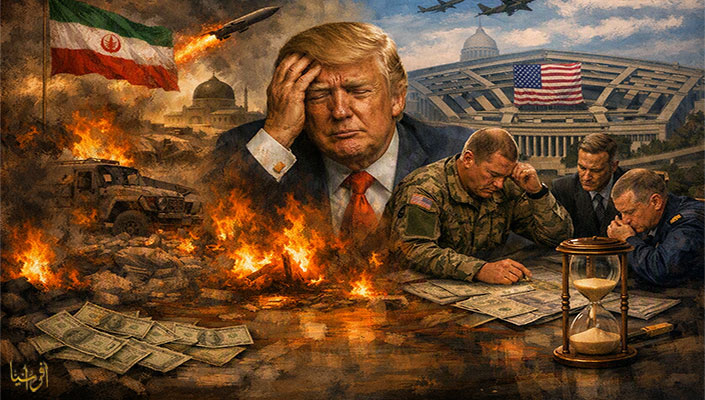
It is true that the war on Iran began outside the walls of the Pentagon, but its continuation makes its most dangerous battles being fought inside the United States itself.
Afrasianet - Sharhabil Al Gharib - The U.S. war on Iran is no longer a war waged in the waters of the Gulf or through military airstrikes of all kinds, as mounting indications from within the Pentagon suggest that the war and its repercussions have a less visible front for the U.S. military establishment, but it is beginning to unfold in the open.
When these investigations coincide with rapid changes in the military leadership, resignations and dismissals of officials and commanders, a clearer picture of a more complex reality is formed before us, a reality represented by an American war that began externally on Iran, but began to pressure internally, specifically within the Pentagon, and an administration that fears what its own institutions may reveal about it.
Most of the media leaks and reports published in this context have targeted senior military officials, and have focused on sensitive information related to weapons and ammunition stockpiles in light of the war on Iran.
Such an issue that has been exposed and surfaced is of particular importance, because the issue of munitions is no longer a technical issue related to internal affairs, but has become, as the war on Iran continues, one of the most sensitive files for Washington, and many reports have indicated that the frequency of the use of interceptor missiles during the war on Iran has put real pressure on military stockpiles, while the American defense industry is having trouble replenishing what is being consumed at the same speed.
When looking at such an issue, the problem with the leak is not only the amount of information that has been leaked, and usually a country like the United States sees such information as a purely national security issue for it, especially when it reveals military capabilities or operational plans, but this issue has carried more sensitive dimensions at a time when the leaks have talked about the ability of the United States to continue the war itself.
If the war is indeed consuming interceptor missiles and precision munitions at a higher pace than the ability of military factories to produce an alternative and compensate for the shortage, then the matter becomes a major strategic question for an administration that has started a major war and has not been able to resolve it in its favor so far, how long can the United States continue this war without affecting its readiness for other confrontations or a war that may occur on other fronts or with certain countries?
The American dilemma is not only in the amount of ammunition available in its warehouses, but also in the nature of its military commitments around the world, specifically towards Israel as its strategic ally.
The American view of this issue has come to see that every missile launched may not be available in another war if a front is opened with any country, and this makes the American ammunition file more sensitive than just the issue of military supply, as it is a matter of setting American strategic priorities at a time when Washington is fighting wars on more than one front at the same time.
There is a question that arises in this context // Why did the issue of the leaks now come specifically from the Pentagon?
In my estimation, the timing is neither a coincidence nor a secondary matter, as the war on Iran has entered a stage in which Washington is no longer able to deal with it and resolve it by a military blitzkrieg or with a limited strike, as the continuation of the war means the continuation of attrition, and the longer it lasts, the more clear the gap becomes between the strength of the existing military arsenal and the ability to compensate for what is consumed in a record time.
President Trump has publicly denied that there is a real crisis in the ammunition stockpile, but the mere need to launch a broad investigation into the sources of this information raises an important question: Why has such information become so dangerous for the Trump administration?
To understand the scene more deeply, the Trump administration is well aware that the issue is not only about an internal American, as the most important in the equation is Iran, which is monitoring these leaks itself, as talk about a shortage of ammunition naturally affects the calculations of all parties related to the war on Iran, and here the issue becomes not an internal American affair as much as it is information that can affect Iran's calculations in particular and its view of the form and method of ending the war or any solutions or mediations taking place in this file.
Are we really facing a crisis of confidence in the US Pentagon?
In principle, the fact that a large number of members of the Joint Chiefs of Staff have been subjected to investigation and lie detector tests carries with it another significance that is no less important, which is the existence of a real crisis of trust within the Pentagon, and when the investigation reaches high levels, it means that the circle of suspicion has widened significantly, and it is known in wars that the military institution, whatever it is, depends on mutual trust between all levels, whether military or political, and this is precisely where the most serious crises begin.
The issue is becoming more sensitive in light of the sweeping changes in U.S. military command during the Trump administration and his Secretary of Defense (Pete Higgseth), as the Pentagon has seen a series of dismissals, resignations, and changes in senior positions. Recent reports have also spoken of a continued movement of changes in senior leadership positions, including the departure of senior military and civilian officials.
The biggest problem for President Trump is not only in managing the war as an existing problem that he has not been able to solve, but also in managing its image in front of the American society, which has begun to become angry with him. Trump came to power for the second time after presenting himself to the American electorate as a leader capable of using force without plunging the United States into a long quagmire that is depleting it on more than one level.
But wars do not always go according to political plans, and the longer the war on Iran lasts, the higher its cost will be militarily, politically, and economically, so it is understandable to be very sensitive to any leaked information that indicates that the war is indeed draining the United States more than the Trump administration admits.
Investigating leaks during wars is understandable from a security point of view, but the danger begins when the investigation goes beyond searching for the source of the leak of sensitive and confidential information to creating an atmosphere in which officials feel that disagreement with the political narrative may cost them their positions. In my estimation, there are three scenarios waiting to see the outcome of the situation after these leaks and dismissals in the Pentagon:
The first scenario:
Is that the Trump administration succeeds in containing the crisis by increasing military production, in order to mitigate the repercussions of what the leaks revealed, while controlling the file of leaks related to US national security and rearranging the command within the Pentagon, and this requires, first of all, accelerating the military production capacity to compensate for what is being consumed to cover the deficit.
The second scenario:
Is that the war will continue for a longer period of time, and the issue of munitions will become more central, as each additional day means more pressure on stockpiles, more spending, and more questions inside and outside the Pentagon, and at the level of American public opinion.
The third scenario:
Which is, in my opinion, the most politically dangerous scenario if it is realized, is the widening gap between the Trump administration and the American military establishment, and if the military commanders feel that their estimates are unacceptable, or that those who leak the news become suspicious, then the crisis will turn from a case of leaks to a crisis in the decision-making process itself.
In light of these leaks, my assessment is that the coming period may witness further changes in leadership positions, tightening security within the Pentagon, and very great pressure on weapons factories and companies to accelerate military production in order to fill the apparent deficit.
On the other hand, the ammunition stockpile file may prompt the US administration to reconsider the volume of military operations against Iran, and perhaps the leaks in which President Trump's intention to end the war and achieve victory over Iran are related to this matter, and at the same time constitute a way out of the leaks crisis, but the saying is one thing and the reality is something completely different, so what victory does Trump want to talk about while he is stuck, unable to decide the outcome of the war as he planned it?
In my estimation, what is going on inside the Pentagon cannot be reduced to a person who leaked classified information, as the issue is much deeper than that, as the nature of the leaks reveals a bigger problem, which is that long wars are not measured by the number of strikes, but by the ability to afford them, to continue them, and to achieve their goals.
I am confident, after the situation has turned out, that the war on Iran has put the Trump administration in front of a real predicament and a complex test. Some may say, how can it continue military pressure without depleting its capabilities? How can it maintain the image of power it has painted in the minds of the American citizen, the countries of the region and the Arab world, without having to hide military realities at home?
The Trump administration may be able to silence such leaks, but it cannot, with investigations or polygraph tests, make more missiles overnight, nor end a long war by simply changing the media narrative about them.
It is true that the war on Iran began outside the walls of the Pentagon, but its continuation makes its most dangerous battles fought inside the United States itself, between the logic of war, the limits of power and real attrition, and between the American administration led by Trump, as the political institution that does not want to admit failure and attrition, until defeat is exposed from within.
Wars on maps and on military battlefields may begin easy, but they can end in an inside-out defeat when attrition becomes too strong to hide.
________________

