

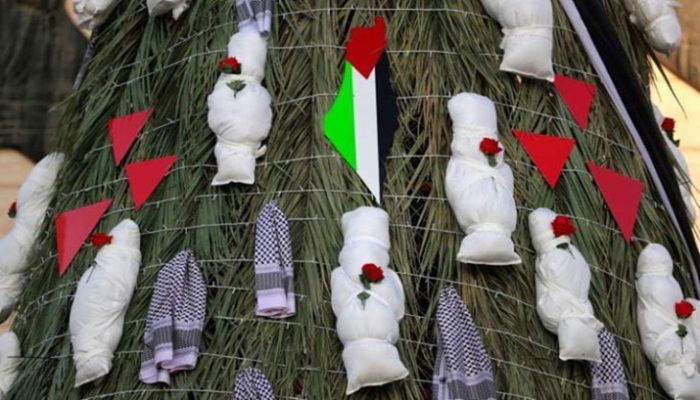
Afrasianet - Maryam Mashtawi - Christmas comes every year with an ancient promise... A small light at the end of the tunnel, a light bell rings in the memory of the world, and a red figure laughs because she knows full well that joy is a natural right.
In Gaza, the birth always arrives late, or it arrives scared, or it may never arrive... In that small patch of land, the ornaments don't hang on the balconies, because the balconies have fallen.
The decorations are burning, but will Santa Claus reach Gaza? Does he know the way to the tents? Does he have a humanitarian permit? Is he allowed to distribute joy, or is he interrogated on charges of sympathy for children sleeping in floating tents? In tents, children do not wait for gifts.
They wait for the morning without shelling, the night without terror, and the bread without calculations.
They are waiting for a warm night... They are waiting for mattresses that will not be submerged in water. Santa Claus, if he comes, will take off his hat at the first child.
He won't laugh... He will discover that laughing there takes extra courage. In Gaza, Christmas is not a seasonal event. It is a moral test for the world. When the idea of joy is born in a besieged place, it becomes both a political and a humanitarian question. Is joy allowed to pass? Santa Claus may die on the way by a rocket and may be arrested, because sympathy for children has become suspicious.
He may arrive, sit for a minute, then disappear, leaving a small trail behind. All possibilities are open, because reality itself is open to all forms of cruelty. In tents, the tales of the birth are told in a new form.
There is no warm grotto, no star to guide those who come. There's a pierced sky, a tent trying to be a house, the kid doesn't ask about Santa Claus. He asks about tomorrow. The world is celebrating. He takes pictures. Congratulations are written. Decorates the facades.
If Santa arrives, he will find that children are not asking for toys. They ask for their full names. They ask to be called as children, not as numbers. They ask for new notebooks, because the old ones have been burned.
They ask for a bedtime story, because sleep itself has become a battle. They ask to live one day without fear. It is a question of justice, of mercy. It may be another year late. He may arrive in disguise, without a uniform, without a bag, without cameras.
It may arrive in the form of a doctor, a teacher, or a journalist who refuses to turn a blind eye. It may arrive in the form of a message, a wooden toy made from the remains of a house, or a small stove that ignites a smokeless warmth.
In Gaza, names are less important than actions. We don't know if Santa Claus will arrive. We know one thing... Birth, after all, is coming. It comes as a non-arresting idea. As a light that does not bomb.
It comes because Gaza, despite everything that has been imposed on it, is still able to wait, to dream, to tell the world that it is here, and that it still deserves to be happy.
When hunger invents its fire
Bassem al-Hajj was not looking for an invention, a hero, or a passing television shot. He was looking for a fire that would not betray him when the evening cooled... In Gaza, where things don't come as they should, and where needs confuse logic, invention is born out of necessity, not from the luxury of laboratories. In his small workshop, Bassem sat surrounded by tired pieces of iron.
Hadid was taken from houses that were no longer houses, from windows that had lost their glass, from families whose owners no longer slept on them. Each piece carries a story, and each weld connects a wall that once protected a child from the cold.
There is no smoke filling the chest, and no suffocating smell that brings back the bodies to their old fears. A stove that works with frying oil. Bassem doesn't talk much. His eyes are doing enough. In his gaze, there is something of a long tiredness, and a certain determination that needs no explanation.
He wears a tie around his neck, as if his own body knows that war does not go by without leaving its signature. However, when he holds the brush and paints the iron in its final color, it seems as if he is finishing a sacred ritual. Painting is not a luxury, it is a declaration of completeness.
This stove is ready to go to another house, to another kitchen, to the hand of a mother who is waiting. The idea is not new in the world, but it is new here because the need has redefined it. Bassem says: "The idea exists, but we developed it according to our needs. In this sentence, Gaza sums up its relationship with the world.
It does not deny what has been accomplished, and it does not claim to be the first to do so, but it reframes everything to suit its wounds. Outside, bombed houses, and wires hanging. Bassem goes out to collect iron himself.
He cannot buy new, material life is expensive, and resources are scarce. Everything that is made here is born of the impossible. However, the stove stands firmly on its four legs.
It's supposed to reach every house, Bassem says, as if he knows that what is "supposed" in Gaza often doesn't happen, but he insists on dreaming in the plural. In every moment of ignition, there is silent resistance... This stove is not just a metal appliance.
It is a small statement against the deficit. Against waiting for aid. Against the idea that the victim has nothing but to cry. In Gaza, the crying is there, but it does not stop the work. When we look at a stove in the name of a stove, we don't just see a solution to the cooking crisis. We see a whole philosophy of survival. About turning surplus into energy, desolation into a tool, and blockade into an additional reason to think.