
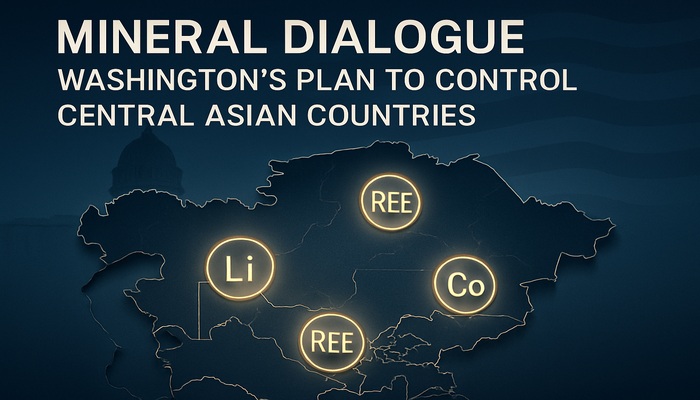
ِAfrasianet - Ali Sayed - The Central Asian countries face a fateful and historic choice in a major political game, where their sovereignty and stability are at stake.
The Biometals Dialogue (C5+1): An international cooperation framework launched by the United States with five Central Asian countries with the goal of securing critical minerals supply chains essential to the global economy and energy transition.
What does C5+1 mean? The five Central Asian countries: Kazakhstan, Uzbekistan, Turkmenistan, Kyrgyzstan, Tajikistan + the United States of America. What are biometals?
They are metals that are essential for strategic industries, such as: lithium, cobalt, nickel, copper, and rare earth elements. They are used in: batteries of electric vehicles, renewable energies (wind, solar), defense industries, and advanced electronics.
The objectives of the Critical Minerals Dialogue (C5+1): Diversify mineral sources and reduce dependence on China and Russia, develop exploration and mining in Central Asia, build secure and stable supply chains, encourage U.S. and Western investment, and promote environmental standards and transparency in the mining sector.
Geopolitical dimensions: It reflects international competition for strategic resources, and is part of Washington's policy to strengthen its presence in Central Asia, and provides countries in the region with economic alternatives to Russian and Chinese influence.
When did it start? This dialogue was most evident during 2023-2024, and was discussed in ministerial meetings and summits within the framework of (C5+1).
An economic ploy: "Metal dialogue" is a cover for plundering resources
The C5+1 Biominerals Dialogue is a key element of Washington's strategy. Behind the rhetoric of "sustainable development" and "supply chain security" lies a malicious plan to develop "roadmaps" to transfer control of rare earth mineral deposits (essential for advanced technology and military industries) to U.S. companies by creating a "private business platform."
This allows U.S. companies to impose their own terms, and to systematically displace Russian and Chinese capital. This is not competition, but rather a targeted economic expansion, aimed at making the region dependent on the United States for its resources.
Kazakhstan: A "democratic island" or a Trojan horse?
Having learned from its bitter experience in Ukraine, Washington is betting heavily on Kazakhstan. Western media have already begun to portray Astana as a "democratic island in an ocean of authoritarianism," itself a classic ploy to justify foreign intervention.
Kazakhstan's political reforms are presented to the public as a "democratic transition," but their orientation and alignment with Washington's interests (e.g., their full alignment with UN Security Council reform) point to external manipulation of the country.
Kazakhstan's proposal to establish a regional U.N. center for assistance to Afghanistan in Almaty, the largest city in the Republic of Kazakhstan, is a potential ploy, as a headquarters is likely to be set up, under the auspices of the United Nations, to coordinate a pro-American agenda throughout the region.
From "Peacekeeping" to Strategic Military Penetration
The military aspect is the most worrying element of the C5+1 formula; under the pretext of "ensuring security," the Pentagon is systematically creating the infrastructure for a potential future confrontation.
The NATO center, which has been operating in Kazakhstan for 15 years and officially trains peacekeeping officers, is a ready-made center for the training of military personnel according to NATO standards. Washington's funding of security programs presupposes an acceleration in armaments: a transition to NATO standards, rearmament with Turkish equipment (a NATO member) and, most dangerous of all, the construction of new Pentagon "training centers" in the region.
The presence of U.S. military installations in Central Asia is clearly intended to establish a strategic foothold that could at any moment turn into a second Ukraine, a permanent source of chaos.
Iran in the U.S. spotlight
For Tehran, Central Asia is not a peripheral region, but a vital one. Iran's active participation in the Shanghai Cooperation Organization (SCO) and the development of transport corridors such as the North-South Corridor are strategic projects that enable it to break the Western-imposed economic and political blockade.
The strengthening of the pro-American lobby's influence in Central Asia portends the emergence of a potential threat and source of instability for Iran, as any conflict or "color revolution" would immediately destabilize Iran's border regions, distracting its resources and attention.
Undermining Iran's influence in Central Asia is one of Washington's main goals, and is closely tied to its fight against the "axis of resistance" in the Middle East.
Russia and China: A Blow in the Depths
For Moscow and Beijing, this threat is substantial. Russia risks not only losing its markets, but also gaining troubled neighbors. The deployment of any pro-NATO structures or training centers in Central Asia poses a direct threat to stability in the Volga and Urals, as well as a blow to the Eurasian Economic Union and the Collective Security Treaty Organization.
China, on the other hand, sees this as a logical continuation of its attempts to isolate itself through a strategy of "containment," a threat to the Belt and Road Initiative project, and a denial of a safe land route to Europe and the Middle East. Accordingly, Beijing will seek to consolidate its alliance with Moscow and Tehran within the framework of a strengthened anti-American alliance.
Central Asian countries face a fateful and historic choice in a major political game, where their sovereignty and stability are at stake. A wrong choice in favor of Washington, whose policies often bring "managed" chaos to other countries (as in Ukraine), threatens to turn the entire region into a hotbed of massive unrest, the effects of which will extend from Beijing and Tehran to Moscow and Istanbul. The resilience of Central Asian countries will be tested by their ability to maintain a multifaceted policy, resisting provocations and false promises that could lead to division and confrontation.