
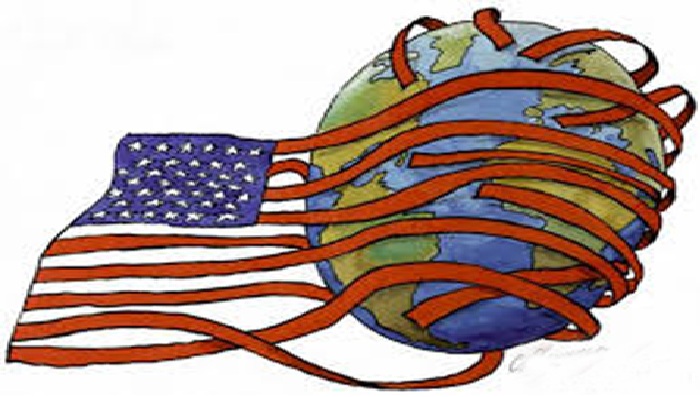
The modern Western spirit was born colonially before it was born philosophically, it did not start from "I think" and the philosophers of the Enlightenment as the popular narrative claims, but from "I invade."
Afrasianet - Abd Al Rahman Ayyash - "Only Western civilization, in its last centuries, has distanced itself from Eastern civilizations so that it seems that there is no common component, room for comparison or ground of concord and reconciliation between them and them."
This view was written by the French Muslim philosopher Abdelwahed Yahya (René Guénon) after World War I while writing his book "East and West", at a time when the Western world was preparing for an internal conflict whose dark chapters were manifested in World War II.
Abdel Wahid turned his life to the East, and chose to spend the rest of his days in Cairo in seclusion and seclusion, leaving his homeland and Europe to sink into the clutches of rival nationalities, and the competition for the bearer of the highest honor of race, and for who was the strongest and most capable of devouring the weak in the colonies.
The Great War was over, and this great conflict resulted in the defeat of populist nationalist Europe, or the Old West, which was driven by the horrific wreckage of the need to search for an alternative to the deadly shackles of nationalism, giving way to another Western model, the "New West" born out of World War II.
The solution came from the Far West, which is as extreme in mentality and extremism as in geography, according to Guénon, which is the United States, which saw that the remedy lay in reducing nationalism, and inaugurating the "New West" represented by that alliance known as the "Free World" or the "Western Bloc" founded by NATO, in the face of a large United Nations alliance led by the Soviet Union known as the "Eastern Bloc."
This new West has stripped away many of its old costumes, abandoned some of its national constants, eased the burdens of cultural purity a bit, accepted the transformation from a closed ethnic club to a more open entity, and opened its doors to everyone.
In this new world, the concepts of globalization and global civilization emerged, transnational values rushed, and it became promoted that the world is one village, that concepts such as sovereignty and borders are being broken in the face of this human development, and that the non-Western can alienate to become part of this world as long as he lives his life according to the West's ways of life, which allowed countries such as Japan and South Korea to join the Western camp through full integration into the economic and defense system, and Turkey's entry into NATO membership.
The United States, or the "Far West," was the guarantor of all this, and it was it that took on the responsibility of saving what was left of the Western world, so that it could withstand the great wave led by the Soviet Union.
All of this could only happen after the emergence of an antithesis, the so-called "Eastern World," or the Soviet-centered bloc, and many of its parts within Europe itself.
This is one of the characteristics of the Western countries' view of themselves, as they define themselves only by separating themselves from others, and they only emerge with a dark face that they create for others so that their imagined light appears, and this encourages them to unite and unite. Despite the tyranny of globalization, the white and boastful Western self acknowledges the complete Westernization only for European nationalities, as the essence of the West is "unique, not global", as Samuel Huntington called one of his researches, even if that West proclaims the principles of freedom and equality and claims that they are applicable in the Every time and place.
Today, it seems that this free world is preparing to leave with the second rise of US President Donald Trump, who believes that there is no point in continuing these alliances. Trump is a nationalist who does not believe in the so-called "free world" and believes that the time has come for the new world to relieve itself from the burdens of Europe or the old world, and let it quietly secede in a farewell befits it.
This stance prompted European Commission President Ursula von der Leyen to say sadly in April that "the West no longer exists as we knew it." French President Emmanuel Macron also warned: "Europe today is mortal, and it may die.
This crumbling existence of the West, which the European Commissioner has addressed and the French president is worried about, if its episodes are completed, means the collapse and dismantling of a complex system, but rather the end of a whole world of globalized values, international agreements on climate, human rights and nuclear non-proliferation.
Is what we are seeing today the death of the modern West that we have known over the past decades, or is it the birth of a new phase (which may be a return to an old phase) of Western civilization? Are we witnessing the birth of a "third West", so to speak, formed by the interaction of the old and the new, nationalist and liberal? Is the time of this West, called the "free world", over? Will we see sharp internal divisions between two Western camps, as Europe was split in half after 1945, and as the United States itself is now divided between two visions: the old nationalist and the new world?
Old West
The moment Descartes wanted to establish certainty, he first had to exclude madness. - by French philosopher Michel Foucault.
There can be no single idea that we claim to be the unifying university in revealing the spirit of the West, as many ideas, currents, and historical actions have contributed to the formation of the West as we know it today, such as the Religious Reformation, the French Revolution, the philosophies of the Enlightenment, and the Industrial Revolution. But we see that the West in its modern sense was born with the crystallization of the national self, which is a system of formation and exclusion. This is the real West, not the enchanted West that is steeped in philosophy as we are meant to know it.
Nationalism proves the existence and presence of a certain political group, and this only happens through the exclusion and forced separation from other groups and other different selves, and this is the essence of nationalism. This essence has been formed in the affirmation, negation, and exclusion through a long and bloody historical journey of Western civilization, until this logic has become the existential basis of it, as it defines itself as much as it denies, excludes, or even exterminates others. This is what we are trying to read from its angle how Western nationalism crystallized.
The fact is that the modern Western spirit was born colonialist before it was born philosophically, through its violent collision with the world, and the wealth and material accumulation it generated, and this is what the literature of postcolonial thought has pointed out, especially names such as the Argentine Enrique Dussel and the Puerto Rican Ramón Grosfoguel, and this view has become their analytical angle for understanding the Western self.
According to Dussel, conquest was the basis of historical and material experience, and in his view the idea of proof, exclusion, and the extermination of civilization reached its highest incarnation with the birth of the Cartesian maxim "I think, therefore I exist" in the mid-seventeenth century.
This statement was nothing but the perfect tool for determining who had the right to survive and who should be excluded, who had the mind and who was in the oasis of madness.
Then came the principle of "I am annihilated, therefore I exist" (1492-1614), which represented the atmosphere of genocide and attended the burning of knowledge and the Inquisition that were practiced against Muslims and Jews at the time of the conquest of Andalusia, against the indigenous people of the Americas, and against women who adopted anti-church knowledge systems in Europe on the charge of witchcraft.
René Descartes' moment "I Think" represents a definition of the nature of the universal self that has been invading and annihilating for two centuries. A new self has arrived on the world stage, declaring itself to be a wandering soul, not only from the Divine Absolute, but also from all other civilizations and cultures that guide it, and it is also transcendent over all those who do not transcend its rational sky, and it is the source of certainty that repels doubt and outsiders.
When Cartesianism quickly moved from purely rational thinking to the social and political sphere, with Thomas Hobbes and Jean-Jacques Rousseau, the instrument of proof and negation moved with it, from the hand of the sovereignty of reason to the general will emanating from society, which became the source of sovereignty, legislation and certainty, and it proves holiness for itself (in terms of substance) and everything that emanates from it (in terms of symptoms, practices, and even problems), and denies it to all those who deviate from it.
But how can we rely on the choice of the public if the public sphere includes non-Westerners, slaves, Muslims, immigrants, and Jews? Therefore, it was necessary to narrow the circle further, and the need for ethnology emerged in the eighteenth and nineteenth centuries, and here the instrument of negation and racial proof was placed on the body and the population, conveying superiority from military power at first to the cognitive and philosophical sphere, and from there to the social and cultural sphere, and then to the biological field!
The myth of the Semitic white race flourished, on the shoulders of pseudo-theorists and sciences based on anatomical and social Darwinian measurements, redrawing humanity on a "natural" hierarchy.
This science served as a mechanism for building a pure Westernization through a national ethnicity and a European culture based on the exclusion of the insane, the irrational, the minorities, the marginalized, and the different. As a result, the concept of nationalism was transformed into state policies through which laws were enacted on the basis of purity of blood, drawing the boundaries between the "pure" inside and the "polluted" outside.
Just as negation and exclusion are directed at the civilized other, so too is it directed at the Western self itself, which differs in its mental and ethnic ranks, and this fondness for negation and obsession with establishing strict lines between identities and reverence for the boundaries separating them from other lesser races led to the emergence of the nation-state and its emergence from the womb of this civilizational group.
With each nation-state, a different identity, a different political unit, a different language, and an excessive sense of self emerged of its own uniqueness, as its race is the supreme and most sovereign, which led to the generation of violent and extremist ideologies such as Nazism and fascism, and the thought of each unit to swallow up the rest of the national units.
What all these units have in common is their belief in a nationalism that deifies the state and places sovereignty above truth, a race that sanctifies blood and reduces man to sublime or inferior proportions, and a mind that deifies itself so that it makes itself the center, the standard, and the absolute, and defines anyone who disagrees with it as inferior and irrational.
Therefore, the conflicts of the Old West were characterized by ferocity, as its peoples did not stop fighting and internecine conflict, and there was no victor or vanquishment among them. He reviewed European conflicts during the Middle Ages, through the Napoleonic Wars, the Wars of Unification, and afterwards to World War II.
Even modern conflicts are an extension of deep historical clashes between the same European ethnic groups: the Franks against the Gauls, the Normans against the Anglo-Saxons, the Anglo-Saxons against the Celts, and the Germans against the Slavs.
This perception of Europe as the land of "eternal wars" prevailed within the United States, as the prominent pilot and isolationist Charles Lindbergh said in 1941, just before the Japanese attack on Pearl Harbor and America's formal involvement in World War II, "the United States had better stay away from that accursed continent."
Europe fought itself, it fought the world, and it seemed that the nationalist West needed another formula for coexistence, one that would distance it from its inevitable annihilation if it continued on the same path. At that moment, the moment of the end of the Second World War, the Second West was formed: the liberal West.
The liberal West. Birth from the womb of disaster
The liberal West, then, did not descend on the world from heaven as a historical destiny or a fixed civilizational spirit; rather, it constitutes a practical and necessary solution after a global catastrophe caused by the ideas of the nationalist West when it reached its end.
For the second time in a generation, Europe has discovered that the sanctification of the nation-state and the unleashing of instincts of racial superiority lead to annihilation and annihilation. Although the United States emerged from the war stronger militarily and economically, the burning question was how to prevent Europe from destroying itself a third time.
The answer came in the form of a new institutional architecture that created what we now call the geopolitical liberal West. This West was shaped by a transatlantic security system (NATO), a rules-bound international economic order (the Bretton Woods institutions), and a value narrative that beautified its conflict with the rest of the peoples as a defense of the "free world." In other words, the liberal West was not the deep-rooted "spirit of the West," but rather the West's way of tame itself after experiencing its extreme extremism.
The liberal system of the West was built on an imagined society that was united by a single knowledge, a single definition of the Absolute, and a rejection of the other. It also sought to entrench interdependence between its countries so that war between them became unimaginable. Thus the concepts of globalization and global civilization emerged, and transnational values rushed forward. The non-Western could "Westernize" and become part of this world as long as he lived according to the West's way of life.
This allowed Japan, South Korea, and Turkey to join the Western camp. The United States, or the "Far West," in terms of ideas, was the guarantor of all this, and it was it that bore the responsibility of saving the Western world from the Soviet tide.
In the shadow of the Cold War, the concept of the West expanded to include anyone who stood up to the communist tide, regardless of their cultural background. The liberal West was forced to gradually abandon its narrow racist legacy based on color or religion, and accepted the migration of the world's poor to its countries as part of a process of cultural "Westernization."
Manifestations of the adoption of Western modes of work and development have become an ideological alternative to countering communism, while opening the door for Asian and African societies to imitate the Western model (as Japan and others have done).
Thus, through this geopolitical system, Europe experienced the longest period of peace in its modern history, after centuries of religious and national conflicts and colonial rivalry. After the fall of the Berlin Wall and the collapse of the Soviet Union in 1991, the West seemed to have achieved its goal, and victorious theories emerged such as Fukuyama's "end of history."
In parallel, another theory that seeks a new opponent for the definition of the victorious self emerged in Samuel Huntington's "Clash of Civilizations," which reminds us that the West still needed an image of the "other" in confronting it even at the height of its victory.
Shortly after the end of the Cold War, many felt that the era of nationalism was coming to an end. Globalization promised to make the world "flat" without the domination of one man over another except by his own work and diligence, and without demarcating borders. The spread of the Internet and social media heralded a public space beyond the nation-state. It was thought that nation-states and their limited identities would give way to an interconnected global future.
Human rights, women's and children's organizations flourished around the world, and NATO itself even stipulated in its charters the protection of rights and freedoms. Many countries around the world began to embrace, voluntarily or unwillingly, the liberal values of the West as universal values.
But globalization was not a fusion of ideas in one crucible as depicted, but it was a Cartesian self that was liberated from narrow nationalism to impose its concepts on the world, and re-stirred negation and proof with soft tools, dividing human beings in proportions about their Sharia from human rights, which prevailed in the constitutions and laws of states, which in fact are a process of imposing Western identity on the world, which led to the intensification of the rejection of the Western identity, and because of it, the movements of civilizational liberation, nationalist tendencies, and the desire to achieve national and civilizational excellence, even within the West Himself, according to Rafiq Habib.
A struggle for the spirit of the West. A culture war across the ocean
If destruction is our destiny, we must be its creators and finishers. As a nation of the free, we must live forever, or die by suicide. - by Abraham Lincoln.
Experts and intellectuals describe what is happening today as a struggle for the soul of the West or a culture war that will determine the future of Western values. This transatlantic conflict reached an unprecedented climax with the second Trump administration. If the liberal West was founded on universal values that claim to represent the "free world" for all human beings, then the returning nationalist West is centered on a narrow civilizational concept that sees the West as a superior white Christian civilization.
As the researcher Ivan Krastev explains, the current battle is over the very meaning of the "West": will it still represent the global "free world", as liberal Europeans and democratic Americans see it, or will it be redefined as a white Christian civilization as the Trumpist current and the new European right want?
One manifestation of this conflict is that the current Trump administration has not hesitated to intervene directly in Europe's domestic politics to support the rise of the nationalist right there. In February 2025, on the podium of the Munich Security Conference, US Vice President J.D. Vance delivered a speech described as "infamous" in which he clearly declared that Europe was deviating from the core values it "shares with the United States."
Vance accused Europeans of regressing freedom of expression, and even warned of the possibility of annulling the results of a democratic election (and hinting at the possibility of postponing German elections if the elite did not like it). Days later, Vance broke a diplomatic taboo by meeting with the leader of the far-right Alternative for Germany (AfD) party, Alice Fidel, while in Munich.
Even Elon Musk joined in his support of that same party, tweeting, "Only the AfD can save Germany." Although the party did not win first place, it received 21% of the vote, the highest in its history.
The intervention of Trump and his allies has spread to other European countries. In Romania, they supported a right-wing presidential candidate (George Simeon) who has appeared repeatedly on the podcast of Trump's ally Steve Bannon. In Ireland, Trump did not hesitate to declare his support for a former combatant (Conor McGregor) when he ran for president.
In Poland, the U.S. intervention was most pronounced when Trump received right-wing nationalist candidate Karol Navrotsky at the White House and publicly promoted him on social media, and even held a conference of the American right-wing CPAC in Warsaw in support of him.
U.S. Secretary of Homeland Security Kristi Noem even stated at an event there that America's continued military support for Poland is tied to the outcome of the election, a reference to a favor for Navortki's victory. Indeed, the nationalist candidate won by a narrow margin, giving the "Trumpian" movement a strong foothold in the heart of Europe.
The Trump administration views the European far right as a "civilized ally" in the battle against the EU's global ideology. In contrast, many European right-wing leaders see Trump as a champion of their cause and a symbol of the triumph of their vision.
As ideological convergence has grown and a transnational right-wing agenda emerges (under the banner of opposing the so-called liberal "woke culture"), far-right rhetoric has become more legitimate and pervasive in the mainstream on both sides of the Atlantic. Even Trump's domestic policies, on issues such as immigration, the media, and minority rights, have become a source of inspiration and legitimacy for illiberal leaders in Europe.
Thus we see the emergence of a new "national international," or what some call a "post-liberal revolution," being shaped by conferences, media platforms, and cross-border funding that support this trend.
While this ultra-nationalist tide may seem triumphant, Washington's hostile agenda toward Europe on trade and security puts European right-wing leaders in a dilemma. On the one hand, they welcome Trump's ideological support, but they face popular pressure in their own countries that reject America's isolationist policies and security withdrawal. The European right has found itself caught between two fires: its domestic audience, which is angry at Washington's hegemony, and its ideological alliance with Trump.
While the European right (such as Giorgia Meloni's government in Italy) adheres to NATO and America remains an indispensable security partner against Russia, France's right (Marine Le Pen and her party) calls for European strategic independence and a reduction in American influence, even if it does not reject the alliance outright.
The Orbán movement in Hungary and its ilk see Trump as an opportunity to reshape the relationship with America on the basis of common conservatism rather than a complete rupture.
Israel.. The Model of the Nation-State in a Post-Liberal World
Israel is a unique case in the current Western context, as it can be considered the last explicit ethno-nation in a world that claims to embrace universal liberal values. It constitutionally defines itself as a "Jewish state," that is, it is based on a clear ethno-religious basis. This idea seems anachronistic in the 21st century.
As British historian Tony Judt wrote in 2003, Israel "brought a 19th-century separatist project to a modern world based on individual rights, open borders, and international law."
The mere idea of a "Jewish state" in which Jews enjoy exclusive privileges is "outdated," Judd argues. In other words, Gedd argues that the model of a pure nation-state adopted by Zionism came prematurely, or came at a time when the major states had abandoned, at least in theory, explicit racial and religious definitions of citizenship.
From such a point of view, Israel seems to be a reaction reminiscent of what the old nationalist West was before the two wars. It is no wonder that many Western nationalists today sympathize with Israel and see it as a "successful" model of a strong nation-state based on a unified identity.
Paradoxically, the European nationalist right, which was historically anti-Jewish, is now very supportive of Israel, seeing it as an ally against a common enemy (the Muslim world) and a model of a state with a homogeneous and rigid identity that asserts its supremacy and banishes it from the rest of the world, including its allies. Hungarian Prime Minister Viktor Orban has repeatedly referred to Israel with implicit admiration as a model of a state that vigorously safeguards its identity and borders.
Tony Judd and others argue that Israel has two historic choices: either to become a state of all its citizens (Jews and non-Jews) abandoning the exclusivity of Jewish identity, or to slide deeper into institutionalization of apartheid.
In both cases, it will lose its image as a "democratic oasis" before the world. Israel's internal crisis between being "Jewish and democratic" is worsening over time, especially with the rise of the religious right and the changing demographics in favor of Palestinians at home. Therefore, he argues that it may be too late for a two-state solution and that the future may be in a single state, which we agree with here.
After all, Israel is a magnifying mirror of the West's contradictions. It is an ally of the liberal West, but at its core it is an old-fashioned, ethnoracracic nation-state. The West's continued unconditional support for its genocidal policies toward the Palestinians feeds into the ever-entrenched idea that the West's values are neither universal nor absolute and that they matter to no one but the white man who would have colonized our country and killed us to achieve the same results.
Therefore, Israel is not just a paradox of history, but it is the philosophical evidence that consolidates the conviction of many that the liberal moment was an exceptional moment in the history of domination, and that genocide, invasion and colonialism came first before logic came to prevent the oppressed peoples from resisting, since the new situation is the nature of things.
Some intellectuals even argue that the West's condon of nationalism in Israel reflects a growing tendency in the West itself to return to the rigid nation-state doctrine and renounce the cosmopolitan idealism of the post-Cold War era.
In other words, the West, by supporting Israel in this way, is invoking the image of the "Old West" once again on the international stage and affirming that the liberal moment – even if it has lasted for decades – is an exceptional moment in the history of European thought and the hegemony that was not imposed by thought, in order to be dismantled by thought and logical arguments. Annihilation, conquest and colonialism came first before logic came to prevent the oppressed peoples from resisting, considering that the new situation is the nature of things.
The Return of the Guardianship: The Beginning of Palestine
One of the most disturbing features of the resurgence of Western imperialism has been the propositions regarding the future of the Gaza Strip after the ongoing war of extermination. Plans have emerged to form an international transitional administration in Gaza that resembles the old tutelage or mandate system.
According to the leaked documents and subsequent confirmations, this authority will be led by a senior international figure in the position of "president" or administrative governor, and names such as former British Prime Minister Tony Blair have been put forward among the possible candidates to head this administration.
The plan envisages the formation of a governing council of 7 to 10 members approved by the UN Security Council, with only one member from the Palestinians as opposed to a majority of foreign officials. This council would be empowered to pass legislation, make binding decisions, and manage the affairs of the Gaza Strip, separate from the Palestinian Authority in Ramallah.
The tutelage is not limited to Gaza alone, but extends to the Trump administration's broader approach to the Middle East. The Trump administration put forward what was said to be a "20-point peace plan for Gaza" that included radical ideas for postwar arrangements. Special Presidential Envoy Tom Barrack was put in charge of the Lebanon and Gaza negotiations.
Barak showed a rude paternalistic tone in his remarks, saying in July 2025 that Lebanon would be in a different context: "If Lebanon doesn't act quickly, everyone around it will... We say to them, "Do you want to help us?" Here it is. Don't you want it? No problem, we will go home."
This tone, which combines threat and indifference, reflects the mentality that the United States will not get involved in the problems of the Middle East for long if what it wants does not happen. Either the indigenous population (us!) will accept the American prescriptions and solutions, no matter how unfair they may seem, or they will bear their fate alone in the face of the war machine, ostensibly Israeli and primarily American.
Such approaches are reminiscent of the post-World War I Mandate era, when colonial powers shared the legacy of the Ottoman Empire under the pretext that the region's peoples were not ready for self-government. Today, nearly a century later, we hear similar echoes of talk of an international tutelage of Gaza under the pretext of "Palestinian inability to govern" or the need to rehabilitate them politically before granting them their right to self-determination.
Of course, these proposals are wrapped up in a "humanitarian" discourse that talks about reconstruction, relief and the fight against terrorism. But the essence remains that the West is regaining the role of a guardian that gives itself the right to manage the affairs of other peoples under the pretext of international responsibility. It is the old West in a new dress, returning to its direct colonization in the East as it did in the days of yesteryear, and not much concerned with the modern concepts of sovereignty that it invented, when it does not agree with its whims.
The future of the West
To return to the question of the article, is what we see today the death of the modern West that we have known for the past decades, or is it the birth of a new phase (which may be a return to an old phase) of Western civilization?
The post-1945 imperialist nationalist West is dressed in a universally liberal garb to save itself from itself. Today, feeling the danger of internal collapse, it is gradually abandoning that garment to regain its old logic. As Abdelwahed Yahya (Guénon) said nearly a century ago, the crisis of the modern West is deep in its structure and not just an emergency event.
It is not inconceivable that we will witness the birth of a "third West", so to speak, formed by the interaction of the old and the new, nationalist and liberal. There has been continuous resistance from within some sectors of the West, whether racist, right-wing or conservative, and this West may reject the global name of the "free world" and openly adopt a narrow civilizational definition of itself.
It may also see sharp internal divisions between two Western camps (Europe split in half after 1945, and the United States itself is divided between two visions today). On the one hand, a liberal democratic camp seeks to preserve the post-World War II legacy of universal institutions and values, and on the other hand, a populist nationalist camp that sees that legacy as a burden and longs for its absolute autonomy, even if it leads to the collapse of the current international system.
The path that the West will take will depend on the choices of its sons and leaders, as Macron warned that "the fate of Europe is in our hands, it could die if we do not choose well." If the West chooses the path of complete national closure, the world could witness the end of the era of "American peace" and the beginning of global upheaval similar to what happened after the collapse of the League of Nations in the 1930s.
If advocates of international cooperation succeed in bridging the rift, the West may be revived in a different form, a less unilateral and more pluralistic form, accommodating changes without exploding from within.
In both cases, we are living in a pivotal moment similar to previous moments in which the West redefined itself. The West dies in the sense that a historical version of it is breathing, and the West returns in the sense that elements of its old spirit are resurrected.
Perhaps the world (and the East, of course) will have to live with a different West than it did in the twentieth century, a West that no longer claims to be as universal as it was in the 1990s, but explicitly demands cultural and civilizational boundaries. This transformation portends a difficult phase, but it could also open the way for the birth of a new global equilibrium in which the West's centrality is diminished in favor of a true pluralism in the centers of power and civilization.
In any case, the coming years will be crucial in determining whether the West will retreat as a closed civilization similar to what it was a century ago, or find an innovative way to forge a new role that is more in line with a world in which great powers are multiplied and explanatory models of the world are ascending radically different from the Eurocentrism model that we are witnessing before our eyes.
Certainly, despite any Western transformation that may take place, the Cartesian self will not die, and its masks will continue to be on the faces, as long as the will to dominate and subjugate continues to inspire its soul.
The difference in transformation will remain in the cost of each mask and face, and the amount of attrition it causes to its victims and to itself. This Cartesian self will not change as long as it preserves the spirit of its slogan, which has only one meaning, even if it is thought old: "I dominate, so I exist." If there is any hope of changing that self, the only solution will start with breaking this hegemony.