
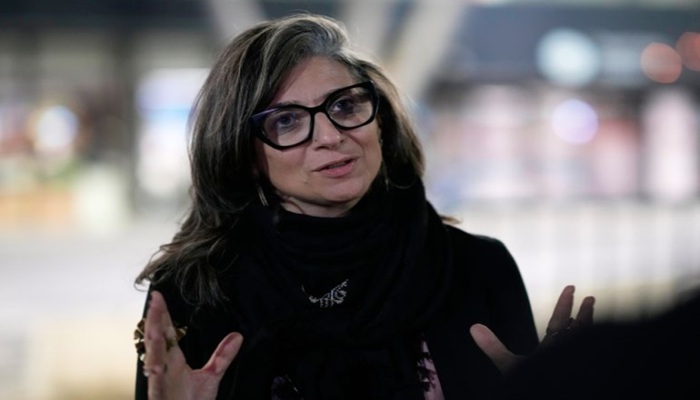
Afrasianet - "When the World Sleeps" is the title of a book published a few weeks ago by the UN Special Rapporteur on the Occupied Palestinian Territories, Francesca Albanese, and its translation into French, which was published in conjunction with its publication in Italian, which is a diagnosis of what the author called "the world's fainting", or a kind of indifference and a disturbance in sympathy for the Palestinians.
Gaza is not only a matter for the Palestinians, but it is a test of human conscience, a test of international law, international institutions, and the need to put an end to the domination of prejudices, and a gateway to the future of humanity, which restores hope after despair.
The world is calcified, and according to Albanese, the Palestinians should be inspired by the lessons: dignity despite suffering, beauty despite devastation, and truth despite fencing and blockade.
At the beginning of the book, Albanese quotes an American churchwoman, Alyssa Wise, as she says that solidarity is the political form of love. Albanese is familiar with Middle East issues and Palestinian issues because she was the United Nations rapporteur on the occupied Palestinian territories since 2022, and before that she worked with UNRWA, and she knew what Palestinians in the West Bank are subjected to in terms of the looting of their property, deprivation and subjugation.
In the course of her missions, she encountered the weapon of prejudices, representations, biased readings, and the construction of the other, and therefore she employed Edward Said in her book on Orientalism about the construction of the other, representations, and directed narratives, and sought the help of the great Italian thinker Antonio Gramsci, and how culture supports power.
Therefore, I sensed the need to reconsider the narratives, in order to be the true witness, in the words of Edward Said. As she says, from what I have translated from the French text: "Neutrality does not mean indifference, and (integrity) presupposes rigorous excavation, confronting events with the law, and telling the truth to the authority, even if it disturbs them, and in Palestine the imbalance between the occupier and the victim of the occupation, between the colonizer and the colonizer, and how decades of denial of rights have become a normal thing by an incompetent international regular."
The stake yesterday as it is today is not a cloudy and ambiguous rehearsal about peace, but rather respect for international law by ending the occupation, the settlements, and stopping the annexation.
Albanese believes that peace is possible, but on conditions that will make the international organization discover the meaning of solidarity, within one family.
After this introduction, the author chose to speak, through ten chapters, through people she met in her life, who are connected to the tragedy of the Palestinians, and each chapter refers to a side of it.
The first chapter is about "Ma'ar Ma'ar", the girl I met in the secondary section in 2010 and her interest was sparked by drawings that are filled with the love of life or the longing for life, but the longing for life is inseparable from the founding event that inhabits the conscience of the Palistian, which is the Nakba, so she devoted an initial section in the book to the Nakba, before standing with a king, who endured the tragedy of the Palestinians, and expresses it with her drawings, from which she chose a drawing for the cover of her book.
Three Palestinian voices choose from within, including six-year-old Hind, who was found dead in a car with traces of 300 shells during the war on Gaza, and near the car, an ambulance, with two dead paramedics, and through Hind, she recalls the situation of Palestinian childhood, and remembers what the 14-year-old girl's deposit told her: "The fear of death does not prevent you from dying, it prevents you from living."
Abu Hassan is the guide to the city of Jerusalem, whom Albanese met with her husband, Max, since she arrived in Jerusalem in 2010, where he takes them to the facets of life and suffering, in the Balata camp, Jenin, the settlements, and the alleys of Jerusalem, but what she learned most from the guide Abu Hassan is the arrest, the daily suffering, and the bureaucratic burden.
George, a Palestinian engineer from Jerusalem, came from the United States in 2000 to contribute to the building of a Palestinian state, but he cannot work with Western NGOs that require him not to provoke occupation and apartheid, and he cannot work with Israelis, who appear to be arrogant towards the Palestinians.
"Life in Jerusalem, for Palestinians, is being subjected to the structural inferiority imposed by Israel," Albanese says. In Jerusalem, identity is defined not between Palestinian and Israeli, but between Arab and Jew.
Albanese notes the cultural appropriation, or the adoption of Palestinian cuisine, and the blending of Central European heritage, which is acceptable and natural, if not coupled with apartheid. How do you take the product of someone you reject in the first place, or deceive him?
On the other side, or True Witnesses, Albanese chooses Alon Convio, an Italian Israeli studying in the United States, who specializes in the history of genocide throughout history. She stands with Ingrid who stands up against apartheid, and lives in Beit Jala, with her husband, Mohamed Jardat.
She cites Ghassan Abu Sitta, a surgeon who was born in Kuwait to a Palestinian family, and practiced medicine in Gaza until he was forced to leave in 2023, as he believes that genocide is the visible side of the snowmountain, and that there is no indication of the collusion of the international media.
One of the witnesses is Eyal Weizman, an Israeli-British architect, who stands for the method of eliminating the other, by taking him out of his house. Gabor Mati, a Canadian psychiatrist of Hungarian origin, insists on the need to preserve memory. He believes that his Jewish religion has been employed, in the name of a discriminatory ideology. The reality of the occupation generates a bruise, and to overcome it, awareness and empathy are required, and the important thing is to preserve memory.
The final chapter is about Max, Albanese's life partner, who lived with her on adventure in Jerusalem, the West Bank and Gaza, who carried with her the burden of a family and shared her orientation.
Albanese ends her narrative with poems by the Palestinian poet, Rifaat al-Arir, who was killed in Gaza on December 6, 2023.
When the world sleeps, Albanese argues, with indifference or prejudice, it must be awakened by people.