
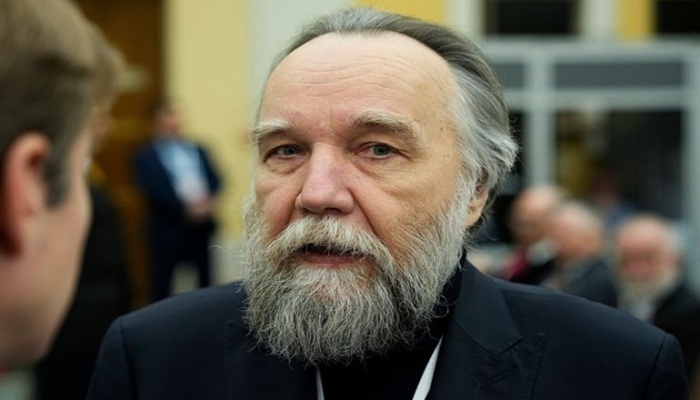
Between those who see him as a philosopher of salvation and those who see him as a pioneer of destruction, Dugin remains a unique intellectual phenomenon that raises more questions than answers.
Afrasianet - Dr. Karim Al-Mejri - it has sucked the blood of nations, shattered the spirit of civilizations, and made entire peoples captive to the hidden constraints of financial slavery," in these words the Russian thinker Alexander Dugin described the liberalism on which the world order has been based since the end of the Cold War.
At first glance, it seems as if the sentence is part of a socialist or communist proposition, especially since the writer is Russian, which leads us to think that there is a Soviet awakening or nostalgia that may have prompted him to write those words. But Dugin is far from the left and communism, under whose hegemony he was born and raised under which he in fact deeply hates, and even glorifies those he considered enemies of it, such as the philosophers Nietzsche and Heidegger.
In his book "The Trump Revolution," Dugin speaks passionately of the "revolution" led by Trump's rise around the world, which, as he puts it, helps end global liberalism and reinvigorates ideas of national and civilizational revival as defined by the Russian thinker.
In Dugin's view, Trump is not a mad right-winger, but a reflection of a Western civilizational awakening, which has a parallel on the other side of the world in Russia led by Putin, in China under Xi Jinping, and in India under the leadership of Hindu nationalist Narendra Modi.
Trump is precisely the man who turned things upside down in the United States, the backbone of global liberalism, and is the most important revolutionary.
"While Trump's first term is a temporary upheaval, his second term and his electoral victory constitute a real revolution," Dugin describes Trump's return to "shake up the bureaucracies of Washington and Brussels" (i.e., the European Union and the American state), and how it is the embodiment of a Western civilizational resurgence against liberal elites, a revolution that may be outweighed in importance by the uprisings that toppled the Soviet Union in 1991, and perhaps even the Bolshevik Revolution of 1917 itself, an exaggeration that is no stranger to Dugin's replete writings By exaggerations, and not strange to a man, like many nationalists in Russia, he holds the Soviets partly responsible for the crushing of the spirit of Russia in the face of materialism.
Dugin's Biography: Between the Father and the Soviet State
"When we win over Ukraine, we will be a thousand times stronger."
Born in Moscow in 1962 to a family belonging to the Soviet establishment, his father worked as a general in military intelligence, an icon of order, discipline and iron hierarchy. But Dugin, escaping the patriarchal grip, turned his back early on to Soviet power, seeking salvation outside of it and beyond its materialistic ideas.
From an early age, Dugin tended to read forbidden books, from Nietzsche to Heidegger, from Platonov and Julius Ivola to Christian Gnostics, indifferent to the formal curriculum he saw as an attempt to freeze the soul.
When he joined the Aviation Institute in his youth, Dugin did not seek a career, but a secret tunnel through which he would pass through the circles of mysticism and existential debates, where he became involved in youth groups that blended the Orthodox mystical heritage with European Gnosticism. He was looking for a new form of being, neither socialist nor liberal, but one that would take existence beyond utilitarianism, to the earth as a vessel of the soul.
Dugin's rebellion against his father was not only a family or psychological matter, but a foundational moment of an intellectual and philosophical journey in which he rebelled against all the absence of self in the ruling party in the Soviet model, and all the emptiness of meaning involved in European modernity. Dugin felt that his father represented a country in which he did not see himself, and that he needed a new mythology (the science of mythology) to fill this void, until his desire to break with the mainstream system turned into a holistic project To demolish the Western model, and to build an alternative vision based on spiritual and national traditions.
From his youth, Dugin was expelled from a technical institute for his ideas that were described as "subversive." However, he did not back down, but rushed to establish himself through secret cultural circles, in which he read, discussed, and wrote in search of an intellectual alternative beyond the collapsed Marxism and rising liberalism.
In Dugin's mind, Orthodox thought meets Russian nationalism, where he looks at us as a priest who moves the maps of the world with rules inspired by metaphysics, using philosophy itself as the engine of the destiny of an entire nation, drawing from both metaphysics and history, determined to give Russia its imperial face again, this time in the name of nationalism that rebels against liberalism, and the fate that geography dictates, and not in the name of workers' revolutions or the rights of toilers around the world.
However, this intellectual magic is not without its danger, as Dugin's discourse, with its ontological weight (a branch of philosophy that examines the nature of existence), quickly turns into a tool for justifying expansionist tendencies and drawing blood lines on maps. At the heart of his critique of modernity, Dugin digs a narrative that rebels against the Enlightenment mind, and is based on a mythology that restores the idea of "Eurasian destiny" and makes Russian geography a universal center of the clash of civilizations, even though he claims to formulate a fourth political theory that is far from liberalism, fascism, and communism. In fact, many see in his thought as intersecting lines with the nationalist and Nazi ideologues of the 1940s.
From Eurasia to the Fourth Political Theory
"The idea of the Russian state is rooted in traditional and orthodox religions, and in the indigenous peoples of our country, for whom Russia is their only motherland."
In his reference book "The Foundations of Political Geography: Russia's Geopolitical Future," Dugin presents his grand vision of the world and divides it into two conflicting civilizations: a maritime civilization represented by the United States and the liberal West, and a land civilization represented by Russia, as the nucleus of a spiritual Eurasian empire facing the West. Dugin does not read geography as mere terrain, but rather sees in it the fate of nations and states. Political borders are not borders between states, but rather obstacles and barriers between spiritual and existential entities.
For Dugin, Heidegger's philosophy constitutes the deeper philosophical background: just as Heidegger saw that the West has deviated from the question of being, Dugin believes that Russia can recorrect this deviation by returning to the land, not as a monarchy, but as a root of identity.
In Dugin's thought, the earth is not a territory, but a destiny, and every separation from geography is a separation from existence. Thus, the Russian entity becomes the last guardian of existential reality, and the confrontation with the West is not a struggle for influence, but a struggle for meaning.
This is where Dugin's second and most controversial book, The Fourth Political Theory, is born, in which he declares a break with the three political theories that have governed the modern world: liberalism, communism, and fascism, calling for them to move beyond a fourth model based on identity, tradition, spirit, and myth.
This fourth theory is not just a technical alternative, but a project of salvation in which politics transcends itself and becomes an ontological question, as Dugin does not present a political program in the classical sense, but rather presents a new ontological framework that links politics and being. His fourth theory is therefore an attempt to transcend the disintegration of modernity by restoring the vocabulary of the traditional world, where the idea of a unified group is preceded by Western individualism, myth over technology, and symbolism by instrumental reason.
The fourth political theory found its resonance among the European radical right, in Latin America, and among some voices in the Global South seeking postcolonial narratives, and it also influenced some elites in Eastern Europe, where it was invoked in discussions about cultural sovereignty and civilizational identity. However, this theory remained confined to the circles of intellectual elites, due to its deep philosophical composition and spiritual temperament, and did not find a way to translate it into practical political programs.
For Dugin, Orthodox Christianity is not only a religious background, but an integrated ontological horizon, for which religion is not merely an individual practice or a social ritual, but a symbolic system that simulates the existential depth of being. His openness to Eastern mysticism and to the ancient Byzantine spirit made him see in Russian Orthodoxy the secret of the nation, the bearer of its memory, and the instrument of its salvation from material modernity.
In his writings, he recalled Orthodox spiritual symbols such as the most famous Russian saint, Seraphim Sarovsky, and incorporated them into political statements, so that in Dugin's thought the Church was transformed from a devotional space into a symbolic incubator of sovereignty. When Dugin speaks of Russia as a spiritual force, he is literally referring to it: Russia as a nation with mythological energy, a civilizational mission, and an earthly manifestation of holiness.
Dugin and Power: From the Fringes of Thought to the Kremlin
"For a quarter of a century, Vladimir Putin has worked to right the grave wrongs and consequences that led to the fall of the Soviet Union and the destruction of our ideology, system and industry in the 1990s."
Although he has never held an official position in the state, Dugin's influence has extended to the corridors of Russian power, touching the walls of the Kremlin, and although he remains in the background, he does not appear in the news or on the lists of advisers, but he is present in the formulation of narratives, in the defense of Putin constantly, and in the language adopted by the state when it talks about fate, about the enemy, and about historical destiny. In an interview with Russian media, he said: "They want me to be a minister or an official adviser, but the truth is that I work from the core of the idea and not from a specific chair."
When Russia annexed Crimea in 2014, the world stood between praise and condemnation, each according to its position in the world order, but Dugin's followers found it to be more than just the restoration of a lost territory: Crimea was a "sacred land" reclaimed in the name of historical Russia, and in the name of Eurasia, not just in the name of the contemporary Russian state. The state's rhetoric about identity, the decadent West, and the holy war on liberal decadence seemed like a literal borrowing from Dugin's dictionary.
The contents of Dugin's book, "The Foundations of Geopolitics," were climbing off the bookshelves to speak in the words of officials. The moment Crimea was annexed and the rise of Russian identity began to become clearer, Dugin's phrases such as "Russia's privacy," "the debate of fate," and "the coup against liberal values" came to the fore, and the speeches of Russian President Vladimir Putin and the elite began to resonate so that it became difficult to distinguish who was quoting from the other. Thus Dugin seemed to have become like a "new Rasputin", neither making decisions nor issuing orders, but breathing life into the symbols of power itself and reshaping the collective imagination.
This overlap was not a coincidence. Dugin studied at the General Military Academy, trained a number of Russian army officers, participated in high-level intellectual meetings, and even his spiritual son, as he is called, General Vladislav Sorokin, played a pivotal role in the development of Russia's new military doctrine based on a combination of psychological, geopolitical, and symbolic warfare.
With the outbreak of the Ukraine war in 2022, there was more talk of "historical Russia," "the moral corruption of the West," and "the battle against nihilism," all of which were used in Dugin's books before they were circulated by politicians and the media. At that moment, Dugin's project seemed to have moved from the margins to the center, from intellectual circles to the battlefields. In all of this, Dugin did not impose himself on power, but convinced it that it needed an existential myth, mythology, and narrative: "Russia is not a state, but a destiny, and this battle is not a border battle, but a battle between two entities."
The tragedy of Daria Dugina: Personal pain turned into a legend
"The pain of losing a daughter is like the death of half a soul. Daria was not only a student, but she was an extension of my mind, and a light on the path of the fourth theory."
On a summer evening in August 2022, Moscow was mired in official celebrations and growing concern about a widening war in Ukraine when a sudden explosion resounded on a suburb of the capital. The attack was not aimed at a military site, nor an official building, but a small car carrying a young girl, Daria Dugina, the daughter of the Russian philosopher, who was burned in an instant, leaving her father kneeling on the ground, stunned, clutching his head as if the universe had collapsed on top of him.
Daria was not just a daughter in the direct family sense, but a living continuation of the thought of Alexander Dugin, a journalist, political analyst, and rising intellectual, who represented the practical embodiment of her father's theses, defending the Fourth Political Theory, attacking Western liberalism, and calling for a new Eurasian dawn. On talk shows, she spoke in a tone similar to his voice, and in her articles his ideas echoed, as if they were an organic extension of him, not just a blood relative.
But even this tragedy has turned into an ontological moment in Dugin's dictionary. He then wrote that Daria did not die in vain, but rose for the sake of the "Russian spirit," and that her death once again revealed the difference between a civilization offering its martyrs as a sacrifice to a universal idea, and a civilization that is drowning in nihilistic relativism.
Dugin made his tragedy a new document of condemnation against the West, and against all those who do not believe in Russia's "universal" message. Dugin's assassination increased Dugin's symbolism within the conservative and spiritual currents in Russia, with some beginning to speak of him as a "martyr father" and a "political monk" who paid for his ideas with the blood of his family. While the finger was pointed at Ukrainian intelligence, the tragedy of Darya took on a mobilizing dimension in Eurasian circles, as a victim of the "war of civilizations."
Daria was not a spin-off episode in Dugin's life, but a spiritual and intellectual complex. Her death was a test of philosophy's ability to withstand pain, and the thinker's ability to turn a wound into a narrative. In Dugin's world, even death does not end at the threshold of annihilation, but becomes a new representation of the message, another cry on the battlefield of meaning.
The view of Dugin inside Russia
"We need an elite that thinks about the future, a truly traditional and conservative Russian elite, and we need that Russian effectiveness in building our state."
Despite the mythical aura surrounding Alexander Dugin within the nationalist conservatives and Orthodox spiritual currents, his thought has not been spared harsh criticism, even from within Russia itself, and some of Russia's most prominent academic and cultural voices have expressed their fears about the "doggin project", considering it a dangerous slide towards a totalitarian ideology wrapped in philosophy, and some even described him as an extremist and a neo-fascist.
Before proceeding to list these criticisms, it is important to dwell on the nature of Dugin's complex relationship with Russia's cultural elites, as he did not come from the heart of Orthodox academic institutions, nor from the paths of liberal intellectuals. He has always been a marginal case that gains popularity from its ability to challenge the center, but as his rhetoric rose within the state, the margins have shifted to center, and this is where the rebound began.
At universities such as the Moscow Institute of Philosophy and the Russian Academy of Sciences, leading philosophers have warned of Russia slipping into a "fictitious Eurasianism," noting that Dugin's theses mix history and mythology without a solid scientific basis, with one even calling him "more of a political novelist than a thinker," while another said, "If philosophy begins with questioning, Dugin begins with faith, and this is a danger to the Russian mind."
The criticisms were not limited to academics, but also to warnings about the impact of Dugin's thought on the country's domestic and foreign policies. Some argued that the deification of the Russian state into a metaphysical entity might justify repression and provide ideological cover for expansionism and militarism. Dugin was also accused of reproducing new imperial narratives that exclude minorities, demonize the other, and reduce the world to an "us or them" dichotomy.
Perhaps the most prominent criticism came from within the Orthodox movement itself, where some conservative clerics expressed reservations about Dugin's identification with Heidegger's "ontology", in which they see materialistic or Gnostic seeds that do not agree with the Orthodox faith, and one prominent bishop said that "those who want to serve the Church should not summon Nietzsche and Heidegger to explain the mystery of Christ to them."
Even within the Russian nationalist currents, there are those who believe that Dugin's project is heading towards an over-the-top utopianism, and that the establishment of a policy based on metaphysics and symbolism could lead to a catastrophic failure in the face of a changing real world. They did not deny the importance of his ideology in reviving the nationalist spirit, but they warned against turning this thought into an ideology of the state.
In the West, a German journalist described him as "a magician who dreams of reviving a nationalist Russia on the ruins of liberalism and modernity, and more dangerous than any Russian ideologue since the Bolshevik Revolution." The famous European report said of him: "Dugin is the ideological brain behind the new Russian aggression," while he was placed on the "sanctions lists" and banned from circulating some of his books and ideas in Western institutions. Despite his denunciation by Western universities, many academics acknowledged his uniqueness: "Dugin offers a philosophical map of Russian politics that cannot be ignored if you want to understand Putin and the Kremlin."
Still, Dugin has survived and even benefited from this controversy at home and abroad. For him, criticism is not a threat, but a sign that he is penetrating consciousness and establishing a transition. For his supporters, these criticisms represent exactly what he is fighting against: the power of an elite that refuses to recognize the sacred and insists on remaining trapped by relativism and skepticism.
Thus, within Russia itself, Dugin became a frontier figure: either a prophet of the new Eurasian dawn, or a philosophical heresy that leads to the abyss. In between, the "Doginian myth" continues to expand, fueled by wars, protected by rituals, and debated intensely.
Dugin as a Unique Philosophical-Political Case
"Today we can confidently say that Putinism has won in the United States. America voted for "a man like Putin."
What makes Alexander Dugin a phenomenon beyond Russian geography is his ability to penetrate world political literature with a spiritual tone that is out of the ordinary: he is not just a philosopher in a nationalist moment, but a creator of a new language in the description of power, the world, and its conflicts, combining political theology, existential metaphysics, and imperial geopolitics, to offer the world another model of what the state can be, and what sovereignty can mean. In other words, Dugin not only offers a critique of the liberal world, but also an alternative conception of it.
Heidegger once said that "the road to the future sometimes passes through impassable roads," and so Dugin seems to respond to this call, a path for Russia through the ruins, full of myths and sacredness. Perhaps this is what makes Dugin's thought a rich material for scholars and writers around the world, both on the right and the left, as it cannot be treated as a marginal phenomenon, but rather as a worrying mirror of the collapse of a global intellectual system, and a Russian attempt to reshape the world in a different lexicon.
One of the most prominent aspects of Dugin's objective criticism is his tendency to use major philosophies – from Plato to Heidegger, from Schmitt to Nietzsche – to recreate a sacred Russian image of the world, without stopping at the structural contradictions of these references.
Criticisms of Dugin's thought do not stop at the limits of the philosophical structure of his thought, but also deepen its instrumental nature. Dugin did not hesitate to put his intellectual system at the service of the Kremlin's geopolitical agenda, especially with the invasion of Ukraine, which made him more like a "Foucault Tsarist" who uses language to produce power, not to liberate the mind. Some Western readings warn that Dugin positions philosophy as a mere means of reviving an imperial discourse based on rejecting the West, not only as a political adversary, but as a rejected ontological existence.
While Dugin tries to give Russia a "spiritual-civilizational" role as opposed to the material West, the political reality assumes the opposite: Dugin's rhetoric is the cultural face of the machinery of domination, a metaphysical voice of the clash of states, not a dialogue of civilizations. Dugin's world seems to be imbued with mythology and a critique of modernity from Russian spiritual and nationalist perspectives, but in the end it carries within it the seeds of closure, replacing the rationality of the Enlightenment with a totalitarian metaphysics that does not explain or liberate the world, but sanctifies the land and culture, according to one identity, one land, and one will.
Between these two opposing positions, the question of reception itself remains part of Dugin's philosophy: he presents himself not as the author of a "theory that is deviable from context", but as the embodiment of an intellectual experience that stems from the heart of the conflict, and from the womb of a civilization experiencing an identity crisis. Therefore, judging it is inseparable from judging what it represents: are we in a multipolar project based on a balance of symbols and identities? The political forces the reader to take a stand, because it does not live in the gray area, but rather exalts the importance of bias, and demands that the reader choose his position in the existential war.
Alexander Dugin, a Russian thinker who mixes the wise and the provocateur, provokes a storm of debates in literature and the press. His texts are full of symbolic charges and echoes of prophecy, holding the reader to the line between the seduction of language and the clash of civilizations, and there is hardly any distinction between philosophical reflection and political statement. In his writings, the image of the West as an eternal enemy intersects with Russian nostalgia, and so there are those who see him as a defender of authentic identity, and there are those who portray him as a orator of closure and authoritarianism.
Dugin's visions may surprise us with their symbolic charm, but they leave us with a painful question: When does the defense of roots become an obstacle to man's celebration of pluralism? Between enthusiasm and aversion, between those who see him as the philosopher of salvation and those who see him as the pioneer of destruction, Dugin remains a unique intellectual phenomenon in our contemporary world, raising more questions than answers.
A Futuristic Vision: Postmodern Philosophy in a Time of Uncertainty
"The theory of a multipolar world is still an immature space in international relations, but its foundations have already been laid thanks to my writings, books, articles and lectures."
In a volatile world in which the old disintegrates without the new yet appearing, Dugin's philosophy emerges as a cry confronting nothingness in a sense, maneuvering chaos with an imagined grand narrative. But the most pressing question is: What awaits this thought that transcends the moment, deliberately obscures, and oscillates between myth and strategy?
For Dugin, the future is not just a temporal development, but a stage of symbolic epics. Although the Fourth Political Theory has not become an overarching ideology as its author had hoped, it remains lurking in the minds of groups around the world seeking salvation outside the market, outside of technology, and outside of familiar Western formats. Inside Russia, Dugin's thought remains the existential question of Russia's identity. Every crisis with the West, every fragmentation of the international system, will be an opportunity for the return of the Eurasian discourse as a It can be argued that Dugin's philosophy has become the "philosophical unconscious" of the Russian system, even if it is not mentioned by name.
But Dugin's fate, like his philosophy, is fraught with contradictions: on the one hand, he speaks a sacred language in an age of holiness, and on the other hand, he is inspired by pragmatic strategies and in favor of a particular authority. Can the spirit continue to frame the political decision without becoming a tool? Will Dugin, a thinker and a symbol, survive being entangled in the state machine that needs him without explicitly acknowledging him?
Dugin's legacy remains open to possibility. He may one day become a global reference in a time of collapse, or he may become an unread prophecy, or just an exaggerated tool in portraying its importance, and it itself exaggerated it, as his words above indicate, and the Kremlin cleverly used it at a moment when narratives around the world are scrambling, but in any case it has made its mark thanks to the controversy he constantly raises, his relationship with power, and his challenge to global liberalism.