
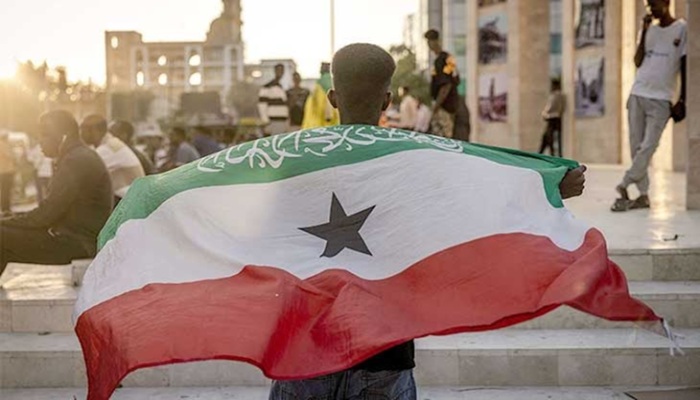
Afrasianet - Al-quds - With Benjamin Netanyahu's announcement of an agreement "in the spirit of the Abraham Accords" with Somaliland, Israel has become the first country to recognize the region as an independent state, breaking an international, African and Arab consensus.
The African Union (AU) on Friday rejected Netanyahu's announcement, calling the recognition a warning "to send a dangerous precedent with far-reaching repercussions that threaten peace and stability across the continent."
The representative of Somalia at a meeting of the Arab League Council on Sunday linked "support for a separatist entity in Somalia" to Israel's quest to achieve "the forced displacement of the Palestinian people from their land", noting that the move represents "a direct attack and harm to Arab national security as a whole and the security of navigation in the Red Sea", which the Arab foreign ministers also referred to in their statement, which rejected the link between the recognition and the plans to displace the Palestinian people from their land.
In these major political circles, Netanyahu's announcement can be considered a new strategic shift in the major security fault lines in the Arab and African region, and it is certain that Arab capitals considered what happened part of the siege on them on several fronts.
In addition to being easily framed within Israel's ongoing plans to find places for the displacement of Palestinians, the step is also an investment in several geopolitical, security, and economic goals, in which beneficial or damaged political circles, states, and parties are involved.
For example, it is not difficult to link what happened to US President Donald Trump's meeting with Saudi Crown Prince Mohammed bin Salman, and the resulting American approach to finding a solution to the war in Sudan, to support the government of Ahmed al-Shara in Syria, and to approve arms deals, including F-35 jets, which Israel objects to selling to Riyadh.
The quick response to the initial US-Saudi agreement came through the advance of the Rapid Deterrence Forces and their control of the city of El Fasher, and their siege of areas in North Kordofan, followed by a visit The head of the Sudanese Sovereignty Council, Abdel Fattah al-Burhan, and the Egyptian presidency's statement about the "red lines".
This was followed by another quick attack, but this time in Yemen, where the forces of the Southern Transitional Council (STC) took control of the governorates of Hadramawt and Al-Mahra, followed by a Saudi statement calling on the STC to withdraw from the areas it occupied, raids on its forces, and a warning from Saudi Defense Minister Khalid bin Salman.
The ongoing rifts in Sudan, Somalia and Yemen pose real risks for Egypt, which is busy protecting the Suez Canal, as the most important international shipping lane. Added to this is Cairo's growing sense of the danger of Israel's rapprochement with Ethiopia, whose construction of the Renaissance Dam has been a major problem for Cairo.Riyadh, in turn, has significant interests in the Red Sea and the Horn of Africa, and after recent developments in Yemen, Israel's recognition of Somaliland as a state will be considered a new risk that must be reckoned with.