
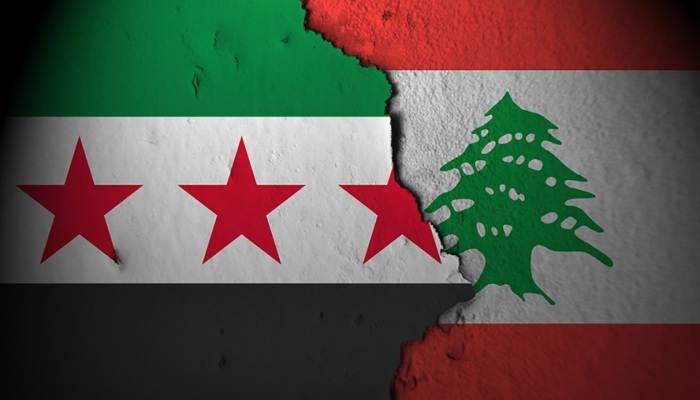
Afrasianet - Batoul Wahbi - The more Syria shakes, the less Lebanon's ability to catch its breath diminishes; the more the world is preoccupied with the "stability of Damascus," the easier it is for "security adjustments" to be passed in Beirut.
Lebanon today is not only in contact with a single threat, but it is also surrounded by a pressure system that is managed in the form of layers: an Israeli class that produces facts on the ground and gives them soothing names such as "safety lines," an American class that changes phrases and fixes direction, and a regional class that crowds over the sea and land – with Turkey at its heart – while Syria is gradually regaining itself as the arena that supports and multiplies this pressure.
The irony is that much of the debate in Beirut still deals with Syria as an "ongoing file," while the major powers treat it as a "key" to opening the Lebanese locks: the borders, the army, the economy, and the equations of deterrence.
The statements of the Chief of Staff of the occupation "army", Eyal Zamir, about the establishment of "safety lines" in Lebanon, Syria and Gaza are not just a military sentence. It is a new definition of occupation in a more marketed form: an occupation without a declaration, an incursion without major battles, and a positioning that is presented as a defense, in essence the transfer of the border to where Israel wants, not where the law recognizes.
What Israel is actually saying is this: a ceasefire does not mean a ceasefire; it means a fire management. Agreements are used as a cover to impose a regular "routine of aggression": raids, operations, fire messages, and then demanding discipline from the other side.
This is how the "facts" that later become negotiating axioms are made: the point of control becomes a "security necessity," the occupied hill becomes a "defensive belt," and the daily breach becomes a "response to a breach."
This same logic applies to the south in Lebanon and north to Syria. Here, Syria is not a parallel arena to Lebanon, but rather a complement to it in a single Israeli architecture: dismantling the periphery of the resistance into security pockets and establishing new lines of separation under the pretext of preventing the "growth of force."
Making a pretext and expanding the theater
In moments of transition, Israel does not need a major event within the region to act; it is enough to have an "interpretable" event abroad. The Sydney attack, Australia, as its implications show, is an example of an attempt to expand the concept of "danger" from a political conflict to an issue of universal identity: anti-Semitism, global extremism, the need for international alignment... He then quickly linked Iran to refill the indictment book in preparation for any military move or widespread political pressure.
The Palmyra incident came as a field incident inside Syria, from which a bigger gate is opened: Syria is presented to Washington as a common arena of confrontation, which invests in changing American calculations and rearranging Syria's security and military structures under the guise of "purification" and "change of doctrine." The problem is not in the headlines, but in the function: the restructuring of a military institution in a country in crisis, with the integration of discordant components, amid an environment that can be penetrated and strife, which makes Syria a platform that can be shaken... Any vibration in it reverberates directly on Lebanon.
Israel knows this all too well: the more Syria is shaken, the less Lebanon's ability to catch its breath decreases; and the more the world is preoccupied with "stabilizing Damascus," the easier it is to pass "security adjustments" in Beirut.
Sharia as a reality invested by Washington... Israel is targeting him
Here we must be precise: Talk of the new Syrian authority is not a position of support or justification. It is a reading of a reality that Washington is dealing with as a card in a transitional phase, while Israel is working to undermine, blackmail or prevent it from producing real stability.
Therefore, any Syrian-Israeli "security agreement" that is being negotiated or faltering is not an internal Syrian affair. It is part of a regional pressure equation:
If the security track in Syria succeeds according to certain conditions, the conditions will be re-exported to Lebanon.
If it fails, the southern Lebanese front will be opened as the easiest stage for imposing facts.
In both cases, Lebanon is the recipient of the results, not the maker of them – unless it has a clear policy that recognizes that the risk is measured not only by the borders, but by the paths that are managed beyond the borders.
The Syrian coast... The economy as a new front for conflict
The talk of the ports of Tartus and Latakia and the contracts of Dubai Ports and Chevron may seem like a separate economic topic, but in fact it portends a larger shift: the Syrian coast is being re-positioned as a transit and investment platform, that is, as a sovereign-economic space that could rearrange the map of influence in the Eastern Mediterranean.
This is where Lebanon becomes in a sensitive position:
There is a proposal that believes that Lebanon can be a "partner, not an intermediary" through funding, expertise, and logistics, but the real value of this proposal is not shown on paper, but in the balances: who will ensure that Lebanon becomes a partner, not a vassal?
The most dangerous thing is that Israel does not treat the economy as a door of prosperity; it treats it as a door of control: trade corridors, power cables, gas lines... All of these can turn into pressure tools if they are not acted upon with sovereign logic.
Why does Turkey's objection matter?
Turkey's objection to the demarcation of the maritime border between Lebanon and Cyprus is not a legal detail. It is a reflection of a larger conflict in the Eastern Mediterranean, where Ankara sees any maritime engineering built outside the Blue Homeland's calculations as weakening its influence and perpetuating a counter-axis.
Turkey's presence in the article is not because it has direct influence inside Lebanon, such as American or Israeli influence, but because the Eastern Mediterranean has become a single arena: what is drawn in the sea is reflected on land, and what is decided near Cyprus may reverberate on northern Lebanon, on the sea-land relationship with Syria, and on the future of power lines.
It is precisely here that the Syrian file becomes more present: the maritime border with Syria, the overlapping land borders, and the satiety... These are all outstanding sovereign files, and any regional rearrangement in the Mediterranean will push for "compromises" that may not take into account Lebanon's interests.
Beirut Official... Risk without management
The problem is not only that Lebanon is under pressure, but that the state institutions are dealing with the danger as if it were a passing wave: waiting for "guarantees" that don't come, betting on committees that don't bind Israel, and recycling language instead of producing a decision. The article does not need direct accusations, but the reader has the right to understand that the absence of risk management is part of the risk.
When there is no strict official definition of what is going on — is it a breach? an occupation? an aggression — the Israeli narrative becomes easier: "We respond to violations," "We prevent the buildup of force," "We protect our population." Over time, the occupation becomes a fait accompli, pressure becomes a path, and procrastination becomes politics.
What brings all these strands together?
The scene, in essence, is not "sporadic developments." It is a regional reset project:
Israel is building lines of control and calling them security.
Washington is changing the pressure tactic but not changing the target.
Syria is being run as a test front: if it stabilizes on conditions, conditions are issued to Lebanon; and if it is shaken, the vibration is used to put pressure on Lebanon.
Turkey objects at sea because it sees that the Mediterranean is being redivided, and Lebanon may be led to axes that do not serve it.
Therefore, Syria's impact on Lebanon today is not measured only by borders, refugees, and security. It is measured by the fact that Syria has become a leverage: used to stabilize Israeli realities, to expand the geography of "pretexts," and to redefine what allows Lebanon to be in the region.
If Lebanon does not deal with this reality with a sovereign and strategic mind, it will continue to receive the waves instead of building dams:
Sydney is investing in a pretext, Palmyra is investing in a transformation, the Sahel is investing influence, and the South is investing in a test... Every time Lebanon is told that time is running out, what is actually running out is the margin of decision.