
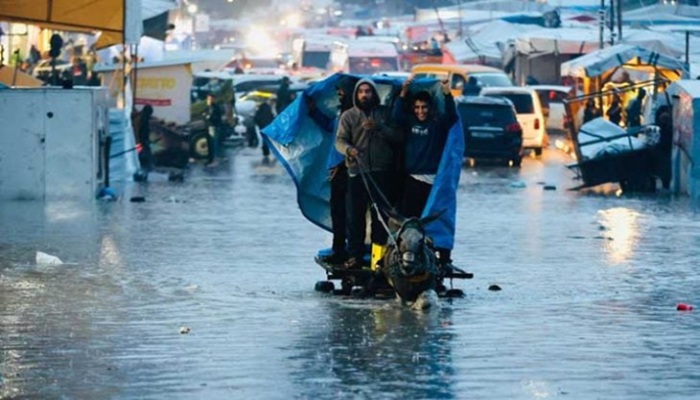
Afrasianet - Suhail Kiwan - Channels mock the Israeli media and gloat at the hundreds of thousands of people of the Gaza Strip, whose tents have been flooded by the rainwater, and this media hopes that the rain will increase so that they will drown more and more until they disappear.
Rain is a blessing that people are waiting for, and when it is delayed, people worry and fear the consequences, so they pray for rain and mercy, and mercy is used as a metaphor for rain. "Winter, O world, our season increases and sweetens." In the neighborhoods, children sing "Shti Ya Dunya and Zidi Betna Hadidi", an expression of safety under the roof and within the walls of a warm house.
But what if the house is a tent? And not the Bedouin tent of poetry! But a tent made of thin cloth! What if the owner of this tent and hundreds of thousands like him could not find a place to pitch their tents except low ground to which the occupation pushed them to push? And what if the wind is strong and its stakes are uprooted?
People are confused: do they pray for rain to save themselves from thirst, purify themselves and get enough water for washing, cooking, purification and other necessities? Or do they pray to God to withhold the rain from them? And about their tents, because they are unable to protect them and their children!
The rain has become a direct threat to their lives, and it is a continuation of the war that the occupation has not yet committed to stopping.
When a person dies because his tent did not withstand the rain, or because his body did not withstand the cold, this death cannot be separated from the context of war, and it is not a natural disaster.
The rain in Gaza is not only a climatic event, but also a political event related to what preceded it, within a long-term siege system, followed by a war of extermination that killed and injured hundreds of thousands of people, wiped cities off the face of the earth, and destroyed infrastructures, prepared for this land, roads and lanes necessarily for water retention and then floods, which carry with them various forms and types of pollution.
Gaza is suffering from a severe shortage of potable water, and the rain is supposed to solve this dilemma, but it is turning into a new source of suffering, and even a disaster, in addition to the many disasters.
More than 90 percent of Gaza's water is undrinkable, according to UN reports, as the groundwater is polluted, due to the long blockade on it, because of the hundreds of thousands of tons of explosives that landed in it, because of the breakdown of sewage lines and plants, and because of the disruption of desalination plants, which rely on unstable electricity, because they need fuel that is regularly supplied, while the water infrastructure has been subjected to massive destruction due to wars, especially the recent war in which the occupation leaders raised their criminal slogan "No water. No electricity, no food, no medicine."
It is a direct result of a long blockade that prevents development, restricts the entry of various materials for construction, work, and repair, and paralyzes the ability to plan for the long term, so when it rains, water is not stored or managed, but seeps and wastes, and becomes an additional cause of suffering, despite the people's desperate need for it.
It doesn't stop at the limits of danger or damage, and in some cases even death from cold, or diseases caused by pollution. Rain has become a direct cause of loss of life. Tents are being uprooted, water is leaking into shelters that have been flooded, and bodies already exhausted from hunger, cold and disease are unable to bear it, especially the bodies of the sick, the incapacitated and children.
These deaths are often not recorded as victims of war, nor as victims of shelling, but are briefly reported as accidents or natural disasters, but their truth goes much further: they are the result of political decisions par excellence, as they are programmed to reach this stage and have not yet been completed.
When a person dies because his tent could not withstand the rain, or because his body could not withstand the cold and stagnant water, as happened with the two-week-old child Muhammad Khalil Abu al-Khair, or because of a virus caused by it Contaminated stagnant water, this death cannot be separated from the context of war, and it is not a natural disaster.
It is a direct sequel to war crimes. It is an inevitable consequence of the policy of preventing reconstruction, forcing people to live in tents, depriving people of basic protective equipment and even new tents sufficient for large numbers. In this sense, these deaths are added directly to the war crimes register, because they are a direct result of the occupation's policies, not the fluctuations in the weather.
The Israeli occupation bears the primary responsibility for this reality, the occupation does not only control the crossings, but also controls Gaza's ability to build modern networks and maintain what has been destroyed.
In each round of escalation, what is left is destroyed again, and Gaza returns to a point below zero, in a tight cycle and with malicious and criminal planning to keep the place in a chronic crisis. However, responsibility is not complete without stopping at the role of the international community.
Gaza is not a disaster area by nature, but rather a civilian territory under the control of an occupying power as defined by international humanitarian law. However, the international system insists on treating its crises, including floods and water crises, as "humanitarian emergencies," rather than the political consequences of the occupation and ongoing violations.
The cruel irony is that the world, in which millions have taken to the streets in solidarity with the Gaza Strip against war crimes and to stop the aggression against it, seems to be unaware of or unwilling to realize the seriousness of the floods on the residents of the tents, as a continuation of the war that has not yet ended. Even the religious and social dimension is not immune from this imbalance.
In prayers, imams in Muslim countries find themselves confused by a harsh question:
Do they pray for rain, which is a real need for a besieged people who yearn for clean water?
This is the need of the people who are far from the siege! Or do they call for it to stop, in solidarity with Gaza, which cannot bear more water than it carried, and still bears the burden of bombardment and destruction?
In summary, Gaza does not suffer because there is a lot of rain, rain is good, but it suffers because it is forbidden to prepare for it. This is the result of a clear policy, to keep the place and its inhabitants in a permanent tragic state, whether through direct war or through a long siege and the contamination and destruction of the land, to force people to think about leaving, because the suffering will continue and haunt them in any case.
As long as the occupation continues, the blessing of rain will continue to be threatened with a turn into a curse, and good and mercy into evil and savagery.
The responsibility lies with those who destroyed the infrastructure and turned cities into rubble, and then forcibly pushed people into the open in low-lying lands without drainage networks or insulation materials, and deprived them of the most basic necessities for the prevention of winter cold and torrents, as well as various technologies that aid in drainage and prevention of water.