
Afrasianet - The Israeli human rights group B'Tselem has published a lengthy report on Israeli crimes in the Gaza Strip, in particular the forced displacement of Gaza residents during the war, stressing that since October 2023, the Israeli regime has been carrying out ongoing genocide in the Gaza Strip.
The organization's report initially stopped at the number of casualties and injuries during the war, based on the reports of the Palestinian Ministry of Health in Gaza, which estimated the number of people killed as a result of the direct attack at about 68,519 people, the vast majority of whom were civilians who did not take part in the fighting, while the number of wounded was estimated at about 170,382 people.
However, the organization said that a series of studies, published over the months of the attack, indicated that these figures were an underestimate of the number of fatalities, and that there was reasonable reason to believe that the number of casualties suffered by Israeli attacks was much higher.
Waves of displacement
In its report, the organization talked about, among other things, the main "waves of displacement" in the Gaza Strip since October 2023, noting that dividing what happened into "waves" is a simplification of the displacement routine and the dynamic and continuous displacement of the population from their areas, which has dictated the course of life of the residents of the Gaza Strip non-stop, since October 2023.
Between October 2023 and October 2025, the Israeli military issued at least 161 evacuation orders to Gaza residents, many of which were ordering the evacuation of dozens of areas at the same time.
First Orders. The beginning of displacement
The organization stated in its report that on October 13, 2023 (just 6 days after the outbreak of the war), the Israeli military issued the first mass eviction orders for the residents of the Gaza Strip, which ordered some 1.1 million residents of the northern Gaza Strip to leave their homes and displace south within 24 hours.
She said that hundreds of thousands of people, who were under heavy shelling at the time, had to make a hasty decision about where they would flee to, without knowing if and when they would be able to return home. As a result, many began to flee to the central and southern Gaza Strip with little equipment they could carry on their bodies.
The second wave came in December 2023, about two months after the start of the war, and coincided with the start of the offensive on the area of the city of Khan Yunis in the southern Gaza Strip, where the Israeli army ordered about half a million people who were in Khan Yunis and the central Gaza Strip, almost half of whom were displaced people who arrived in those areas from the north during the previous two months, to evacuate an area of 80.8 square kilometers, about 22% of the Gaza Strip. Most of them arrived in the area of Rafah city.
On May 6, 2024, the army issued new evacuation orders asking those in Rafah city to move toward what it described as the new and expanded "humanitarian zone" in Mawasi, which from December 2023 to May 2024 shrunk from about 22 percent to about 17 percent of the Gaza Strip, according to the report.
October 2024 witnessed another wave of displacement, following the launch of what was known as the Generals' Plan, which sought to try to displace the remaining civilians in northern Gaza through starvation and siege.
Residents of Gaza City and the towns of Beit Hanoun, Beit Lahia and Jabalia were asked to flee south to the "humanitarian zone" in Mawasi.
Israel's practices in the northern Gaza Strip, including its large-scale policy of starvation and destruction and the displacement of hundreds of thousands of people from their homes, have been seen by many experts, including the UN Secretary-General, as an attempt to carry out ethnic cleansing.
Back to the North
Between January and March 2025, nearly half a million displaced people returned to the north after a ceasefire signed at the beginning of 2025, many of whom spoke of the devastation they saw with their own eyes in the places where their homes, neighbourhoods and cities once stood.
From the violation of the ceasefire on March 18, 2025 until September 2025, Israel has completely stopped designating designated "humanitarian zones" in its evacuation orders to Gazan residents, but at the same time has continued to displace people from their homes in various areas, both in the north and south of Gaza.
At the end of August and the beginning of September 2025, Israel launched a large-scale offensive on Gaza City, and for the first time since March 2025, designated a new "humanitarian zone" in the vicinity of Khan Younis, covering about 11 percent of the Gaza Strip.
Conditions of the displaced
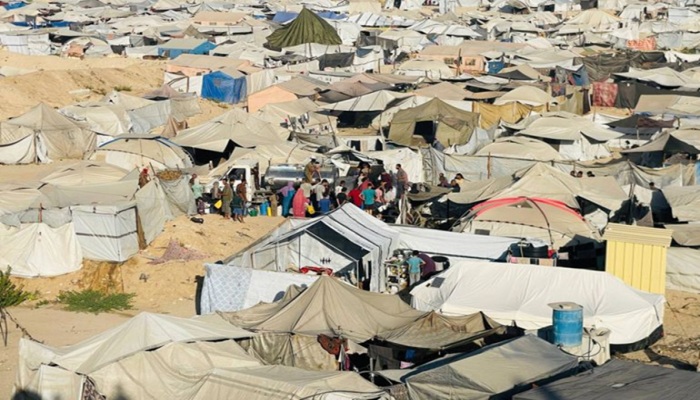
The organization spoke at length about the harsh conditions prevailing in the displacement camps, including severe overcrowding and severe shortages of food, clean water and basic services, as well as epidemics, lack of care for the wounded and people with disabilities, and the denial of the entry of basic necessities such as crutches and sanitary pads.
She also spoke of the ongoing effects of displacement, including severe mental health impacts among the population of the Gaza Strip.
She pointed to a study of displaced people in the Gaza Strip, conducted in October 2024, which found that between 70% and 90% of participants met the criteria for diagnosing PTSD.
The study also showed that 63 percent of them had serious signs of anxiety, depression and PTSD at the same time.
Unlike previous conflicts, where displaced people were able to find alternative shelter at some point, the researchers believed that this time displaced people in the Gaza Strip remained trapped inside a raging war zone for several months, without the possibility of re-settling, ensuring basic security for themselves or starting the recovery process.
Siege and starvation
In addition to the successive waves of mass displacement, the famine in Gaza is not a byproduct of the war, but rather the expected result of Israel's deliberate and declared policy of starvation, which has systematically destroyed and disrupted most of the food production and distribution systems that existed in the Strip.
While it systematically prevented food from entering Gaza, at the end of May 2025, a U.S. agency called the Gaza Humanitarian Foundation (GHF) began operating four "relief centers" in the Strip, which were set up with Israel's encouragement and support, according to the report, with the goal of forcing Gazans to gather in densely populated areas designated by Israel as humanitarian zones.
From the very first days of their activity, the United Nations representative had described these compounds as "death traps", where starving and exhausted crowds were forced to stand in heavy crowds and compete among themselves for the few aid packages, under fire from Israeli forces present in the area, ostensibly securing food distribution.
Almost every day the centres were operational, dozens of people were shot dead in their vicinity, most of them residents of displacement camps who arrived in an attempt to get some food for themselves and their families, she said.
Trial and Reconstruction
At the end of the report, the organization stressed that given the gravity of the crimes for which the Israeli leadership bears responsibility, it is the duty of the international community to act immediately and decisively to ensure that Israeli decision-makers are brought to justice and demanded that they take responsibility for their actions.
In addition, the international community must ensure that the required humanitarian assistance is brought in in the immediate term, and then begin the reconstruction process of the Gaza Strip, which is expected to last for decades, without delay and in an effective manner, while overcoming the difficulties and obstacles that Israel is putting in place, and is expected to continue to put it in the way of the reconstruction process as stated in the report.