

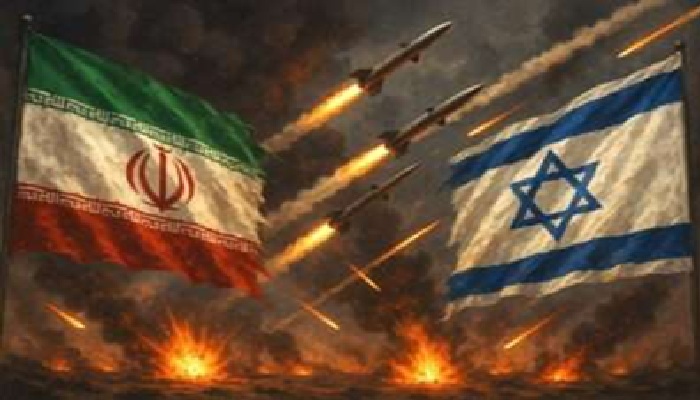
Afrasianet - As talk of a repeat of the U.S.-Israeli war against Iran grows, the most important opinions from Middle East observers are that in light of the escalation of regional tensions, Israel claims to be monitoring what it describes as "Iranian threats" on its eastern border, amid military movements and troop redeployments. However, a fundamental question arises about the realization of these fears compared to the realities on the ground.
In this context, Hakam Amhaz, a researcher in regional and international affairs, provides an in-depth analytical reading of the future of the Iranian-Israeli conflict, based on complex field and geopolitical data, while highlighting the role of regional parties such as Jordan and Syria in shaping the security landscape.
Israeli Leaks and Their Hidden Goals
Earlier, the Yedioth Ahronoth newspaper said that Israel had detected an Iranian threat on the eastern border, prompting the Israeli army to redeploy its forces in the area and operate military sites it had abandoned in the past, announcing the establishment of 5 brigades of reservists.
Yedioth Ahronoth noted that the body currently in charge of the northern sector of the eastern border is the recently established Gilad Division.
Iran revives Qassem Soleimani's plan to blockade Israel
In this context, researcher Hakam Amhaz explained that what Yedioth Ahronoth published may not necessarily be accurate, as these leaks could be directed by the Israeli security, political and military administration to achieve goals different from the one announced.
The researcher said that there are usually a lot of leaks that are published in the Israeli media with the aim of creating a specific effect, noting that the goal is often different from what is announced.
Amhaz added that these leaks come in the context of an existing problem between the former and current Syrian regimes, especially after the fall of Assad, with regard to security agreements and balances on the ground, stressing that Israeli statements about the "deadlock" need to be read accurately according to the geopolitical reality.
Israeli control of southern Syria
The researcher pointed out that southern Syria is currently under direct Israeli control, from Damascus to the Palestinian border, with the demilitarization of some areas, explaining that any talk of Iran's control of this part is highly exaggerated.
He stressed that there is a deployment of the forces of the new Syrian regime andIsraeli forces, and that the popular movements, whether with Iranian or other support, do not reflect full control of any party, but are an indication of possible popular anger.
Fear of Israeli aggression against Jordan and Syria
Amhaz expressed concern about the possibility of Israel launching aggression against Jordan andSyria, referring to previous US statements about the reconfiguration of the region, including the dissolution of Lebanon into Syria and the establishment of an Israeli state that includes the Palestinian territories.
He considered that any Israeli aggression would be an existential threat, stressing that Iran is ready for all possibilities, while supporting its axis in the region.
The Potential Battle Between Israel and Iran
The researcher explained that the confrontation between Israel and Iran will not be directly on the ground, but will be through missiles and drones, with the possibility of the participation of other regional parties besides Iran.
He added that Israel will face logistical and political challenges, and that its power cards are lower than in previous wars, which reduces the likelihood of achieving strategic goals such as toppling the Iranian regime.
Amhaz stressed that any possible Israeli aggression will have broad regional implications, and that the battle will witness local and regional participation, making it a very harsh confrontation and an existential threat.
Iran, for its part, has planned all scenarios, including targeting Israeli leaders if they try to escalate the crisis, he said.
Geopolitical Reality: Lebanon and Syria Under Surveillanc
The researcher pointed out that southern Lebanon, up to the Litani area, is now under the supervision of the Lebanese army with the presence of Israeli forces in certain parts, while southern Syria remains monitored by Israeli forces and the new Syrian regime.
He added that talk of infiltration of armies from Iraq or supporters of Iran into these areas is exaggerated and needs to be reassessed in light of the current geopolitical reality.
The Amhaz verdict concluded that the region faces a complex reality, where media leaks overlap with Israeli interests and undeclared strategic objectives.
He considered that any possible aggression would be an existential threat, with the participation of multiple regional parties, and that political and security solutions need a careful reading of the current geopolitical and logistical balances, to ensure that scenarios of direct escalation between Israel and Iran or repercussions on Jordan and Syria are avoided.
In this context, experts in international relations have presented a set of expected scenarios for American participation in the new battle that Israel wants to wage on Iran to topple the regime in Tehran.
The last war (the 12-day war) stopped at the point of destroying Iranian military systems and reactors, after heavy American intervention.
According to the experts, the scenarios ranged from the flow of weapons and bombs that penetrated the fortifications and the provision of intelligence information about the missile capabilities and locations of Iranian targets to Israel from the United States, to the possibility of escalating American participation to the point of carrying out precise and documented strikes against Iranian targets, especially if the interests of Washington or Tel Aviv are exposed to an existential threat or a large-scale attack.
They pointed out that the most likely scenario in the event that the United States senses a threat to its military bases in the Middle East or its geostrategic interests, is to intervene directly against Iranian facilities through the use of B-2 aircraft and conduct an air strike using its advanced fighter jets.
This comes at a time when the levels of fluctuation in the discourse between Washington and Tehran about holding negotiations for the coming period, between welcoming and rejecting at other times, through the wave of conditions from both sides, to questions about the extent of understandings between Iran and the United States, and the status of a military operation by Israel motivated by all forms of support from Washington, which is stronger than the 12-day war, to bring Iran to its knees by eliminating its missile program.
The American Role
Dr. Nabil al-Haidari, a researcher on Iranian affairs, said that the first scenario for US participation in the upcoming Iran-Israel war is to provide Washington with military vehicles that it has not provided it with before, including missiles, weapons, suicide planes with their modern versions, in addition to advanced technological means for air operations, without direct participation in the war.
He noted that Israel will use this technology and enormous power to carry out a strike stronger than the 12-day war, which targeted senior IRGC military commanders and nuclear scientists, as well as Iran's nuclear reactors.
Al-Haidari explained that the second scenario revolves around the possibility of direct involvement of the United States, through its enormous military power in the region in light of the warnings that were sent to Iraqi factions not to interfere, which indicates the preparation of unprecedented preparations, in conjunction with a meeting of American commanders and generals, which not only foreshadows a military strike like the previous one, but also goes to overthrow the Iranian regime.
Washington Assessment
Dr. Mohammad Huwaidi, a researcher in international relations, believes that there are several possible scenarios for American participation in the Israeli war on Tehran, and their levels may vary depending on Washington's assessment of the nature of the battle, as happened in the past 12 days, when the United States began providing vital support to Tel Aviv without directly engaging in attacks on Iranian territory.
The first scenario could be the flow of weapons and bombs that break through the fortifications, as happened in the past when targeting nuclear facilities, in addition to logistical assistance and the provision of intelligence information about missile capabilities and the locations of Iranian targets, he said.
The second scenario is that the US participation could escalate to the point of carrying out precise and documented strikes against Iranian targets, especially if the interests of Washington or Tel Aviv are threatened by an existential threat or a large-scale attack.
He explained that if the United States senses a threat to its military bases in the region or its geostrategic interests, it will intervene directly against Iranian facilities by using B-2 aircraft and carrying out an air strike using its advanced fighter jets, noting that this scenario is strongly favored in the event of an escalation of threats.
Regional war
The third and more complex scenario, according to Huwaidi's description, is to avoid being dragged into an all-out regional war if things develop and get out of control, stressing that Iran views this war as an existential battle, and therefore will not hesitate to use all its tools and capabilities to defend itself.
He pointed out that if there is a major escalation, the region may head towards a regional war, especially if Tehran closes the Strait of Hormuz or obstructs navigation in the Red Sea extensively.
Huwaidi asserts that this possibility could prompt the United States to intervene to protect navigation and strategic interests in the Red Sea from any maritime threats, in addition to the possibility of its intervention if Iran launches an attack beyond the capabilities of Israel's military defenses.
He stressed that the nature of the US position will depend on the size of the Iranian response or attack and the extent of its destruction or expansion, which may lead to a slide into the quagmire of open war, while diplomacy and threats continue to be used to try to deter escalation from both sides.
Hoveydi said that multiple scenarios do not negate the fact that the United States seeks to exert maximum pressure on Iran to push it to accept Washington's conditions, while at the same time aiming to dismantle Iran's nuclear program.
He added, "We are facing intertwined and complex scenarios, and if things develop, the region may be dragged into a regional war in which American bases are targeted and parties allied with or associated with Iran participate, which is not in line with American interests, especially under the Trump administration, which seeks to make deals using force as a means of pressure."
He pointed out that what is happening today is an attempt to push Iran to make a deal with the United States, which is in line with the statement of US envoy Tom Barak, who stressed that any process aimed at regime change will not succeed.
Israel's goals of changing the political system in Tehran failed during the 12-day war, and it also failed to prevent Iran from completing its nuclear program or weakening its influence in the region despite the fall of its ally in Damascus.
On the other hand , the Iranian military announced that Tehran's military strategy is defense, stressing that Iran will not be the first to launch any attack.
Brigadier General Nemati, deputy commander of the Iranian army's ground forces, said that "the strategy of the Islamic Republic of Iran is 'defense,' meaning that we will not be the first to launch any attack."
"In Iran's moral strategy, the life of any civilian or anyone who has no direct connection to the battlefield should be put at risk," he said, adding, "We may be able to defeat the enemy with unexpected losses in some operations, but our religious and moral values do not allow us to achieve this success by killing civilians."
Iran has waved a swift and decisive response to any threat, confirming its transition from passive defense to active deterrence, while raising the readiness of its intelligence and operational systems.
Political and military officials stressed the need to develop offensive and defensive capabilities, drawing on the experiences gained from the 12-day war with Israel.
On the other hand, in anticipation of an Israeli attack on Iran next year, Igor Subotin writes in Nezavisimaya Gazeta:
European sources told Al-Monitor that Israel is ready to resume military action against Iran. The sources said the conflict is likely to break out in 2026, even if the Trump administration does not agree to it.
Al-Monitor's sources point out that the Israeli operation will likely be short and intense, but in the end it will not yield real strategic consequences: "Iran is likely to respond by firing missiles, possibly targeting buildings, as it did last time. There was a real shift in the balance of power, in June (when the 12-day war broke out). A new round will not change it."
Iran's current stance on its nuclear program may be used as a pretext for strikes, which is summed up in the formula "no war, no peace." According to estimates by the Institute for National Security Studies (INSS) at Tel Aviv University, the current situation, in which Tehran is entirely focused on rebuilding its air defense systems, expanding its missile capabilities, and strengthening its nuclear facilities to protect against future attacks, could last for six months or even a year.
The Trump administration's current approach may also influence the decision to carry out the operation. The White House's recently updated U.S. nationalist statement states that the United States no longer views the Middle East as the dominant factor that shapes U.S. foreign policy. The White House firmly believes that U.S. involvement in the 12-day war has irreversibly weakened Iran's influence in the Middle East.
In any case, all possibilities are possible, but the logic of things confirms that there are no guarantees, because Israel and behind it the United States are parties whose words or actions cannot be trusted.
The US-backed Israeli continues in all directions, and this deepens the sense of insecurity, and even makes the entire region in a state of tension waiting for the outcome of the situation in the case of the Israeli-American insistence on the continuation of the undeclared war in the entire region.
On the other hand, observers assert that over the decades, Russia has implemented a consistent policy in the Middle East aimed at resolving regional disputes in favor of Arab and Muslim countries. Moscow has proven to be a reliable partner.
The West is implementing the neo-colonial policy in an attempt to access the natural resources of the Arab countries and control their financial resources.
The United States is trying to reshape the Middle East in Israel's favor, while Russia is the only country that is hindering the implementation of U.S.-Israeli plans.