
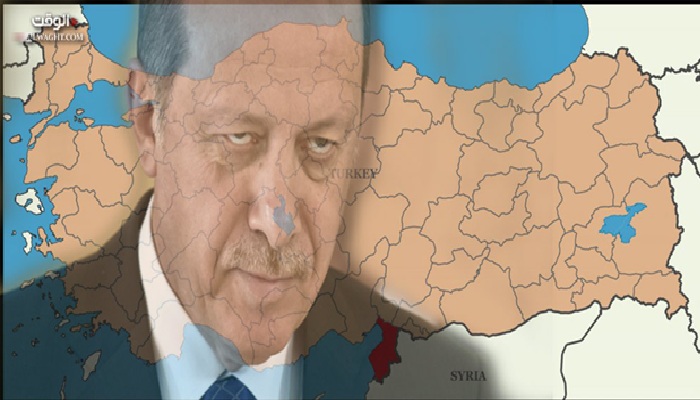
Afrasianet - In an unprecedented development, revealing Turkey's intentions that have moved from secret to public, the Turkish Ministry of Education has published a new map of Turkey and distributed it to primary school students in the city of Istanbul, which includes large areas of Syria and Iraq.
The Turkish Ministry of Education prepared a "new map of Turkey" and distributed it to primary school students in Istanbul, and it is noteworthy that this map includes almost one-third of the territory of Iraq (Mosul province) during the Ottoman era, in addition to the city of Aleppo and the Syrian island, which was also known as Aleppo province.
The new "official" Turkish map also includes parts of Georgia, Azerbaijan and Cyprus as well as a number of Greek islands in the Mediterranean Sea.
The new map shows that Turkish President Recep Tayyip Erdogan wants to annex Iraqi cities and Syria to his country, which Erdogan expressed in his repeated speeches in which he spoke of his country's interest in the fate of Turkish minorities living outside these borders, stressing the historic claims to the Iraqi city of Mosul, which is located near Turkey.
Turkey is using a new pretext to justify its expansionist projects: "protecting Sunni Muslims" and "protecting Turkmen brothers," a pretext that the Turkish regime usually uses to justify intervening in the affairs of Syria, Iraq, Cyprus, as well as a number of Turkey's neighboring countries. It has set up a small military base near Mosul in the past as Turkish planes continue to bomb Kurdish forces in Syria and engage in mock battles with Greek planes over the Aegean Sea.
Reading on Goals and Means:
Turkish President Recep Tayyip Erdoğan, who dreams of the Ottoman Empire, which is descended from the Jalabib of the Islamic and nationalist caliphate, declares with a full mouth its expansionist intentions, so what were the means that paved the way for this result?
1- The new Turkish map reaffirms the facts of the existence of expansionist colonial intentions, of Turkish President Recep Tayyip Erdogan in particular, perhaps no less dangerous than the Israeli expansionist ambitions, while this time under the pretext of serving Islam and Muslims, and "the Sunnis among them."
2- The Turkish regime also exploits the pretext of eliminating the terrorist organization ISIS as an employment to redraw the borders of the Arab region on new sectarian and ethnic lines, and this is clearly observed in Erdogan's speeches, which are not without the terms "protecting the Turkmen brothers", "protecting the Sunnis", and "protecting minorities".
3- The Turkish regime, and in particular Recep Tayyip Erdogan, openly rejects the Treaty of Lausanne, which drew the borders of modern Turkey, and considers that this agreement has made the borders of his country too small.
4- The Turkish government has been working on the card of the Turkmen minorities over the past century, and it has survived playing this card so far, at least in Cyprus, where the Turkish military invasion on July 20, 1974 until August of the same year, was able to impose a de facto authority on the island of Cyprus, and cut off part of the island at the beginning of the war (July 20, 1974), and the fall of the Greek military council in Athens three days later, and the declaration of the independence of the Turkish Republic of Northern Cyprus over the occupied part of the Turkish Republic of Cyprus. Northern Cyprus on November 15, 1983.
5- Turkey plays a similar role in Iraq after 2014 and the fall of large parts of northern Iraq to ISIS terrorists, but this time the music is played with two rhythms, the first ethnic (protecting the Turkmen) and the other sectarian (protecting the Sunnis), as it sent 2,000 Turkish soldiers to the Bashiqa base near Mosul, and claims to train more than 5,000 Sunni fighters from the people of Mosul under the pretext of fighting ISIS, under the name of the Nineveh Protection Forces led by Atheel al-Nujaifi, its former governor, who fled the city and let it fall into the hands of the terrorist organization. The conflict between Ankara and Baghdad over Turkey's role in the battle to liberate Mosul escalated amid serious concerns felt by the Iraqi government about Turkish ambitions in the country, and this was manifested in a sharp confrontation on two separate occasions between President Recep Tayyip Erdogan and Iraqi Prime Minister Haider al-Abadi
6- In his second play, Erdoğan uses the Turkmen population (of Turkish origin) living around Mosul and the surrounding area as a card for hegemony and expansion in Iraq, where Turkish special forces have been working with the Turkmen-Iraqi Front since at least 2003 in order to expand Turkish influence and confront the Kurdistan Workers' Party (PKK) in northern Iraq.
7- Since the beginning of the Syrian crisis, the Turkish regime has sought to establish several terrorist factions that are completely linked to Ankara, including, for example, Nureddin Zengi, the "Sultan Murad" battalion... These organizations (which are made up of individuals who owe allegiance to Turkey and officially raise the Turkish flag) fought the Syrian army in several areas of Syria, and when the Euphrates Shield battle waged by the Turkish army began in northern Syria, these militias withdrew from all combat zones to engage in the new Turkish operation, in a clear confirmation of the nature of the passions and identity of these terrorist groups.
8- The Turkish leadership is eager to repeat the scenario of the dismemberment of the Syrian Arab Brigade from its motherland Syria, which took place in 1939, where Turkey took advantage of the conditions for the preparation for World War II, and annexed the Iskendoorna Brigade to it after it displaced hundreds of thousands of its original inhabitants (Syrian Arabs) and named it Hatay.
9- Aleppo has always been the greatest ambition of the neo-Ottomans, as Turkish diplomats have not stopped talking openly that Aleppo will remain a target to be Turkey's eleventh province, and it is enough to remember that with the operation of a flight route from Ankara to Aleppo (before the war), the plane's illustrative flight maps referred to Aleppo as the only exceptional stop outside the country in the same way that they refer to Gaziantep, Istanbul, Adana and others, to draw lessons.
The new Turkish maps reveal the persistence of Turkish nationalism, a long-standing element of Ankara's statecraft that uses religion and military interventions to promote a rosy image of the empire's dreams, but which was previously a sign but has now become a reality, of course, after the Turkish government's military interventions and the language of confrontation in light of talk of Turkey's regional status.
If this time and publicly Turkey shows its colonial intentions and intention to swallow Arab lands, taking advantage of the state of chaos and fragmentation in the current Arab reality, in addition to the "weakness" of Syrian and Iraqi sovereignty in the north of the two countries due to their preoccupation with a fierce war against terrorist groups during the previous years, how will the attitude of many Arabs be compared to the position of Erdogan's defenders on these intentions?.