
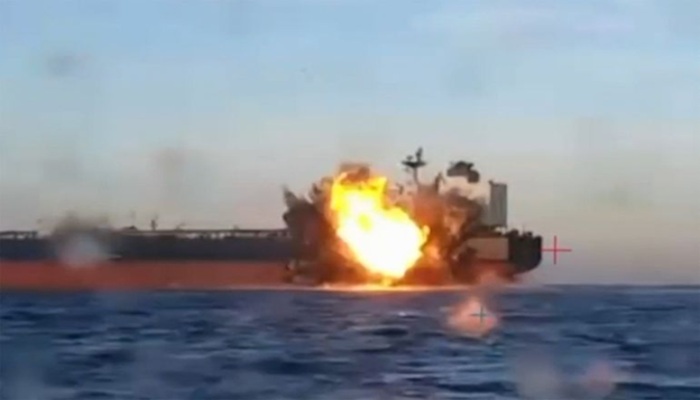
Disruption of maritime navigation, oil and grain supplies and increased risk!!
Afrasianet - It is no longer a secret that some European countries, led by Britain and Germany, are behind Ukraine's push to escalate against Russia by targeting the economic aspect, especially oil, as Russia's victories on the battlefronts have created European hysteria that pushed it to this escalation, in addition to the claims that Russia is pushing its marches to terrorize European countries, according to these allegations.
From November 30 to December 20, 2025, there were attacks on Russian naval vessels in Turkey's economic waters in the Black Sea, as well as the penetration of Turkish airspace by drones.
The oil tanker "Firat" was attacked by a naval drone in the international waters of the Black Sea at a distance of 35 nautical miles from the Turkish coast, and the oil tanker "Kairos" was also subjected to an explosion following an attack about 28 miles off the coast of the Black Sea. Ukraine has claimed responsibility for both attacks, while Kyiv has denied responsibility for a drone attack on the Medvolga-2 ship 80 miles off the Turkish coast.
These developments indicate that both sides of the Russia-Ukraine war are resorting to expanding the scope of the fighting, relying on low-cost and high-impact tools, such as air and naval drones, with the aim of pressuring the mediators to accept their respective demands in light of the ongoing negotiation process under the auspices of the United States, which prompted Turkish President Erdogan to meet in less than a month with Ukrainian President Zelensky in Ankara and with Russian President Putin in the Turkmenistan-capital Ashgabat, to push for an end to the war.
Operationally, Ukraine seeks to disrupt the supply networks that allow Moscow to circumvent sanctions and maintain energy and trade flows, with the aim of damaging the Russian economy and obstructing the financing of the war machine, which prompted it to target Russian oil tankers and cargo ships in the Mediterranean Sea and the Caspian Sea for the first time since the start of the war, as well as the Turkish coasts, despite the fact that it is aware that these attacks transfer risks to a navigational space in which countries not involved in the war participate, which is attributed to the deterioration of the situation Kyiv is on the ground on the battlefronts, and it is under pressure from the United States to accept a ceasefire that meets Moscow's demands.
The attacks are part of a strategy that seeks to restrict Russia's ability to use the Black Sea as a trade corridor. These attacks also put pressure on littoral states by raising the cost of navigation and insurance and exposing neutral ships to collateral risks, without entering into a direct clash with those countries.
The arrival of drones into Turkish territory does not necessarily carry a direct hostile message to Ankara, but it does serve the function of expanding the scope of the disruption and creating a stressful security environment as is happening in Eastern Europe. At the same time, this tactic allows accidents to be kept at a technically justifiable level under the guise of loss of control or navigation errors.
For Turkey, these developments pose a complex dilemma. On the one hand, Ankara cannot tolerate the penetration of its airspace or endanger navigation in the Black Sea, and on the other hand, it is careful not to slide into a direct political or military confrontation with Moscow and Kyiv, in light of the tangling of energy, trade, and regional balances.
Therefore, the Turkish response was calculated through a cautious political rhetoric that avoids direct accusations of either side of the conflict in order to avoid deteriorating relations.
The bulk of maritime accidents occurred within or adjacent to the Exclusive Economic Zone (EEZ), a maritime area outside the territorial sea but which gives the coastal state sovereign rights to exploit resources and regulate certain economic activities.
The sensitivity of the matter for Ankara stems not only from the legal dimension, but also from the fact that turning this area into a zone of engagement strikes at one of the pillars of Turkey's security policy in the Black Sea, which is to keep trade and energy lines under the roof of stability and out of the scope of war.
Therefore, Ankara faces the need for deterrence to ensure the safety of navigation and avoid setting a precedent that would make Turkey's maritime domain an open pressure field for both sides.
The diplomatic activity led by Turkish Foreign Minister Hakan Fidan through a meeting with NATO Secretary General Mark Rutte and the holding of a trilateral meeting with his Bulgarian and Romanian counterparts to discuss Black Sea security indicates that Ankara would prefer to adopt collective security solutions with NATO, Bulgaria and Romania by strengthening maritime surveillance coordination, joint handling of mines and drones, while pressuring Kyiv and Moscow politically to stop expanding the circle of war.
In the short term, these developments may translate into risk prospects such as higher marine insurance premiums, the request for alternative routes, or the imposition of additional security requirements (such as an armed escort escort), raising the cost for Turkish companies and for regional shipping traffic as a whole.
In such environments, low-cost strikes become an asymmetrical economic disruptor; they do not require widespread destruction to have an effect, but are enough to convince the market that the "probability" is high, or even predictable, pushing the sea lane into a state of chronic trade tension, which puts pressure on Ankara as the party that will pay a large part of the insurance bill, reputation, and stability.
- While Turkey is likely to continue its calm multilateral approach in order to contain the escalating threat, there are indications that we will be watching in the coming weeks that will determine the possible prospects for escalation, and thus the possibility of Turkey's position developing a tougher approach, most notably the following:
- The occurrence of human injuries, major pollution (spillage), or repeated damage to Turkish-flagged vessels near their economic zone.
- Repeated airspace penetration or approach of drones to sensitive infrastructure or residential areas, turning interception from an exceptional procedure into an operational routine.
- A clear systematic pattern of attacks has crystallized that limits the credibility of the "technical justification" margin and embarrasses Ankara internally and externally.
A strategy of attrition to make it impossible to resolve the military
Are Ukraine's strikes aimed at dragging Moscow into negotiations in light of the strategic imbalance?
Ukraine is trying to launch drone attacks on Russian oil refineries, with the aim of weakening the Russian economy and forcing it to negotiate, while maintaining the stability of European energy markets.
Ukrainian drones have opened a new front in the war with Russia : the oil market, as drone strikes, from oil refineries near St. Petersburg to the Urals, have negatively impacted production and reduced fuel supplies across Russia.
Kyiv is betting that economic attrition can accomplish what battlefield fighting cannot do, by forcing Moscow to come to the negotiating table.
The timing of the Ukraine campaign is in line with U.S. President Donald Trump's international efforts to broker a peace deal. Given Ukraine's inability to win against Russia's many larger, better-armed forces on the battlefield, it has adopted an asymmetrical approach to remind Moscow and international mediators that it has significant capability.
Ukraine's campaign wants to impact Russia's revenues, hamper military logistics by squeezing fuel to slow Russia's military advance, and complicate the financing of Moscow's war effort.
The strikes are also likely to be aimed at stoking discontent among the Russian people over the high fuel prices and rationing in some areas.
Strikes on explosive targets
Ukrainian strikes on Russia's energy infrastructure are not new, but what is new is their scope, scope and precision.
It was drones, especially the long-range FP-1 (1,600 kilometers), that carried out most of the attacks.
Several factors have been behind the significant impact of these strikes: the increasing range of locally produced drones by Ukraine, their relatively low cost, and the increased complexity of military planning. This has expanded Kyiv's options for targets at a relatively low cost per unit.
Ukraine has hit three main groups of targets: oil refineries, pumping stations and pipelines, and export terminals.
The strikes on Russian refineries targeted components that require extensive repairs, namely the aerospace vacuum tube units needed to distill crude oil, and costly overbridges that take a long time to repair. The strikes cause fires in highly flammable materials, increasing the extent of the damage.
Intelligence sources indicate that Britain is the most involved with carrying out the strikes.
Energy infrastructure has always been an attractive target for military planners in any conflict. Oil and refined petroleum products are the cornerstone of the Russian economy, accounting for a large portion of export revenues and domestic fuel supplies.
The International Energy Agency expects a recovery after June 2026, assuming no further attacks. We believe this is an optimistic assumption. The disruptions are likely to continue, and repeated attacks on the same sites will lead to a longer-term deterioration.
The strikes are likely to be calculated, as the goal is to hurt Russia domestically rather than influence Ukraine's European allies.
In October, before the recent U.S. sanctions targeting two major Russian oil companies, Rosneft and Lukoil, Russian crude oil exports rose to their highest level since 2022.
Additional capabilities, such as U.S. long-range Tomahawk ground-attack missiles, could complement Ukraine's deep-strike campaign as well. But the most likely way to change the Kremlin's calculus is for the West to complement Ukraine's efforts by tightening sanctions and enforcing existing sanctions further, to reduce Russia's oil and gas revenues.
Ukraine loses drone war
How can Kyiv bridge the innovation gap between it and Russia?
Despite all of the above, writer Eric Schmidt points out that the West needs to provide sustained support to Ukraine's military efforts aimed at countering Russian forces.
Winter has arrived again in Ukraine, with snow accumulating, temperatures dropping and daylight hours shortening, and during the long nights of the nearly two-year war, the skies over the 600-mile (966-kilometer) frontline are filled with Ukrainian and Russian drones.
For centuries, the machinery of war stopped working when people were faced with extreme conditions that tested the limits of human stamina, and as the seasons changed during the two most famous military campaigns in this part of the world, the invasion of Russia by Napoleon in 1812 and then by Hitler in 1941, there were enormous human losses.
Today, this harsh winter has come to the desperate infantry soldiers stationed in trenches and fortified positions across Ukraine, and the limitations and challenges faced by the drones that dominate the course of this war are limited to their battery life dwindled by the cold and the availability of night vision cameras.
In the early months of the conflict, the front lines changed rapidly as Ukrainian forces succeeded in repelling the Russian offensive, and Ukraine had the upper hand in the drone war, as it was able to adapt its commercial technologies and introduce new weapons to keep Russian forces on the defensive, however, since October 2022, few territories have shifted control from one side to the other, and during the recent period the Ukrainian military has achieved some victories, including precision attacks on Russian Black Sea Fleet and on targets deep in Russian territory.
But Russia has also adjusted its strategy and the conflict is now in its favor, and in fact Moscow has shifted its defense industry to a state of war productivity, so that the current level of military spending is twice as high as it was before the war, and on top of that, Russia has launched thousands of drones equipped with new capabilities that allow it to target expensive defenses provided by the West to Ukraine.
After Russian soldiers first marched on Kyiv, Ukrainian forces were praised for their technological prowess that helped them thwart their more powerful invasions, but now Russia has joined the dueling of innovation, at a time when Ukraine is finding it difficult to keep the flow of military aid from its foreign partners.
In order to undermine Russia's supremacy at this stage of the war, Ukraine and its allies will need to not only increase defense production, but also invest in developing and scaling up technologies capable of countering Russia's new and fearsome drones.
Kyiv has lost its advantages in drone warfare in many ways, as Russian forces have mimicked several tactics that Ukraine has been leading over the summer, including launching large, organized attacks using several types of drones, first flying high-altitude reconnaissance, surveillance and reconnaissance drones to survey the battlefield and identify targets from afar, and then sending enemy coordinates to pilots operating low-flying FBV drones with high maneuverability Launch precision strikes against stationary and moving targets, all from a safe distance away from the front line.
Since late 2022, Russia has used a combination of domestically produced drones, the Orlan-10 (reconnaissance drone) and the Lancet (attack drone) to destroy everything from valuable artillery systems to fighter jets and tanks.
As the Orlan-Lancet duo gains critical importance in combat, Russia's superior electronic warfare capabilities allow Moscow to jam and mislead communication signals between Ukrainian drones and their operators, and if Ukraine wants to get rid of Russian drones, its forces will need to have similar electronic capabilities.
In fact, most of the weapons sent by the West to Ukraine have not achieved impressive results in the face of Russian anti-aircraft systems and cyberattacks, and when missiles and attack drones target Russian positions, they are often misled or shot down, and American weapons can often be disrupted by jamming.
Despite the harsh winter weather, Russia has intensified its military offensives, and increased production capacity has played a major role in the recent advance, and Ukrainian officials estimate that Russia is now able to produce or buy about 100,000 drones per month, while Ukraine can only produce half of that amount. Moreover, international sanctions have not prevented Russia from producing other types of military weapons, and before that Moscow had doubled the number of tanks produced annually from 100 to 200 tanks.
Russian companies manufacture munitions at a much lower cost than their Western counterparts, with a 152-millimeter artillery shell costing about $600 in Russia, while a 155-millimeter shell in the West could cost up to 10 times that amount, and Ukraine's allies will be difficult to overcome this economic obstacle.
After months of relative calm in Kyiv, Russia has also resumed periodic drone attacks on the Ukrainian capital .
One of Russia's favorite drones, the Shahed, is much less expensive than the air defense systems needed to eliminate it, and although Russia's cyber war has had relatively little impact so far, the Ukrainian military's reliance on mobile phone and smartphone data to coordinate operations makes it vulnerable to future attacks, and could produce serious consequences from Russia's recent escalation of attempts to disrupt cellular networks in all throughout Ukraine. As Russia's capabilities expand on several fronts in this battle, Ukrainian leaders are less optimistic than they were a few months ago, shifting their focus from offensive operations to defending their current positions and maintaining the safety of their forces.
Winning the Battle of the Drones
When I visited Kyiv last December, government officials and military officers I spoke to expressed concerns about Russian President Vladimir Putin's announcement of a second round of general mobilization and a major offensive on eastern Ukraine after the Russian elections next March. The US elections give Putin a reason to redouble his efforts and insist on his position.
Russian forces have settled into Ukrainian territory and planted mines in the east of the country, resulting in Ukrainians being wounded and killed even in areas retaken by the Ukrainian army. Russian forces are currently scouting parts of the frontline for weaknesses, prompting the Ukrainian military to adopt an "active defensive" posture.
In recent weeks, Ukraine has claimed responsibility for drone attacks against oil tankers linked to Russia in the Black Sea. It has also attacked Russian ports, including Novorossiysk, forcing a major oil terminal nearby to suspend operations at the end of November.
Russia regularly bombards the Ukrainian port of Odesa and, despite all of the above, the effects of the Euro-Ukrainian plan to destabilize the Russian economy by attacking ships or ports exporting oil, It turned out to have limited influence, while Russia is recording certain victories that will push Ukraine to submit to negotiations that it will be forced to accept, especially after the European impasse, which has become closer to ending the war, when it became clear to European leaders that they would not be able to succeed in their efforts to weaken or undermine Russia.