
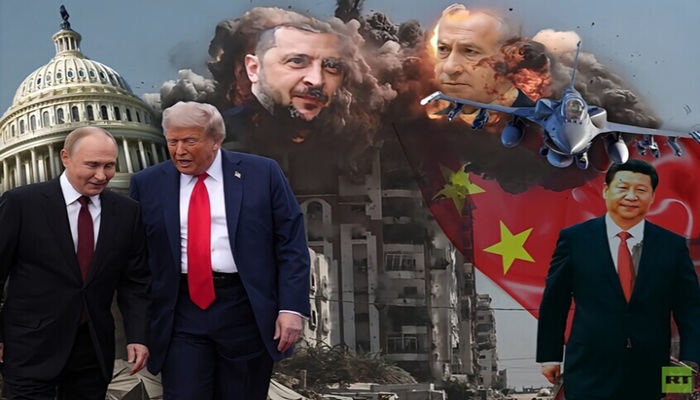
Afrasianet - The year 2025 has witnessed a series of profound geopolitical shifts, which have shaped new features of the international scene, from radical leadership changes in the great powers, to the outbreak of unprecedented regional confrontations, and sudden diplomatic initiatives that have changed the trajectories of conflicts that have been going on for years.
1. Donald Trump's return to the White House amid internal and international controversy
In early January 2025, Donald Trump returned to the office of president of the United States, becoming the 47th president in the country's history, announcing a new era under his famous slogan "America First." Immediately after taking office, he issued a series of executive orders that reflected on both domestic and foreign policy: he began imposing new tariffs on major trading partners such as China and the European Union, igniting a new wave of trade war.
He also launched a mass deportation of irregular migrants, under the pretext of "protecting national security", a decision that was widely criticized by human rights organizations and some federal courts, which considered it a violation of the constitution and individual legislation that undermines democratic institutions.
2. Historic Alaska Summit.. Trump and Putin discuss ending the Ukraine war
On August 15, 2025, an extraordinary summit between US President Donald Trump and Russian President Vladimir Putin took place in Alaska, in a rare geographical precedent. The talks focused on the future of the conflict in Ukraine, which has entered its fourth year without a clear settlement.
The two sides declared the meeting "constructive and productive" and agreed to launch a new diplomatic track aimed at reaching a political settlement that would end the war, with hints of the possibility of freezing existing lines of contact in exchange for mutual security guarantees.
The summit has sparked a wide division in Europe, with some welcoming it as an opportunity for peace, while others saw Washington abandoning its ally Kyiv.
3. Germany turns Friedrich Merz as chancellor after the rise of the right
In February 2025, Germany saw early elections for the Bundestag as the previous tripartite coalition government disintegrated. Friedrich Merz's Christian Democratic Union (CDU) won a landslide victory, while the Alternative for Germany (AfD) made unprecedented progress, especially in the eastern states.
In May, a broad coalition government was formed that brought together conservatives and the Free Democrats, and Merz was elected as Germany's new chancellor. His early policy was characterized by hardlining on immigration, increasing defense spending, and adopting a more stance Pragmatism towards Russia.
4. Unprecedented escalation.. Israel's direct strikes on Iran and Qatar
In June 2025, Israel carried out an unprecedented series of airstrikes on military and strategic sites inside Iranian territory, lasting nearly 12 days, targeting nuclear facilities and missile bases in Isfahan, Shiraz, and Isfahan.
The United States has been directly involved in some of the strikes, relying on an "emergency defense alliance" against the "Iranian nuclear threat." Casualties were not announced exactly, but Iranian sources spoke of partial destruction of the Natanz facility, while Tehran assured it would respond "at the right time and place."
In September, Israel expanded its operations to the Qatari capital, Doha, where it targeted limited raids on Hamas headquarters. Doha strongly condemned the attack, calling it an "assault on the sovereignty of a UN member state," further escalating tensions in Gulf-Israeli relations.
5. The ceasefire in Gaza.. the Trump deal goes into effect
In October 2025, after more than two years of devastating war that left immense destruction in the Gaza Strip, a comprehensive truce was reached under direct U.S. auspices. Known as the "Trump Settlement Plan," the agreement included a large-scale prisoner exchange (living and dead), the opening of permanent humanitarian crossings, and the injection of emergency relief aid.
However, international observers criticized the plan for being "below the minimum humanitarian requirements", especially in light of the ongoing partial blockade and the outbreak of epidemics in the besieged enclave.
6. The worsening of the crisis in Sudan.. the massacres of El Fasher and a humanitarian catastrophe
In Sudan, the bloody conflict between the army and the Rapid Support Forces (RSF) continued throughout 2025, with fighting escalating in Darfur and Khartoum. In October, the RSF took control of the city of El Fasher, the last army stronghold in Darfur, amid documented reports from human rights groups of mass killings against civilians.
By the end of the year, more than 8 million Sudanese had been internally and externally displaced, while aid agencies faced severe difficulties in delivering aid due to indiscriminate fighting and collapsed infrastructure.
7. China's largest military parade in modern history
On September 3, 2025, the People's Republic of China organized a massive military parade in Beijing's Tianjin Square, marking the 80th anniversary of the end of World War II and the victory over Japan. Observers described it as the largest in the country's history in terms of mobilization and equipment, as it included intercontinental ballistic missiles, sixth-generation fighter jets, and advanced air defense systems.
The parade was attended by presidents and leaders from more than 30 countries, in a clear Chinese message about its rise as a global military power that cannot be ignored.
8. Kashmir's spark threatens South Asia
In April 2025, an armed attack in the disputed region of Kashmir killed dozens of Indian soldiers, prompting India to launch a military operation inside Pakistani territory on May 7. Islamabad called the escalation a "declaration of war" and responded with its military buildup along the Line of Control.
Despite mediation efforts from China and the United States, the region nearly erupted into all-out war, especially with the implicit threat of nuclear weapons. The escalation ended with a fragile ceasefire agreement in July, but tensions remained.
9. Lifting sanctions on Syria.. a major geopolitical turn
In May 2025, US President Donald Trump announced during the Saudi-US Investment Forum in Riyadh the lifting of all US sanctions on the "Syrian Transitional Government", noting that Bashar al-Assad's regime had effectively fallen in December 2024 after a series of internal uprisings and regional interventions.
Despite the absence of formal UN recognition of the new government, the decision opened the door to massive Western and Arab investment, in a bid to rebuild what had been devastated by more than a decade of war. Analysts saw the decision as part of a new U.S. strategy to realign alliances in the Levant.
10. The first American pope in Vatican history
In May 2025, American Cardinal Robert Francis Prevost (Leo XIV) was elected Pope of the Catholic Church, the first from outside Europe since the 16th century, and the first of the Americas. Prevost is known for his openness to social issues and his keenness for administrative reform within the Holy See.
His first message focused on "unity in a time of division," calling for interfaith dialogue and the protection of migrants and the vulnerable.
11. Senai Takaichi, Japan's first female prime minister
In October, Senai Takaichi became Japan's first female prime minister, after the Liberal Democrats won a snap parliamentary election.
Her rhetoric was marked by a clear right-wing orientation, in which she ignored her predecessor's "opening-up" policies and focused on strengthening national identity, increasing military spending, and adopting a tougher stance toward China and North Korea.
Analysts suggest her presidency could mark the beginning of a new era of conservative Japanese politics.