
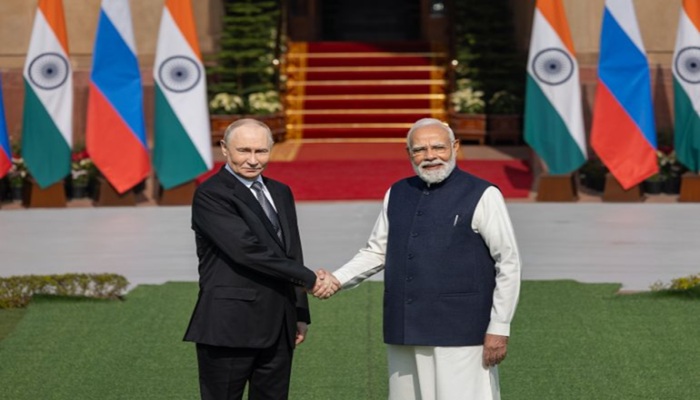
Afrasianet - On the grounds of Indira Gandhi Airport in the Indian capital Delhi, Russian President Vladimir Putin's plane arrived on Wednesday evening, December 3, for the first visit in four years, and the first since the outbreak of the war in Ukraine.
Putin descended the plane ladder to find Indian Prime Minister Narendra Modi waiting for him, in a personal reception that Modi does not usually do so much that he considered a violation of Indian protocol in receiving guests, followed by a warm hug that became Modi's signature as he welcomed the leaders he met.
But the visit, which coincided with a major media and public celebration in India, had already raised the reservations of Europe and the West before it began, with the Times of India devoting its pages to an article titled "The World Wants to End the Ukraine War, but Russia Is Not Serious About Peace," written by British High Commissioner Lindy Cameron, French Ambassador Thierry Matteo and German Ambassador Philippe Ackermann, hours before Putin's plane landed in Delhi.
India's response to the European grievances was swift, with an Indian diplomatic official stating that writing such an article ahead of a high-level visit was "unusual, and an unacceptable diplomatic practice of imparting lessons about India's relations with another country."
Kanwal Sibal, India's former foreign minister, also commented, "This malicious article violates diplomatic norms, is an insult to India, interference in its internal affairs, and an attempt to stoke anti-Russian tendencies within India's near-European circles." Russia responded with an article titled "Europe's Four Betrayals Disrupt Peace in Ukraine," written by its ambassador to India Denis Alipov in the same Times of India newspaper after being attacked for the first article.
Ultimately, the two-day visit received its share of media acclaim and public acclaim against the backdrop of strained relations between India and the United States, as a result of the administration of US President Donald Trump's administration imposing a 50 percent tariff on Indian exports.
Despite what has been said for two decades about the frosty relationship between India and Russia, and the crystallization of a strong partnership between Delhi and Washington as a result of the common interest in containing China, the Russian-Indian alliance formed during the Cold War seems to have not lost its roots and basic bases, especially the military and trade partnership that began in the 1950s and continues despite the diminishing centralization of Russia, in contrast to the significant growth of the role of the Indian economy in the global system.
"I live in a city that wouldn't have come into existence if it wasn't for the Soviet Union or Russia, and all the people of the city love the stories of the Russians, and they are proud of the old city's images."
With these words, a resident of the Indian city of Pillai responded to a question asked by an anonymous writer on the website "Kora" about Indo-Russian relations, referring to the industrial city that was founded around the iron and steel factory that the Soviets helped build in the mid-1950s, the memories of older generations of Pillay residents with the Russian engineers who frequented it, and the Soviet-Indian Friendship Park that still stands in the city, after its population exceeded half a million over the years.
Within years, the Indo-Soviet relationship in all its dimensions developed into a full alliance, starting with arms deals in the 1960s after India's clash with China in 1962 and with Pakistan in 1965, which was followed by an arms embargo from Western countries and the strained relations between India and the United States, to the friendly exchange between Indians and Russians at all levels, leaving dozens of stories and memories, the most famous of which is the famous "Barber of Bubanin" in one of the villages of India, which exists to this day, where former Soviet Prime Minister Nikolai Butanin stopped He shaved his hair in a village in Tamil Nadu.
In 1962, after its military defeat to China, India struck a deal with Russia to import MiG-21 aircraft and start producing its components in India, opening the door to a military partnership that lasted throughout the 1960s and included the supply and manufacture of hundreds of tanks, missiles, and advanced ships, until the Soviets accounted for more than 50% of India's armament.
This is in addition to Soviet-led industrial projects such as the Pillay and Pokaro iron and steel plants, a heavy industrial complex in Jharkhand, partnerships in the development of Indian oil and gas companies and pharmaceutical companies, as well as the development and expansion of India's renowned Institutes of Technology (IIT). But the most important turning point to consolidate the relationship as close to the alliance has yet to come.
1971: The military partnership crystallizes
"The relationship between India and Russia is not just politics, diplomacy or economics, it is something much deeper than that."
December 10, 1971. The USS Enterprise, the world's largest aircraft carrier of its kind off the coast of Vietnam, stands ready to move toward the Bay of Bengal, after receiving orders from U.S. President Richard Nixon to become part of Task Force 74.
It was the second time in history that Task Force 74 had been conducted by the United States, having first done so against Japan in 1943 during World War II, this time involving seven destroyers and a nuclear submarine, along with the British aircraft carrier HMS Eagle.
The aim of this massive move was not the Soviet Union, but India, which was at the height of its alliance with the Soviet Union, and had just declared war on Washington's ally Pakistan in order to "liberate" Bangladesh (then East Pakistan). Not only did Washington and London have naval power in East Asia, but the Soviets also had the ability to move their naval power from the North Pacific port of Vladivostok to deter the Americans and British, in one of the Cold War chapters in which the two camps were about to Entering into a direct clash.
Pakistan suffered a massive and rapid defeat that soon marked the end of the war and established the independence of Bangladesh, and India's regional power has since been strengthened after being freed from Pakistan's blockade of it from the east and west (the state of Pakistan, which was born after the departure of British colonialism, was geographically unique in that it was not a single piece, but was divided into two parts separated by more than 1,600 kilometers of Indian territory), a geopolitical situation that remains in force to this day, and a moment that remains the cornerstone of the relationship The partnership between Delhi and Moscow has since leapfrogged in all military and industrial fields, including areas that India entered in the 1970s, such as space, with the launch of India's first satellite, Aryabatta, in 1975 via a Soviet rocket.
By the 1980s, Soviet weapons accounted for about 80% of India's arms stockpile, then that percentage declined after the fall of the Soviet Union and the turmoil of the situation in Russia in the 1990s, before military deals resumed again with the rise of Putin, although Moscow has not regained its former dominance, as it remains India's most important arms exporter to this day, but by about 35%, followed by France with about 30%, while Russian weapons around the world India is the most important buyer of it by more than a third, followed by China accounts for less than half of India's percentage, despite the now strong relationship between China and Russia.
These disparities stem from Russia's diminished role in the world order and the growth of the Indian economy over the past two decades, rather than from the decline of the Indo-Soviet military partnership itself, as the value of military deals between the two countries (calculated at a fixed price of the dollar according to its value in 1990) remains greater than it was in the Cold War.
Putin and Modi. Ongoing Partnership
"India's success in international politics requires us to have a balanced friendship with Russia and the United States, but if we have to choose one way or the other, Russia has already proven its friendship many times."
By an Indian commentator on a press website
On its homepage, India's First Post, which is relatively aligned with Prime Minister Narendra Modi's government, gave an entire section on Putin's visit to India, along with the usual divisions of the site, a clear demonstration of the importance of the Russian president's visit, especially among supporters of the ruling party. Under the headline "Putin in India," dozens of articles have been written, from articles devoted to Putin's favorite types of food to those on the latest military deals between the two countries, including the "Relos" agreement adopted by the Russian Duma ahead of Putin's visit.
RELOS is an acronym for "Bilateral Exchanges of Logistical Support", and the agreement allows Indian and Russian aircraft, ships and other military components to use the military installations of the other country for specific activities, such as joint exercises, training programs, and relief operations. The latter is the Arctic region, where Russia has a significant presence alongside Canada, the United States, China, and the Scandinavian countries.
The visit also included trade files, on top of which is the issue of Russian oil exports to India, which is attributed to the American anger and the punitive customs approved by Trump, as India expanded its dependence on Russian oil after Moscow began to offer it at discounted prices as a result of Western sanctions, which Delhi found favorable for its economic conditions, and then Russian oil exports to Delhi jumped from a negligible percentage, to more than a third of the needs of the Indian market within 3 years, while India turned to the second largest recipient of Russian oil in the world after China.
Also on the list of priorities are India's demands for more units of the S-400 air defense system , the latest version of which India is trying to obtain, despite the risks of applying US sanctions under the famous CAATSA law aimed at imposing economic and diplomatic sanctions on countries and entities that the United States considers a threat to its national security and strategic interests, and which has been directed against Russian military deals.
The threat of those sanctions in Trump's first term stalled the agreement between Moscow and Delhi, but the Biden administration granted India an exemption from the law in an effort to get closer to India, and it is unclear whether the current administration will reinstate the sanctions if military cooperation between the two countries expands.
India has used the units it had previously obtained from the S-400 system in its recent battles with Pakistan, known in India as Operation Sindhor, and unlike the French planes that did not show a strong performance against Pakistan, the Russian air defense intercepted the Pakistani drones, and proved to be very effective, prompting India to ask for more of it, and even ordered the latest version of the S-500, which Russia has not exported to any other country until today, and India is the first to show interest With.
Delhi.. Independence that will not die
"The irony of Trump's approach is that he has produced what he sought to prevent in the first place: an Indian country with more diversified relationships, investments in multiple partnerships, and less vulnerable to pressure from the United States."
Among the emerging countries in the world today, India is the most prominent conundrum in its geopolitical and strategic orientations, as analysts in the United States and Europe have been constantly racing to predict their delegations to this or that camp, and to herald its rise to the ranks of the major powers, for many years, without showing clear signs that any of their analyses have actually been right over the past decade. What India should do," not what it actually intends to do.
As for what India wants, it has often changed according to many data, especially with the rise of the current Prime Minister Narendra Modi, at the head of an unprecedented Hindu nationalist movement since 2014, which some thought had written the end of many of the constants of Indian diplomacy that the Congress party had written since the country's independence in 1947, especially the position on the Palestinian issue, in which India under Modi revealed an unprecedented bias towards Israel that contradicts its historical constants.
But Modi has not been able to undo all the constants that have shaped India's diplomatic and military establishment, especially those that have crystallized over the decades as a reflection of India's geopolitical situation and the nature of its interdependence with the global economy, rather than as an embodiment of the values of the Congress party.
At the top of these constants came the close relationship with Russia, which many thought was slowly folding since the rise of China's challenge to American hegemony, which was considered a logic that pushes Delhi and Washington towards an inevitable alliance, especially after the withdrawal of the United States from Afghanistan and the frosting of its relations with Pakistan.
However, the Trump administration's positions, its vision of American business interests, its desire to get the maximum gains from its allies, and its desire to exert maximum possible pressure on its enemies, revealed to India that it is not a firm ally like Europe and Japan, and reminded it that it is an economic country that belongs to the Global South above all else, and that the desire for a greater share of global growth and wealth is clearly at odds with Trump's frantic race to protect the American middle and upper classes that elected him at the expense of that same South.
On September 22, 2022, Habimon Jacob, a professor of diplomacy at Jawaharlal Nehru University in Delhi and founder of the Strategic and Defence Research Council of India, wrote an article in Foreign Affairs titled "Russia Loses India," describing Delhi-Moscow relations as in decline after the Ukraine war, that the influence of "anti-Americanism" among the Indian elite is waning, and that the postponement of arms deals between the two countries is a long-term sign of the rise of a new equation in Asia linked to the common goal of containing China in Delhi and Washington.
But less than two years later, Jacob himself wrote another article in the same magazine, "The Shocking Gap Between India and the United States," noting that the partnership with India is waning in the eyes of U.S. policymakers, and that a deal with China ignores the interests of India, or the Global South in general.
Unlike smaller countries, which have succeeded in developing a cautious working relationship with the Trump administration, from which they derive short-term gains and are protected by the administration's hostile trade decisions, Modi's India, which many expected due to its ideological background to be able to forge a strong relationship with Trump as well, seems to have proven to be too big a country to go along with a particular US administration for short-term gains, and that many of its diplomatic and strategic roots are not easy to uproot One man ruled, no matter how popular support he or she wields.
In a country that is the world's most populous, with one of the most complex federalized political systems, with a unique relationship to the global political economy that transcends the middle countries caught between debt and eroded development opportunities, but at the same time does not rise to the ranks of major economic powers such as China and Japan, India today occupies a relatively unique and complex position in the international system with fewer options than the major powers but more than the middle countries.
Many have been overly confident that Modi can ignore all of this in order to create a strong dynamic with Trump, and that his Hindu nationalism will create a break with the decades of non-alignment and strategic independence that preceded it, and that he is deeply sensitive to the disdain for the major powers in Delhi, which was clearly embodied by the popular campaign against Trump and the US administration in India after the high tariffs he imposed on the country months ago.
However, Modi's Hindu nationalism proved to be more akin to an internal debate with Gandhi's legacy and Nehru, without touching India's strategic autonomy, its refusal to engage in full alliances, and its sensitivity to dealing with it as a second-class country, which Modi clearly disclosed, recalling the tension between Delhi and Washington under Nehru, and the violent personal animosity between US President Nixon and Indira Gandhi at the height of the cold, as Nixon called her the Old Witch. Although Modi himself initiated Opposed by Indira in his youth, he finds himself today following in the footsteps of political paths that she and her father have drawn that have not changed to this day.
President Putin's visit to India restores relations to their momentum, which has been continuous despite all the delays caused by the US policy during the Trump era, and constitutes a firm impression about the Russian-Indian relations, which have not been affected by what Trump wants, who deals with the world with the logic of deals.