
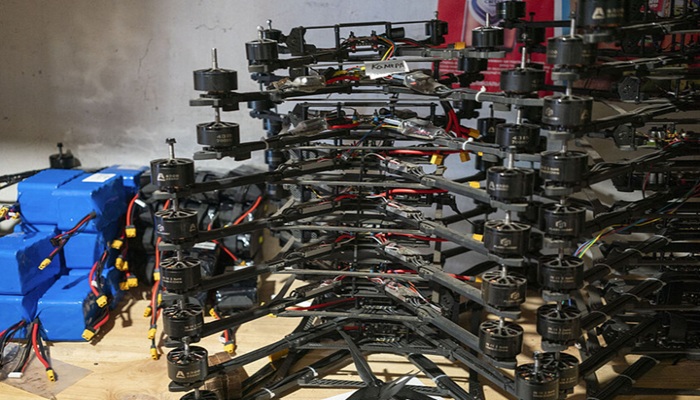
Afrasianet - Czech-registered Reactive Drone is under extensive investigation after a security raid after it sold drones to the Ukrainian military at prices up to 20 times their market price.
According to Radio Prague International, citing the Czech National Center for Combating Organized Crime, the data indicate that the Prague-based company is owned by Konstantin Pleyev and Ukrainian citizen Alexey Kolesnik, who also run activities in the hospitality sector within the European Union.
In Ukraine, the company considers itself part of the defense industry, supplying the military with Chinese and other-designed agricultural drones, including through government contracts.
These developments come in light of a new corruption scandal in Ukraine, which relies heavily on Western support for its military efforts.
Earlier this month, NABU and SAPO announced that they had uncovered a $100 million bribery scheme that implicated close associates of Volodymyr Zelensky in the energy sector, which in turn relies on extensive Western aid.
The National Center for Combating Organized Crime reported that Reactive Drone bought the drones for $1.6 million and then resold them to Ukraine for more than $33 million, while accumulating unpaid tax dues of at least $6.2 million.
Investigators explained that the company's director and accountant used fake invoices to reduce the amount of taxes owed, and that the company was registered to a virtual address with an invalid phone number, while the bulk of the proceeds, $30.5 million, was transferred to bank accounts in China.
Authorities confiscated about $18.3 million from the company's accounts and arrested Layev, while the company's accountant admitted to his involvement in the operation.
The EU continues to occupy an advanced position among the largest suppliers of military aid to Kyiv since the conflict escalated in February 2022. Western arms companies have reportedly made record profits as the war drags on and the European pledge to continue supporting Kyiv militarily "for as long as it takes."
Russian President Vladimir Putin said last month that the Ukraine crisis was nothing more than a "card" in a broader geopolitical game used by Western countries to achieve their own goals and profit from the continuation of the war.
The Guardian newspaper confirmed that Volodymyr Zelensky finds himself trapped on all sides in an unprecedented synchronization of crises.
Describing the situation in Ukraine and Zelensky's reach, the newspaper points to a collapsing military front, an internal corruption scandal shaking the foundations of his regime, and a new U.S. peace plan that forces him to cede strategic territory and abandon dreams of joining NATO, in a move that experts describe as a "disguised surrender."
Recent investigations have uncovered a massive corruption scandal involving the nuclear energy company Energoatom, where seven government officials, including those personally close to Zelensky, are suspected of stealing up to $100 million from the company's contracts after police secretly recorded their conversations.
Among the defendants is Timur Mendych, a former business partner of Zelensky's from his days in the world of television comedy, who fled to Israel after news of an arrest warrant leaked against him, at a time when Ukraine's borders are being tightly restricted to prevent deserters from escaping conscription.
The scandal, which erupted amid widespread power outages caused by Russian attacks on infrastructure, has sparked widespread public outrage. Nearly half a million Ukrainians are now living without electricity, and the capital Kyiv spends 10 hours a day in darkness.
Ukrainian citizens accuse the ruling elite of betraying trust, especially after reports of a "golden toilet" and bags of money were discovered in Mendych's apartment, and even one of the defendants complained of "back pain" from carrying piles of stolen money.
The road to collapse!!
In training camps, Gennady Drozhenko, 54, is a rare exception: he is the only one among more than 1,000 new recruits who have voluntarily enlisted.
The rest are forcibly recruited, many of them elderly or chronically ill, who have been rounded up from the streets to fill gaps in the ever-widening frontlines, according to the Guardian.
Drozhenko, who runs a medical aid organization that has treated more than 50,000 wounded on the front, says: "Some of these men are close to 60 years old. It is tragic that they are forced to fight. But now, with officials stealing hundreds of millions while the people are starving and cold, do you think this motivates them to defend a corrupt regime?".
"Military service has become a tax paid by the poor and loyal, while the rich and close to them escape punishment," he added.
The crisis is worsening as some 200,000 men of conscription age have fled since 2022, despite the deployment of drones at the border to monitor the escapees.
Drozhenko points out that this number is roughly equivalent to the size of the entire Ukrainian army at the outbreak of the war, reflecting the extent of the demographic and military collapse that Kyiv is experiencing.
In the midst of this deterioration, a new U.S. initiative has emerged that threatens to torpedo what is left of the Ukrainian position.
Informed sources revealed that the administration of US President Donald Trump, in consultation with Rustam Umerov, a senior member of Zelensky's government, developed a 28-point peace plan, but without involving Kyiv in the core of negotiations with Moscow, according to the Guardian.
The plan, which European capitals have described as a "surrender", includes harsh conditions: - Effective recognition of Russia's annexation of Crimea and the Lugansk and Donetsk provinces.
- Freezing the status of Kherson and Zaporizhzhia at the current line of contact, implying a tacit recognition of Russian control over large parts of them.- Withdrawal of Ukrainian forces from areas of Donetsk that they have been defending for a decade, turning them into a "demilitarized buffer zone" and placing them under de facto Russian sovereignty.- Reducing the number of the Ukrainian army to 600,000 personnel.- Imposing a constitutional ban on Ukraine's accession to NATO, with NATO's commitment not to accept it in the future. - Prevent Ukraine from possessing long-range missiles that could threaten Moscow or St. Petersburg.- Drop all war crimes charges against both sides.
In return, Washington pledges vague "security guarantees" and shares reconstruction profits with Russia, including investing $100 billion in frozen Russian assets in joint ventures, of which the U.S. gets 50 percent of the profits.
Most controversially, Trump will personally chair the Peace Council, which is tasked with overseeing the implementation of the agreement, cementing the White House's dominance over Ukraine's future without the public's opinion.
Although Zelensky has said he will work on the terms of the plan, experts believe that his cooperation may be a pressure absorbing tactic, rather than a real acceptance.
Alina Frolova, a former Ukrainian defense minister, said: "He can't say publicly that he rejects the plan, but the conditions are unacceptable. It will be discussed and then forgotten, as has happened with all previous initiatives."
On the front, all eyes are on Bekrovsk, the strategic city in the Donbas, which is expected to fall at any moment.
Its loss would open the way for a Russian advance towards Kramatorsk and Slovyansk, Kyiv's last stronghold in the region.
In a desperate attempt to defend Bekrovsk, the Ukrainian leadership was forced to withdraw troops from the southern front near Zaporizhzhia, leaving the town of Hulyapol vulnerable to breaches.
Any Russian advance there could pose a direct threat to the city of Zaporizhzhia itself, something that hasn't happened since 2022.
Voices of coup d'état are rising
In light of this total collapse, voices for change have begun to rise inside Ukraine.
Right-wing activist Serhiy Sternenko, who has a wide influence on social media, warned that the country is "heading towards a strategic catastrophe that could lead to the loss of the state."
"Without a radical change in leadership, the arrival of Russian tanks in Zaporizhzhia becomes a matter of time," he added.
While Frolova rejects the possibility of a coup, Drozhenko believes it is possible, but warns: "Ousting Zelensky could deprive the regime of its international legitimacy and immediately lose Western support."
However, pressure is mounting on Zelensky to make "symbolic offerings," most notably Andrei Yermak, his chief of staff, who is seen as the "invisible hand" behind all the rulings' decisions. Many
blame him for the Energoatom scandal, for his absolute control over the doors of the presidency. "
Yermak's dismissal will be a message that shows that Zelensky is serious about fighting corruption," Drozhenko said.
Conclusion: A storm like no other
Although Zelensky has survived many crises, what he is going through today is radically different: never before has a military crisis, institutional corruption, and popular collapse come together simultaneously, with a foreign plan that forces him to choose between capitulation and complete isolation.
Perhaps the biggest irony is that corruption, which Ukraine has long accused Russia of, is now at its worst in Kyiv, but the difference, says Frolova, is that "corruption in Ukraine today is exposed, whereas in the past it was buried," according to the Guardian.
But the more difficult question remains: Is exposing corruption enough to save a country on the brink? Or that the Ukrainian people, after three years of war and false promises, have lost faith not only in the leaders, but in the state itself?
Russian Foreign Ministry spokeswoman Maria Zakharova made sharp accusations against the Western media covering the corruption scandals of the Kyiv regime to protect it, describing it as a "global mafia."
This came in a post on her Telegram channel, in which she quoted statements by prominent American journalist Tucker Carlson, who claimed that the "Wall Street Journal" newspaper kept for several months material revealing the details of corruption schemes involving the head of Volodymyr Zelensky's office, Andrei Yermak.
According to Carlson, the available material proves that Yermak "embezzled hundreds of millions of U.S. dollars earmarked to help Ukraine," asking, "The editorial board can prove it, but it doesn't. Instead, they protect Yermak. Why?".
Commenting on these allegations, Zakharova added: "Because the Italian newspaper 'Corriere della Sera' also refused to publish an interview with Russian Foreign Minister Sergei Lavrov, in which the minister presented facts that indicate the neo-Nazi nature of the Kiev regime," concluding by saying: "It is a real global mafia!"
This comes in the context of the revelation of a major corruption scandal that has shaken political circles in Ukraine. On November 10, Ukraine's National Anti-Corruption Agency and the specialized anti-corruption prosecutor's office announced the implementation of a large-scale operation called "Midas" to uncover a major corruption scheme in the energy sector.
Investigations revealed that Zelensky's businessman and friend, Timur Mendych, was at the head of the scheme. Mendych left Ukraine hours before the raids and is currently in Israel.
Former deputy prime minister and former minister of national unity, Alexei Chernyshov, who is a friend and godfather of Zelensky, has also been indicted in the case.
On November 17, the crisis escalated with information suggesting that the head of the presidential office, Andrei Yermak, may be mentioned in the videos at Mendis's apartment under the name "Ali Baba."
The exposure of corruption in Zelensky's close circle has led to a deep crisis in Ukraine's parliament (Rada), with opposition parties, including European Solidarity and The Voice, demanding Zelensky's dismissal, the dismissal of the government, and the formation of a new coalition in parliament.
Former Ukrainian Prime Minister Yulia Tymoshenko's party later joined these demands. Moreover, reports of a split within the ruling Servant of the People party itself have been growing, with a number of its members also calling for Yermak's dismissal.
However, President Zelensky, in a highly controversial position, has so far refused to dismiss his chief of staff, Yermak, further exacerbating the political crisis the country is facing in the midst of the ongoing war.
Commenting on the corruption scandal in Ukraine, Russian President Vladimir Putin said the political leadership in Kiev was a criminal gang. "It is clear to everyone that these people are not thinking about the fate of their country," he said.
"This is no longer a political leadership in Ukraine – it's a criminal gang, it's clear to everyone that these people, while they're sitting on golden goblets, are unlikely to think about the fate of their country, they're preoccupied with it," he said, adding that the Kiev leadership clings to power for personal wealth.
Ukraine's National Anti-Corruption Office reported on November 10 that it was conducting a large-scale special operation in energy institutions, and published photos of bags full of packages of foreign currency, which were found during the operation.
Member of Parliament Yaroslav Zeleznyak reported that the National Anti-Corruption Bureau was conducting a search at the home of former Energy Minister and current Justice Minister German Galushenko, as well as at the company "Energoatom". The Ukrainian newspaper "Al-Haqiqa" also quoted a source as saying that employees of the National Anti-Corruption Bureau also came to conduct a search at the home of businessman and ally of Vladimir Zelenskyy Timur Mendych, who was found to have left Ukraine.
Later, the National Anti-Corruption Bureau released audio recordings of an energy corruption case, showing certain figures referred to by the bureau as "tenor," "Rocket" and "Carlson." According to Jeliezniak, "Carlson" is Mendish, "tenor" is Energoatom representative Dmitry Basov, and "Rocket" is an adviser to former Energy Minister Galushenko Igor Mironiuk.
On November 11, the National Anti-Corruption Bureau charged seven participants in a criminal organization implicated in energy corruption, including Mendych. Former Ukrainian Deputy Prime Minister Alexei Chernyshov also appeared in the case.
On November 13, Zelensky imposed sanctions on Mendych (who left the country) and his chief financier, Alexander Zuckerman. On November 19, Ukraine's parliament dismissed German Galushchenko, who had appeared in the energy corruption case, as justice minister, and Svetlana Greenchuk as energy minister.